Identification
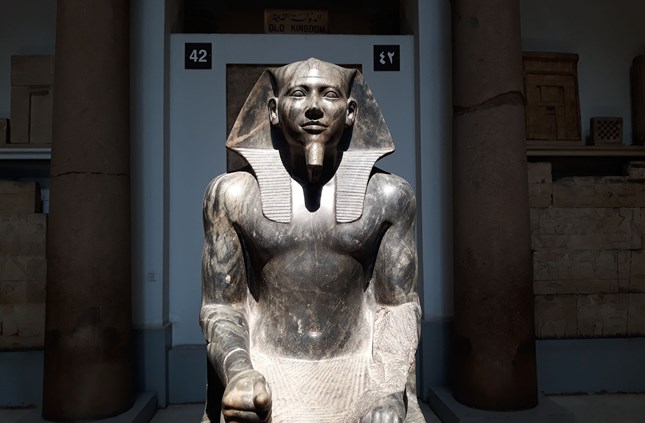
The Seated Statue of King Khafre is widely considered the supreme masterpiece of Old Kingdom sculpture. Carved from extremely hard diorite, it captures the essence of divine kingship with perfect symmetry and eternal calm.
| Object | Seated Statue of King Khafre |
|---|---|
| Date | Fourth Dynasty (c. 2558–2532 BCE) |
| Material | Diorite (Gneiss) |
| Height | c. 168 cm |
| Original Location | Valley Temple of Khafre, Giza |
| Current Location | Egyptian Museum, Cairo |
Historical Importance
This statue represents the peak of Old Kingdom sculpture. It perfectly expresses the concept of divine kingship, establishing the canonical image of the pharaoh that would endure for centuries. It is often cited as the finest royal statue ever produced in Ancient Egypt.
King Khafre
Khafre was the son of Khufu and the builder of the Second Pyramid at Giza. He is also closely associated with the Great Sphinx. Ruling at the height of royal power, his image embodies eternal authority and the absolute stability of the state.
Discovery (1860)
The statue was discovered in 1860 by the French Egyptologist Auguste Mariette. It was found in a pit within the Valley Temple of Khafre at Giza. Although found upside down, it was largely intact, a masterpiece rediscovered after millennia.
Original Context
The statue originally stood in the T-shaped pillared hall of the Valley Temple. This was a space for rituals and offerings connected to the king's funerary cult. It was one of twenty-three statues of the king in this temple, serving as a focal point for processional ceremonies.
Function of the Statue
The statue functioned as a physical vessel for the Ka (life force). It was a cult image designed to receive offerings, symbolizing the king's continued presence. Through this stone form, Khafre lived eternally.
Description
Khafre is shown seated on a high-backed throne, wearing the Nemes headdress and a ceremonial beard. His hands rest on his thighs—the right hand clenched in a fist (strength), the left flat (benevolence). His posture is upright and symmetrical, radiating absolute calm and control.
Material and Technique
Carved from extremely hard diorite (anorthosite gneiss) quarried in Nubia, the statue was polished to a high sheen. The choice of this stone was deliberate: it is incredibly durable and luminous, a material chosen for eternity. The craftsmanship demonstrates extraordinary technical mastery.
Artistic Style
The statue displays perfect frontality and idealized anatomy. The muscles are defined but not strained; the body is perfectly balanced. There is no visible tension or movement, conveying a sense of timeless perfection suitable for a god-king.
Facial Features
Khafre's expression is calm and impassive, gazing into eternity. He has almond-shaped eyes, a strong jawline, and a faint smile. The face is youthful but ageless, representing the king beyond time rather than a realistic portrait of a man at a specific age.
Throne Symbolism
The sides of the throne feature the Sema-Tawy motif: the intertwining of lotus (Upper Egypt) and papyrus (Lower Egypt) plants around a hieroglyph for "unite." This symbolizes the unification of the two lands under the king's authority.
Religious Meaning
In Egyptian belief, the king was divine in both life and death. This statue allowed for his eternal worship. By residing within the stone, the Ka could accept offerings, effectively making the statue a sacred living entity.
Funerary Beliefs
The statue connects directly to mortuary cult rituals and the concept of eternal renewal. It ensured the king’s union with the gods and acted as a guarantee of immortality, anchoring his spirit to the earthly realm.
Artistic Legacy
Khafre’s statue set the standard for later pharaohs. It defined royal iconography for millennia, influencing Middle and New Kingdom art. It remains the eternal model of how an Egyptian king should look.
Condition
The statue is largely intact, with only minor surface damage. Its preservation is exceptional, making it one of the best-preserved masterpieces from the ancient world.
Archaeological Significance
This artifact helps scholars understand Old Kingdom religious ideology and the technical mastery of stone carving achieved by the Fourth Dynasty. It is a cornerstone of Egyptology and a key piece in understanding the royal cult.
Comparison: The 4th Dynasty Evolution
Educational Value
The statue is used extensively to teach canonical Egyptian art, divine kingship, and symbolism in sculpture. It is an essential reference for museums and art history courses worldwide.
Simplified Summary
The Statue of Khafre is the ultimate image of the Egyptian pharaoh as an eternal god-king. Carved from imperishable stone and embraced by the god Horus, it represents the absolute height of Old Kingdom artistic achievement.