Identification
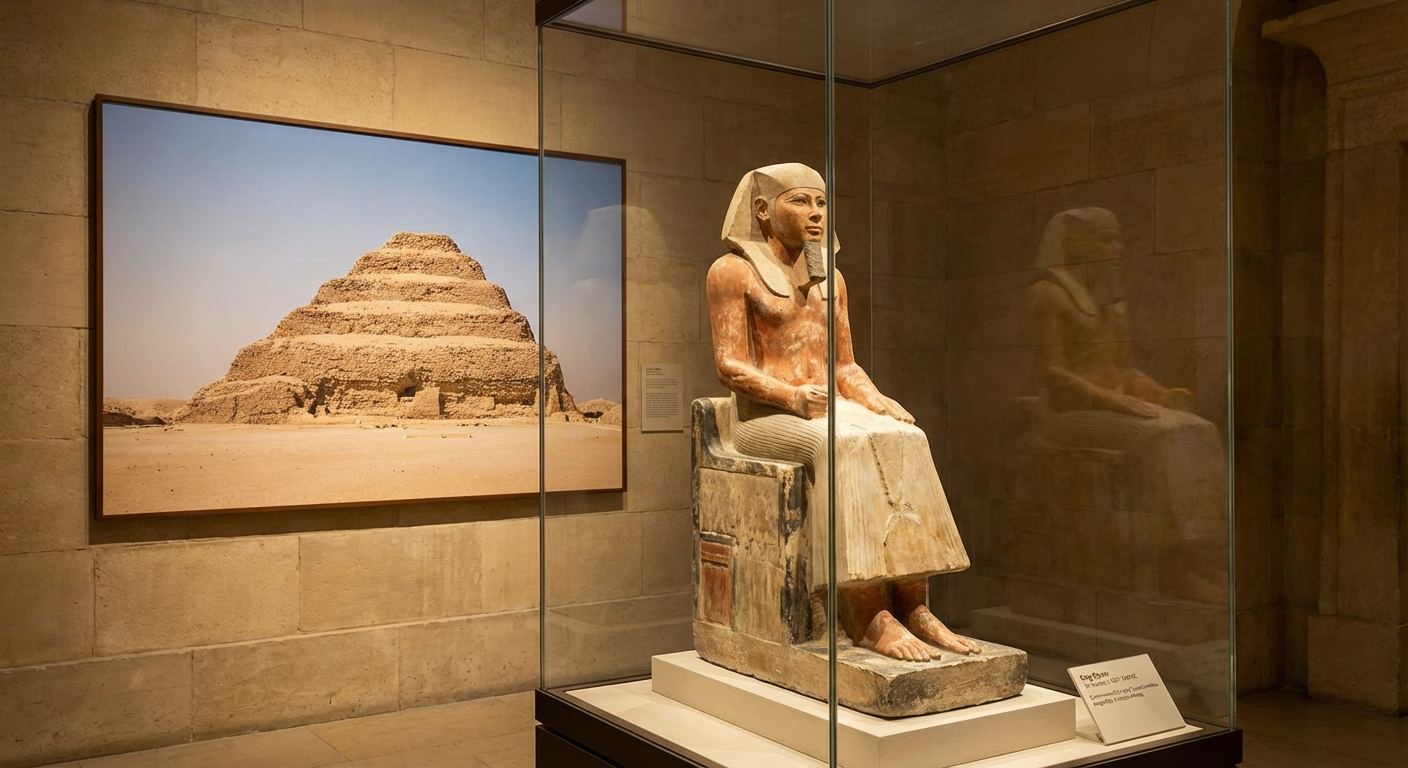
The Statue of King Djoser is a masterpiece of the Old Kingdom. It is the earliest known life-size Egyptian royal statue, marking a pivotal moment in the history of art. It was discovered intact in its original location, gazing out towards the northern stars.
| Object | Seated Statue of King Djoser |
|---|---|
| Date | Third Dynasty (c. 2667–2648 BCE) |
| Material | Painted Limestone |
| Original Location | Serdab chamber, Step Pyramid, Saqqara |
| Current Location | Egyptian Museum, Cairo (JE 49158) |
Historical Importance
This statue is not merely a portrait; it is a milestone. Before Djoser, royal representations were mostly reliefs or small figurines. This statue represents the first true attempt at creating a permanent, life-size, three-dimensional body for the king's spirit. It marks the birth of classical Egyptian sculpture that would define pharaonic art for 3,000 years.
King Djoser
Netjerikhet (better known as Djoser) was the second king of the Third Dynasty and the builder of the Step Pyramid, the world's first major stone structure. Ruled during the early Old Kingdom, he is associated with architectural and administrative innovation. This statue reflects his status as the monarch who solidified the concept of eternal kingship.
Discovery (1924)
The statue was discovered in 1924 by the archaeologist Cecil Mallaby Firth. It was found inside a small, sealed chamber known as a serdab on the north side of the Step Pyramid. Unlike many statues found in open courts, its hidden placement preserved it, although the eyes had been gouged out in antiquity.
Function of the Statue
In Egyptian belief, the statue was not art for art's sake. It was a functional object:
- Physical Substitute: If the physical mummy was destroyed, the soul could inhabit this stone body.
- Ka Resting Place: It served as a focus for the Ka (life force) to receive offerings.
- Ritual Interface: Through the serdab holes, the king could participate eternally in the offerings presented by priests.
Description
Djoser is depicted seated on a high-backed throne. He wears the Nemes headcloth over a massive, striated wig, and the ceremonial false beard (now broken). He is wrapped in a tight, long cloak (Heb-Sed robe) that envelopes his body, leaving only his hands and feet visible. His right arm rests across his chest, while his left hand rests palm down on his thigh, a pose of calm, eternal authority.
Artistic Style
The statue exhibits the rigid frontal pose that became standard for royal sculpture. Symmetry and balance are prioritized over movement. The features are idealized: large ears, high cheekbones, and a stern expression, conveying power rather than individual personality. The block-like nature of the throne reinforces the idea of stability.
Color and Surface
Though limestone is white, the statue was originally painted to look lifelike. Traces of paint remain: the skin was a reddish-brown (standard for men), the wig black, and the cloak white. The eyes were originally inlaid with rock crystal or quartz to give them a lifelike glint, though these were stolen in antiquity.
Symbolism
The statue symbolizes Stability (Djed) and Order (Ma'at). The heavy wig and the Nemes headdress symbolize the pharaoh's divine nature. The tight cloak connects him to the Heb-Sed festival (jubilee), suggesting he is rejuvenated and ruling forever.
Religious Necessity
Art was a religious necessity. The Egyptians believed that for the Ka to survive, it needed a recognizably human form to inhabit. This statue ensured that Djoser would have a "backup body" made of imperishable stone, guaranteeing his existence even if his flesh failed.
Afterlife Connection
The statue connects directly to the cult of the dead king. Positioned on the north side of the pyramid, it faces the "Imperishable Stars" (circumpolar stars), which the Egyptians believed were spirits of the gods/ancestors that never set. By gazing at them, Djoser's spirit joined their eternal cycle.
Artistic Innovation
This statue represents a massive technological leap: the mastery of carving hard stone into complex, three-dimensional forms. It moved Egyptian art from two-dimensional relief and small votive figures to monumental sculpture, creating a new visual language of power.
Condition
The statue is largely intact, though it shows surface wear and the loss of the inlaid eyes. It is carefully conserved at the Egyptian Museum in Cairo. A replica now sits in the original serdab at Saqqara for tourists to view through the eye-holes.
Archaeological Significance
As a cornerstone artifact, the statue helps scholars understand the early ideology of kingship and the rapid development of arts during the Third Dynasty. It confirms the centralization of power and resources necessary to commission such works.
Comparison: Evolution
| Aspect | Earlier Periods (Dynasty 1-2) | Statue of Djoser (Dynasty 3) |
|---|---|---|
| Scale | Small figurines / Ivories | Life-size monumental sculpture |
| Dimensionality | Relief-dominated | Fully three-dimensional |
| Style | Symbolic forms | Realistic royal presence |
A clear leap forward in artistic capability.
Educational Value
The statue is used extensively to teach the origins of Egyptian art, the role of sculpture in religion, and the concept of the "Ka" statue. It is a foundational piece for any student of Egyptology.
Simplified Summary
The Statue of Djoser is the first true royal statue of Egypt, created to give the king eternal life through art. Sitting in his hidden chamber, he was designed to watch over his kingdom and receive offerings forever. It stands at the very beginning of the great tradition of pharaonic sculpture.