Identification
The Standing Statues of King Djedkare Isesi mark a significant transition in the Late Fifth Dynasty. Found at his mortuary complex in Saqqara, these limestone fragments reflect a shift away from strict solar ideology and coincide with major administrative reforms that reshaped the kingdom.
| Object | Standing statues of King Djedkare Isesi |
|---|---|
| Date | Late Fifth Dynasty (c. 2414–2375 BCE) |
| Material | Limestone |
| Original Location | Pyramid complex at Saqqara |
| Current Location | Egyptian Museum, Cairo (fragments) |
Historical Importance
The statues of Djedkare Isesi are historically crucial because they signal a departure from the sun-temple dominance of his predecessors. They coincide with major administrative and provincial reforms that centralized power back to the king. Artistically, they mark the transition toward the style and concepts that would define the Sixth Dynasty.
King Djedkare Isesi
Djedkare Isesi was one of the longest-reigning kings of the Fifth Dynasty. He is famous for not building a sun temple, breaking a tradition held by most of his dynastic predecessors. Instead, he implemented reforms to reduce the power of the solar priesthood and centralized the administration, choosing to build his pyramid at Saqqara rather than Abusir.
Discovery
The statues survive mainly as limestone fragments found during excavations at his pyramid complex in South Saqqara. They were identified through inscriptions and stylistic analysis. Although fragmentary, these pieces are vital for understanding the shift in artistic direction during the latter part of the dynasty.
Original Context
Originally, these statues stood in the mortuary temple, along processional routes, and in offering courts. Their placement indicates that they served the royal cult directly rather than being part of a solar ritual complex, emphasizing the king's personal mortuary needs over solar worship.
Function of the Statue
The statues functioned as cult images for mortuary offerings and vessels for the royal Ka. They served as visual statements of renewed royal authority, demonstrating that the king had regained autonomy and was no longer solely defined by his relationship to the sun god Ra.
Description
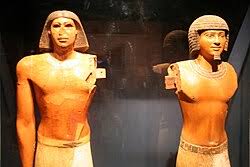
Djedkare is depicted standing upright with his left leg advanced and arms held close to the body, wearing traditional royal regalia. The canonical standing pose continues, but the context and subtle stylistic changes signal a new era.
Artistic Style
The statues show less emphasis on solar symbolism compared to earlier Fifth Dynasty works. There is a return to more solid and grounded proportions, reflecting a slight return to earlier Old Kingdom conventions. It is an art of reasserted tradition and stability.
Facial Features
Fragments indicate a calm, dignified expression with subtle individuality. There is less abstract idealization than in the statues of the sun-temple builders; instead, we see a more human king, reflecting the administrative reality of a ruler deeply involved in the governance of his land.
Material and Technique
The statues were carved from limestone and originally painted. The workmanship shows moderate refinement, prioritizing function and authority over the ethereal perfection of earlier eras. It is a practical art for a practical administration.
Religious Meaning
In Djedkare’s reign, the influence of the solar cult declined while Osirian and traditional mortuary beliefs strengthened. The king’s afterlife became less exclusively solar, and the religious balance shifted back towards the preservation of the individual king's spirit.
Funerary Beliefs
These statues reflect a renewed emphasis on the mortuary cult proper. They demonstrate the continued need for Ka statues to ensure survival but point towards the funerary ideology that would fully blossom in the Sixth Dynasty with the Pyramid Texts.
Artistic Context
Compared to Nyuserre, Djedkare's art is less ritual-focused and has a more administrative tone. There is a reduced display of purely solar ideology, with art mirroring the king's policy of consolidating power and managing the state's resources more directly.
Archaeological Significance
The statues help scholars understand how political reform is reflected in art. They mark the end of sun temple dominance and provide key transitional evidence for the shift towards the styles and practices of the Sixth Dynasty.
Condition
The works are highly fragmentary and show signs of surface erosion. However, they have been carefully catalogued and studied. These fragments speak volumes about the changes in the royal workshops and the shift in focus during the late Fifth Dynasty.
Comparison: A Decisive Turn
| King | Ideological Emphasis | Artistic Result |
|---|---|---|
| Nyuserre | Solar culmination | Ritual perfection |
| Djedkare | Administrative authority | Grounded tradition |
From serving the sun to ruling the land.
Educational Value
This statue is used to teach political reform in art, Late Fifth Dynasty transitions, and the relationship between ideology and sculpture. It is essential for understanding how art serves as a barometer for political change in ancient Egypt.
Simplified Summary
The Standing Statues of Djedkare Isesi represent a king reclaiming authority from the solar cult. Expressed through grounded, traditional royal imagery, they prepare the way for the artistic and political landscape of the Sixth Dynasty.