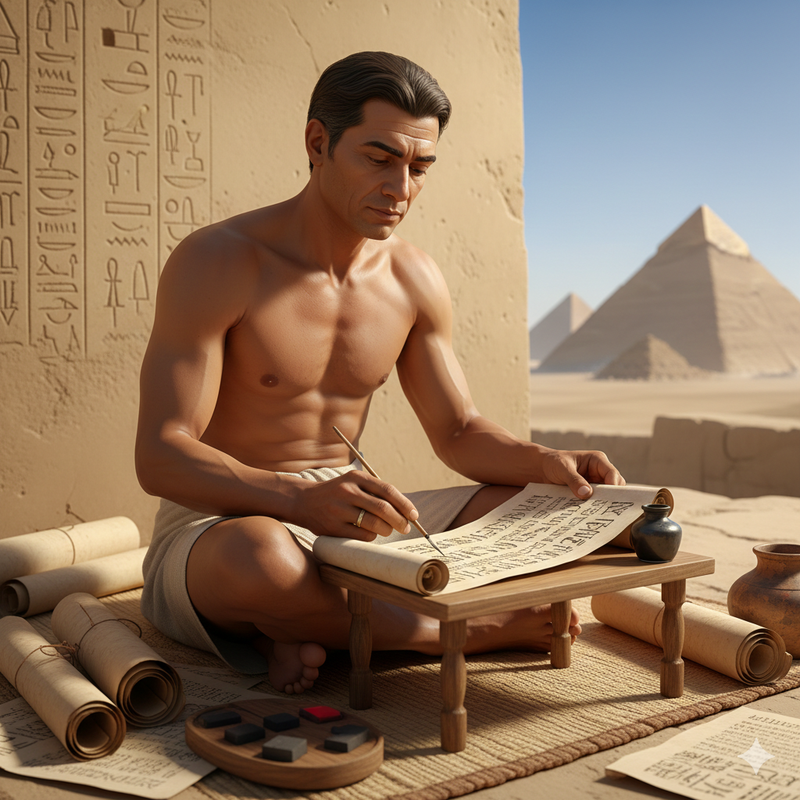
"In Ancient Egypt, literacy was power. The Scribe (Sesh) was not merely a writer but an administrator, accountant, tax collector, and the backbone of the state bureaucracy. To be a scribe was to escape the hardships of manual labor and ascend the social ladder."
The Sesh (𓏞) held one of the most respected positions in Pharaonic society. Under the patronage of Thoth, the god of wisdom, scribes recorded everything from grain stocks and temple offerings to military campaigns and magic spells.
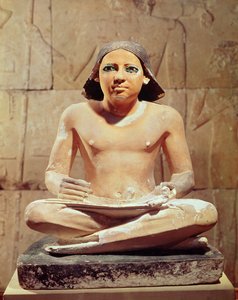
The House of Life (Per Ankh)
Education began young, often around the age of five or six. While most scribes inherited the profession from their fathers, talented boys from lower classes could sometimes enter the Per Ankh (House of Life), the educational institution attached to temples.
The Curriculum
Students started by memorizing and copying classic texts in Hieratic (the cursive script used for daily administration), not Hieroglyphs. They studied mathematics, geography, and bureaucratic etiquette. Discipline was strict: "A boy's ear is on his back; he listens when he is beaten."
Hieroglyphs vs. Hieratic
While Hieroglyphs ("Sacred Carvings") were used for stone monuments and eternity, Hieratic was the "handwriting" of Egypt, written with ink on papyrus. It allowed for speed and efficiency.
Tools of the Trade
The scribe's kit was so iconic that it became the hieroglyph for "writing" itself (𓏞 - representing a palette, a water pot, and a pen case).
-
Papyrus: Made from the pith of the papyrus reed, pounded and pressed into sheets. It was Egypt's greatest export.
-
Reed Pens: Scribes chewed the end of a rush or reed to create a brush-like tip.
-
The Palette: A rectangular board, usually wood or stone, with two circular depressions for ink cakes.
Black Ink (Carbon/Soot): For main text.
Red Ink (Ochre): For headings, dates, or highlighting errors (rubrics).
"Be a Scribe!" (The Satire of the Trades)
A famous Middle Kingdom text, known as the Instruction of Dua-Kheti, vividly contrasts the comfortable life of a scribe with the misery of other professions to motivate students.
"I have seen the metalworker at his toil at the mouth of the furnace... He stinks more than fish roe... The mason works until his knees and spine are broken... But the Scribe, he directs the work of all men. For him, there are no taxes, for he pays with his writing."
This text reveals that literacy was the key to escaping manual labor and entering the elite class of administrators.
Scribes Who Became Gods
Some scribes rose so high that they were deified after death.
-
Imhotep: The architect of the Step Pyramid (c. 2650 BC) was also a high priest and physician. He was later worshipped as a god of healing and wisdom.
-
Amenhotep son of Hapu: A scribe and architect under Amenhotep III (c. 1350 BC), known for his wisdom and deified in the Ptolemaic period.