"Animals and symbols formed an integral part of the religious, cultural, and social fabric of ancient Egypt. These elements were not merely creatures or drawings; they were the living manifestations of deities and the carriers of profound cosmic meanings related to creation, life, death, and eternity."
The ancient Egyptians wove a unique relationship with the natural world, seeing in every being and symbol a reflection of a divine power or a philosophical concept. For them, the physical world was a transparent window into the spiritual world. To read a wall in a temple is to read a code where every feather, beetle, and scepter holds a universe of meaning.
The Living Manifestations
Contrary to the Greek misconception that Egyptians worshipped animals, they actually worshipped the Divine Power (Ba) that chose to reside in specific animals.
- The Apis Bull: The living manifestation of Ptah on earth. Only one bull at a time was recognized by its specific markings. When it died, it was mummified and mourned as a god.
- The Falcon: Soaring high in the sky, it represented Horus, the god of kingship and the sky. Its eyes were the sun and the moon.
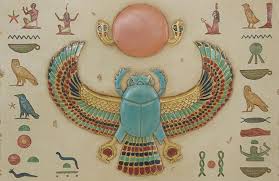
- The Scarab Beetle: Rolling a ball of dung across the sand, it mimicked Khepri rolling the sun across the sky, symbolizing spontaneous creation and rebirth.
A Vocabulary of Magic
Egyptian art and writing (Hieroglyphs) were inseparable. A symbol was not just a picture; it possessed Heka (magic). To draw a symbol was to bring its power into existence.
The Ankh
"Life." Resembling a sandal strap or a key, it symbolizes eternal life. Gods are often shown holding it to the nose of the Pharaoh to give him the "breath of life."
The Djed
"Stability." Representing the backbone of Osiris or a tree trunk. It symbolizes endurance and resurrection. Raising the Djed pillar was a crucial royal ritual.
The Was Scepter
"Power/Dominion." A staff with a forked base and the head of the Seth-animal. It represents authority and control over chaos.
Unity in Duality
Egyptian symbolism often relied on pairs to represent totality and balance (Ma'at).
- The Sedge and the Bee: Symbols of Upper and Lower Egypt respectively. Together, they form one of the King's five names (Nesu-Bity).
- The Vulture and the Cobra: Nekhbet and Wadjet, the "Two Ladies" who protect the King's brow (the Uraeus).