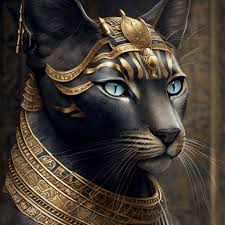
"When a house is on fire, the Egyptians do not bother to extinguish the flames... but position themselves at intervals to watch the cats and protect them." – Herodotus.
In Ancient Egypt, cats (called Miu or Mau) held a status unmatched by any other animal in the ancient world. Originally domesticated to protect granaries from mice and snakes, they evolved into symbols of fertility, joy, and divine protection. They were the living representatives of the goddess Bastet, guardians of the home, and companions for eternity.
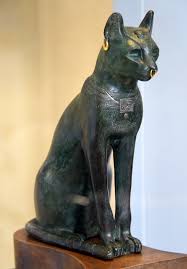
Bastet: From Lioness to House Cat
Originally, Bastet was depicted as a fierce lioness warrior (similar to Sekhmet). Over time, as cats became domesticated, her image softened. By the New Kingdom, she was portrayed as a woman with the head of a domestic cat, or simply as a seated cat wearing gold earrings.
- Goddess of Joy: Bastet represented the gentle heat of the sun, fertility, pregnancy, music, and dance. She was the protector of the home and family against evil spirits and disease.
- Bubastis: Her cult center was in the city of Bubastis (Per-Bast) in the Nile Delta. Her annual festival was described by the Greek historian Herodotus as the most joyous and crowded festival in all of Egypt, involving barges, music, and copious amounts of wine.
Sacred Protection: A Capital Crime
Because cats were considered demigods, harming one was a grave offense against the cosmic order (Ma'at).
The Punishment: Killing a cat, even accidentally, was punishable by death. Diodorus Siculus, a historian, recorded an incident where a Roman soldier accidentally killed a cat. Despite the pharaoh's pleas for mercy to avoid war with Rome, an angry Egyptian mob lynched the soldier.
The Battle of Pelusium
The Persians famously exploited this devotion in 525 BC. King Cambyses II ordered his soldiers to paint cats on their shields and carry live cats into battle. The Egyptian archers refused to fire for fear of hitting the sacred animals, leading to their defeat and the fall of Egypt to Persia.
Death and Mourning
The death of a family cat was a major tragedy. The entire household would enter a period of mourning.
- Shaving Eyebrows: As a sign of grief, family members would shave off their eyebrows. They would lament until the eyebrows grew back.
- Mummification: Cats were mummified with the same care as humans. They were wrapped in fine linen, treated with cedar oil, and buried in special cemeteries.
Massive cat catacombs have been found at Bubastis and Saqqara, containing literally millions of mummified cats offered by pilgrims to Bastet.