Luxor East & West Bank Tour
Karnak Temple · Valley of the Kings · Hatshepsut Temple
Private Guided
Full-Day Tour
Hotel & Cruise Pickup
Karnak Temple · Valley of the Kings · Hatshepsut Temple
Exclusive Offer
Grab The Deal
Get a Custom Quote Today
Full Day
8–9 Hours
Private Tour
Your group only
A/C Vehicle
East & West Bank crossing included
Expert Guide
Egyptologist
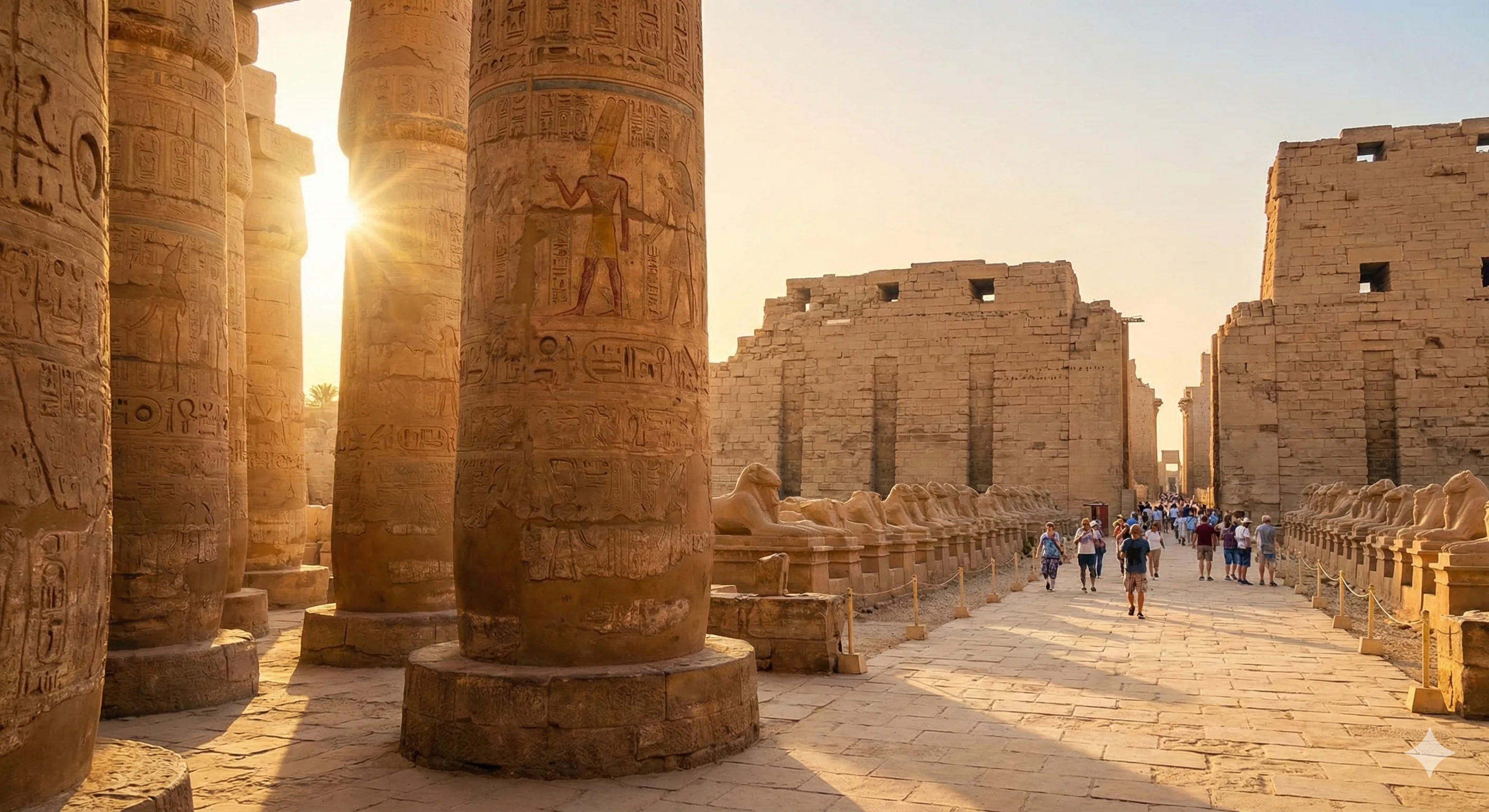
Ancient Thebes — modern Luxor — is often called the world's greatest open-air museum, and this private full-day tour brings its two faces together in a single unforgettable journey. On the East Bank, the "City of the Living," walk among the colossal columns of the Karnak Temple Complex and the elegant Luxor Temple, dedicated to the sun god Amun. Then cross the Nile to the West Bank, the "City of the Dead," where the Valley of the Kings hides the rock-cut tombs of the pharaohs, and the Mortuary Temple of Queen Hatshepsut rises in dramatic terraces against the cliffs of Deir el-Bahari.
Travel with a private Egyptologist guide and an air-conditioned vehicle, with convenient pickup from your Luxor hotel or Nile cruise ship. The day moves at a relaxed, flexible pace, with time for lunch at a local restaurant between the two banks, and optional extensions such as the Karnak Sound and Light Show or an additional visit to the Valley of the Queens.
Your Egyptologist guide meets you at your hotel or Nile cruise ship in Luxor to begin the day on the East Bank.
Continue exploring the East Bank at the heart of the modern city.
Cross the Nile to the "City of the Dead" and descend into the royal tombs of the New Kingdom.
Continue exploring the West Bank's mortuary monuments.
Wrap up the day with a relaxing meal before heading back.
The Karnak Temple Complex was built and expanded over some 2,000 years by successive pharaohs, making it the largest religious site ever constructed. Dedicated primarily to the Theban triad of Amun, his wife Mut, and their son Khonsu, its centerpiece is the Great Hypostyle Hall, containing 134 massive sandstone columns arranged in sixteen rows. Sacred lakes, towering obelisks, and avenues of ram-headed sphinxes complete a complex that once served as the religious heart of ancient Thebes.
Unlike most Egyptian temples, Luxor Temple was not dedicated to a specific god or a deified pharaoh but to the rejuvenation of kingship, and hosted the annual Opet Festival honoring the divine union of Amun and Mut. Built largely by Amenhotep III and expanded by Ramses II, it features colossal seated statues of Ramses at its entrance and one of the tallest surviving ancient Egyptian obelisks. The Avenue of Sphinxes once linked the temple directly to Karnak, nearly two miles away.
For nearly 500 years during the New Kingdom, Egypt's pharaohs abandoned the pyramid form and instead carved their tombs deep into the limestone cliffs of this remote valley on Luxor's West Bank. More than 60 tombs have been discovered here, including that of the boy king Tutankhamun, whose intact burial was famously uncovered by Howard Carter in 1922. The tombs' walls are richly decorated with scenes from the Book of the Dead and other funerary texts guiding the pharaoh through the afterlife.
Built into the cliffs of Deir el-Bahari, the Mortuary Temple of Hatshepsut is considered one of the finest examples of ancient Egyptian architecture. It was commissioned by Hatshepsut, daughter of Thutmose I and one of the few women to rule Egypt as pharaoh in her own right, during the 18th Dynasty. The temple's three colonnaded terraces rise dramatically against the mountainside and are decorated with scenes from her reign, including a famous trading expedition to the Land of Punt.
Contact our travel experts to customize your Luxor East & West Bank tour and make it truly unforgettable.