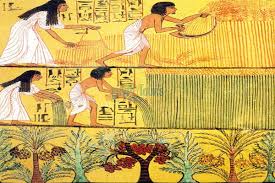
"Egypt was not just a gift of the Nile; it was a gift of the labor that tamed it. The surplus of grain was the true wealth of the Pharaohs, funding the pyramids, feeding the armies, and building a civilization that lasted 3,000 years."
Agriculture was the backbone of the Egyptian economy. Unlike other ancient civilizations that relied on unpredictable rain, Egypt relied on the annual Nile flood. However, the flood alone was not enough. It required sophisticated engineering and relentless labor to trap, store, and distribute that water.
Mastering the Water: Basin Irrigation
The Egyptians developed a system known as Basin Irrigation. They divided the floodplain into a grid of large basins (fields surrounded by earthen walls or dikes).
- The Process: When the Nile rose, they opened sluice gates to flood the basins. The water sat for weeks, soaking the soil and depositing rich silt.
- The Release: When the water level dropped, they opened the gates again to drain the remaining water back into the river or into lower basins, leaving the soil perfectly prepped for planting.
Technology of the Fields: The Shaduf
During the dry seasons (Shemu), water levels dropped below the fields. To solve this, the Egyptians invented the Shaduf in the New Kingdom (c. 1550 BC).
How it worked: It is a simple lever mechanism consisting of a long pole balanced on a crossbeam. One end has a bucket, the other a heavy counterweight (stone or mud). This allowed a single farmer to effortlessly lift water from the river or a canal up to higher ground to irrigate gardens and orchards year-round.
The Three Staples
Egyptian agriculture focused on three main crops that sustained the entire population:
Emmer Wheat
The primary source of carbohydrates. It was ground into flour to make bread, the staple food of rich and poor alike.
Barley
Used to make beer. Beer was not just a drink but a source of nutrition, safer than water, and used as currency for wages.
Flax
Grown for its fibers, which were spun into linen. Linen was the universal fabric for clothing, from the peasant's loincloth to the mummy's wrappings.
Surplus: The Fuel of Empire
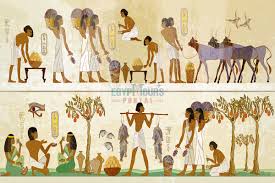
The efficiency of this system created a massive agricultural surplus. This excess food was collected as taxes and stored in state granaries.
This surplus is what allowed the Pharaohs to feed the thousands of specialized workers who built the pyramids, the artisans who decorated the tombs, and the soldiers who expanded the empire. Without the surplus wheat of the Nile, there would be no Sphinx, no Karnak, and no Tutankhamun.