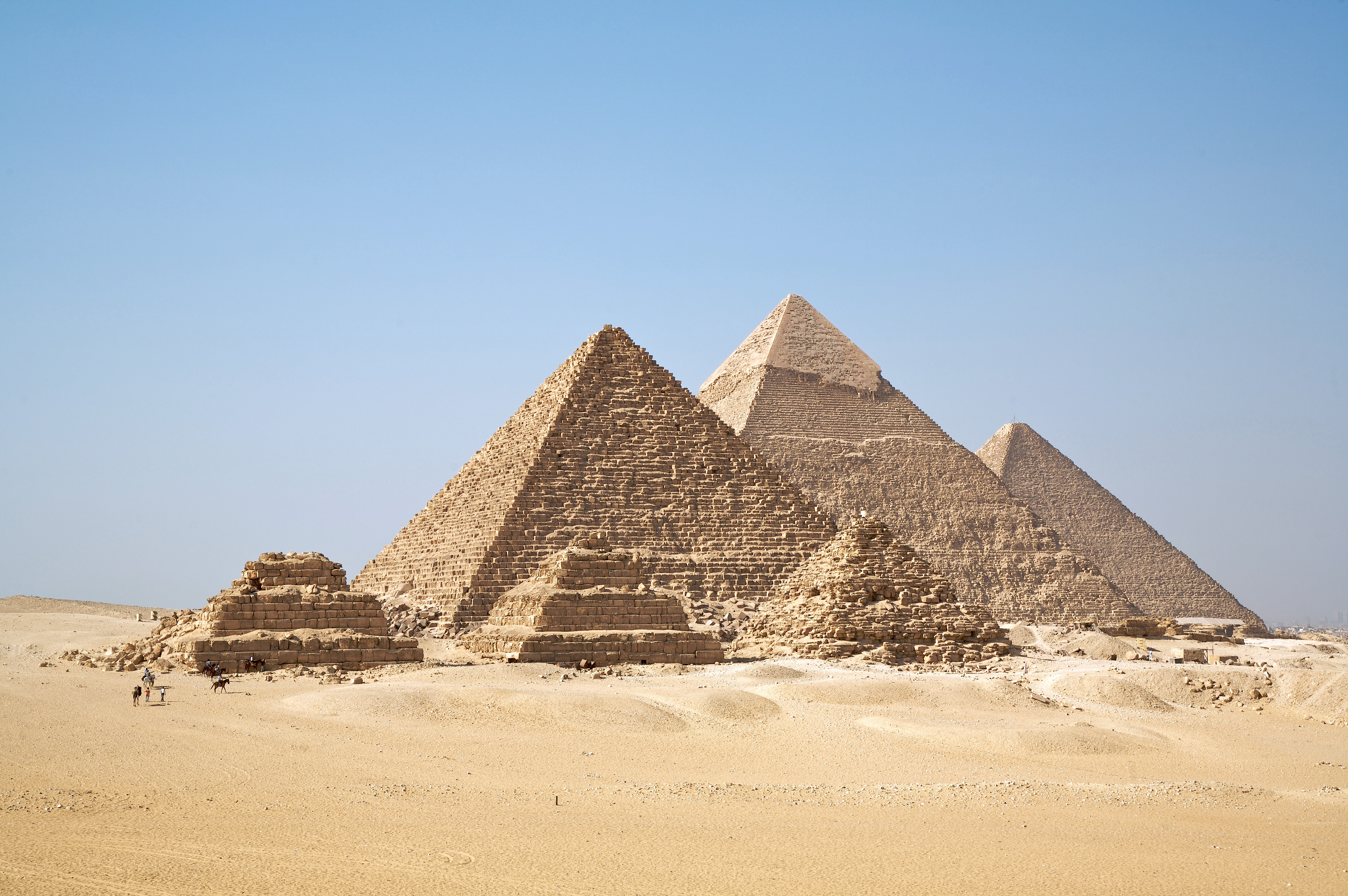
Rising at the foot of the third and smallest of the Giza pyramids, the Mortuary Temple of Menkaure stands as one of the most historically significant funerary complexes in ancient Egypt. Though partially ruined today, its remaining limestone and granite blocks tell a compelling story of royal ambition, religious devotion, and the elaborate ceremonial life of the Old Kingdom. The temple was the setting for daily rituals performed by priests to sustain the eternal soul — the ka — of Pharaoh Menkaure, who ruled Egypt during the Fourth Dynasty around 2510 BCE.
Unlike the colossal mortuary temples of the New Kingdom, which were built independently and often at a great distance from royal tombs, Menkaure's mortuary temple was physically attached to the east face of his pyramid, conforming to the Old Kingdom architectural tradition. Together with the valley temple to the east, the causeway linking them, and the pyramid itself, it formed a unified complex designed to honor and perpetuate the pharaoh's divine status for eternity.
Contents
Overview of the Mortuary Temple of Menkaure
The Mortuary Temple of Menkaure is situated directly against the eastern face of the Pyramid of Menkaure, the third and smallest of the three great pyramids at Giza. It was the focal point of the royal funerary cult — the religious institution responsible for maintaining offerings and rituals for the deceased pharaoh in perpetuity. The complex was designed to be both a place of worship and a gateway between the mortal world and the divine realm of the afterlife.
Menkaure, whose Greek name was Mycerinus, is remembered both for this modest pyramid and for the extraordinary group sculptures — the Menkaure Triads — discovered within his valley temple. While much of the mortuary temple itself was left incomplete at the time of Menkaure's death, it was hastily finished under his successor Shepseskaf using mud brick, a detail that archaeologists have used to reconstruct the timeline of its construction.
Historical Background
The story of the Mortuary Temple of Menkaure is inseparable from the broader history of the Giza Necropolis and the Fourth Dynasty of ancient Egypt.
Menkaure ascends to the throne of Egypt as the successor of Khafre, beginning his reign as the fifth pharaoh of the Fourth Dynasty. Plans for his pyramid complex at Giza are initiated.
Construction of the Pyramid of Menkaure begins, along with work on the associated mortuary temple directly east of the pyramid and the valley temple at the edge of the desert plateau.
Menkaure dies before the complex is fully completed. His successor, Shepseskaf, assumes responsibility for finishing the unfinished sections of the mortuary temple using mud brick instead of fine limestone.
Shepseskaf completes the mortuary temple complex in its final, simplified form. Cult activities begin, with priests performing daily rituals of offering and purification for Menkaure's ka.
Harvard archaeologist George Andrew Reisner conducts systematic excavations of the Menkaure pyramid complex, uncovering the fragmentary remains of the mortuary temple, extraordinary statuary, and vital architectural data.
Ongoing Egyptological research and conservation work at the site continue to reveal new details about the temple's layout, ritual use, and connection to the broader Giza funerary landscape.
The mortuary temple's construction history — spanning two reigns and reflecting both grand ambitions and pragmatic compromises — offers rare insight into the operational realities behind Egypt's most iconic monuments.
Architecture and Layout
The Mortuary Temple of Menkaure follows the canonical Old Kingdom plan for pyramid mortuary temples, consisting of several distinct zones arranged along an east–west axis aligned with the pyramid. The entrance hall opened to the east, leading into an open courtyard surrounded by a colonnade. Beyond the courtyard lay a series of storage magazines, a statue hall, and the innermost sanctuary facing the pyramid's base.
The temple was originally planned to be constructed entirely from Tura limestone — the fine white limestone quarried from the eastern bank of the Nile — with an outer casing of red Aswan granite. However, as construction was left incomplete at Menkaure's death, Shepseskaf substituted the unfinished upper portions with mud brick, which is significantly less durable. As a result, much of the superstructure has deteriorated over the millennia, while the lower granite-lined walls survive in better condition.
The overall footprint of the mortuary temple measures approximately 45 by 45 meters — relatively modest compared to those of Khufu and Khafre — reflecting Menkaure's smaller pyramid and, perhaps, a shorter reign. A limestone causeway several hundred meters long connected the mortuary temple to the valley temple at the lower desert edge, forming the ceremonial processional route used during royal funerary rites.
Ritual Functions of the Mortuary Temple
The primary purpose of the Mortuary Temple of Menkaure was to serve as the operational center of the royal funerary cult. This entailed a continuous program of priestly rituals, daily offerings, and ceremonial activities intended to sustain the king's spirit in the afterlife.
Daily Offering Rituals
Priests stationed at the temple were responsible for performing the "Opening of the Mouth" ceremony and presenting daily food, drink, and incense offerings before statues of the king. These rituals were understood to physically nourish the ka — the spiritual double — of the deceased pharaoh, ensuring his continued existence in the divine realm.
Storage and Administration
The numerous storage magazines built into the temple's floor plan were used to store the vast quantities of offerings and ritual equipment required for daily ceremonies. The funerary cult of a major pharaoh required an entire administrative and priestly infrastructure, with dedicated estates established across Egypt to fund the perpetual operations of the temple.
Entrance Hall
The eastern entrance of the temple featured a formal gateway that marked the transition from the public causeway into the sacred inner precinct.
Open Courtyard
A central open-air courtyard formed the ceremonial heart of the complex, surrounded by a colonnade and used for public ritual gatherings.
Granite Facing
The lower walls of the temple were lined with finely cut red Aswan granite, intended to symbolize permanence and divine protection.
Statue Niches
Recesses in the inner walls held standing statues of Menkaure, before which priests performed daily offering ceremonies.
Inner Sanctuary
The westernmost chamber of the temple, directly facing the pyramid, was the holiest space, where the king's eternal spirit was believed to reside.
Storage Magazines
Multiple storage rooms flanking the main axis held the enormous quantities of food, linen, and ceremonial objects needed for daily rituals.
Together, these architectural elements created a carefully controlled ritual environment in which the boundary between the living and the dead, between the human and the divine, was deliberately blurred.
Connection to the Valley Temple
The Mortuary Temple of Menkaure was not a standalone structure but functioned as the upper terminus of a broader ritual landscape. Funeral processions arriving by boat from the Nile would land at the valley temple, proceed through purification rites, and then travel up the causeway to the mortuary temple, where the body of the king was finally installed in the pyramid.
Key Features and Discoveries
Archaeological investigations of the Menkaure complex have yielded some of the most extraordinary finds in the history of Egyptology, shedding light on both the art and the belief systems of the Old Kingdom.
The Menkaure Triads
Among the most celebrated discoveries from the Menkaure complex — found primarily in the valley temple — are the so-called Menkaure Triads: a series of schist (greywacke) statues depicting the pharaoh flanked by the goddess Hathor and a personification of one of the nomes (provinces) of Egypt. These masterpieces of Old Kingdom sculpture are now housed in major museums worldwide, including the Egyptian Museum in Cairo and the Museum of Fine Arts in Boston.
Dyad Statue of Menkaure and His Queen
Another iconic sculpture from the complex is the paired statue of Menkaure and Queen Khamerernebty II, one of the earliest and finest examples of the royal couple statue type in Egyptian art. The intimacy and idealized beauty of the figures mark a high point in Fourth Dynasty royal portraiture.
Granite Casing Blocks
The lower portions of the mortuary temple walls retain substantial sections of their original red granite casing, giving archaeologists a clear picture of the intended grandeur of the monument. The precise cutting and fitting of these blocks reflects the extraordinary masonry skills of Old Kingdom craftsmen.
Mud Brick Upper Sections
The contrast between the lower granite construction and the upper mud brick additions completed under Shepseskaf is one of the most archaeologically informative aspects of the site, providing direct evidence of the disruption caused by Menkaure's untimely death and the haste required to ready the complex for cultic use.
Reisner's Excavation Records
George Reisner's meticulous field notes and photographs from the 1906–1910 excavation season remain among the most important primary sources for understanding the temple's original layout and the sequence of its construction. His work effectively created the modern blueprint for scientific archaeology in Egypt.
Legacy and Significance
The Mortuary Temple of Menkaure occupies a central place in our understanding of Old Kingdom funerary architecture and royal ideology. It represents the culmination of a centuries-long development of the pyramid complex as a ritual landscape, blending architectural form with religious function in ways that profoundly influenced later Egyptian temple design.
The statuary recovered from the complex, particularly the Menkaure Triads, set standards for royal sculpture that persisted throughout the Pharaonic period. The emphasis on idealized perfection, frontal symmetry, and divine association in these figures established a visual language of kingship that endured for over two thousand years.
Today, the Mortuary Temple of Menkaure is a protected archaeological site within the UNESCO World Heritage-listed Giza pyramid complex. While access to the immediate interior is restricted, visitors can observe the surviving granite blocks and the pyramid's base from the site perimeter, and the broader Giza plateau remains one of the most visited ancient sites in the world.
Visitor Information
Planning a visit to the Mortuary Temple of Menkaure? Here is everything you need to know before you go.
| Location | Giza Plateau, Giza, Egypt (adjacent to the Pyramid of Menkaure) |
|---|---|
| Access | Accessible as part of the Giza Pyramid Complex ticket area |
| Opening Hours | Daily, 8:00 AM – 5:00 PM (winter); 8:00 AM – 7:00 PM (summer) |
| Admission | Included in the Giza Plateau entrance ticket (additional fees for pyramid interior) |
| Best Time to Visit | October to April; early morning for fewer crowds and cooler temperatures |
| Nearest City | Cairo (approximately 12 km / 7.5 miles from the city center) |
| Transport | Taxi, Uber, Cairo Metro + bus, or guided tour from Cairo |
| Photography | Permitted in the open site area; additional camera tickets may be required |
| Guided Tours | Available on-site; private tours bookable in advance (recommended) |
| Nearby Attractions | Great Sphinx, Pyramid of Khufu, Pyramid of Khafre, Solar Boat Museum |
Practical Visitor Advice
The Mortuary Temple of Menkaure is best visited as part of a comprehensive Giza Plateau tour. Arrive as early as possible to avoid the midday heat and tourist crowds. The site can be explored on foot, but comfortable shoes are essential given the uneven terrain. A licensed Egyptologist guide is strongly recommended for context, as the ruins themselves offer few interpretive signs.
Who Will Enjoy This Site Most?
History enthusiasts, archaeology students, and travellers with a deep interest in ancient Egypt will find the Mortuary Temple of Menkaure deeply rewarding. Those with a more casual interest may prefer to focus on the Great Pyramid of Khufu or the iconic Great Sphinx, using Menkaure's complex as a supplementary stop.
Pair Your Visit With
Combine your visit to the Mortuary Temple of Menkaure with the nearby Valley Temple of Menkaure (where the famous triads were discovered), the Great Sphinx and its Temple, and the Solar Boat Museum adjacent to the Pyramid of Khufu. A full day on the plateau is recommended to do justice to all the major monuments.
Frequently Asked Questions
What is the Mortuary Temple of Menkaure?
Who built the Mortuary Temple of Menkaure?
Where is the Mortuary Temple of Menkaure located?
Can visitors enter the Mortuary Temple of Menkaure?
What famous artifacts were found at the Menkaure complex?
How does the Mortuary Temple of Menkaure differ from other Giza temples?
Sources & Further Reading
The following scholarly and institutional sources were consulted in the preparation of this article and are recommended for readers seeking deeper knowledge of the Mortuary Temple of Menkaure and its archaeological context.