
Standing directly against the eastern face of Khafre's pyramid at Giza, the Mortuary Temple of Khafre is one of the most significant surviving monuments of Old Kingdom funerary architecture. Built during the reign of Pharaoh Khafre — the second son of Khufu — around 2570–2544 BCE, this upper temple formed the sacred heart of an elaborate mortuary complex that stretched from the Nile floodplain to the summit plateau of the Giza Necropolis.
Unlike the better-preserved Valley Temple nearby, the Mortuary Temple today survives largely as a foundation of massive granite and limestone blocks — yet even in its current state, it communicates the extraordinary ambition of 4th Dynasty royal architecture. Priests would have moved through its halls daily to maintain the royal ka, the spiritual life-force of the king, through offerings, prayers, and ritual purity. For ancient Egyptians, the temple was not a memorial — it was an eternal engine of royal resurrection.
In This Article
Overview & Location
The Mortuary Temple of Khafre sits at the eastern base of the Pyramid of Khafre on the Giza Plateau, approximately 13 kilometres southwest of central Cairo. It occupies the elevated desert edge of the plateau, positioned so that each dawn the sun would rise over the pyramid and illuminate the temple's open court — a deliberate solar alignment reflecting the king's divine relationship with Ra.
The temple is the uppermost element in a carefully designed sequence: the Valley Temple near the Sphinx Causeway received the king's body at the Nile's edge; the covered causeway conveyed it across the plateau; and the Mortuary Temple served as the final ritual station before the king's eternal rest within the pyramid itself. Geographically, all three elements remain visible at Giza today, giving visitors a rare chance to experience an almost intact Old Kingdom mortuary landscape.
Historical Context
The Mortuary Temple of Khafre was built during one of ancient Egypt's most architecturally innovative periods. The 4th Dynasty (c. 2613–2494 BCE) saw the construction of the three Giza pyramids, the Great Sphinx, and some of the most technically accomplished stone monuments in history. Khafre was the son of Khufu (Cheops) and the predecessor of Menkaure, and his reign represented the apex of Old Kingdom royal ambition.
Khafre begins his reign and initiates construction of his pyramid complex at Giza, continuing the tradition established by his father Khufu.
Construction of the Pyramid of Khafre, the Mortuary Temple, the causeway, and the Valley Temple — arguably the most complete royal mortuary ensemble of the Old Kingdom.
Khafre's death and burial within the pyramid. The Mortuary Temple becomes operational as a functioning cult centre, staffed by royal mortuary priests (the hem-netjer).
The mortuary cult of Khafre — like those of other Old Kingdom kings — declines as central state control weakens during the First Intermediate Period. Offerings diminish and temple activity ceases.
Renewed pilgrimage activity at Giza. The Sphinx and surrounding monuments attract venerators, though the Mortuary Temple itself is by this time largely dismantled for building material.
Systematic archaeological excavation of the Giza Plateau by Auguste Mariette, Flinders Petrie, Uvo Hölscher, and the Giza Plateau Mapping Project (GPMP) led by Mark Lehner reveals the temple's full plan and significance.
The temple's fate was common to most Old Kingdom monuments: after the collapse of the state apparatus that funded the mortuary cults, temples were gradually stripped of their fine granite casing, statuary, and fittings over the millennia. What survives today are primarily the enormous basalt floor pavement and the lower courses of the massive granite and limestone core blocks.
Architecture & Layout
The Mortuary Temple of Khafre measures approximately 110 metres east–west by 45 metres north–south, making it considerably larger than the mortuary temples of many later dynasties. Like the Valley Temple attributed to Khafre, it was sheathed in polished red Aswan granite externally, with an interior lined in alabaster and fine limestone — an expression of royal wealth and divine purity.
The plan follows what Egyptologists call the "standard Old Kingdom mortuary temple program," which by Khafre's reign had been refined from the simpler funerary enclosures of earlier dynasties into a sophisticated series of axially arranged spaces. The sequence moves the visitor — or in ritual terms, the officiating priest — from the public realm of the entrance into progressively more restricted sacred zones closer to the pyramid.
From the causeway entrance, visitors would pass through a vestibule into a large open court surrounded by granite pillars, against which statues of Khafre once stood in niches. This court gave onto a series of storage magazines, a transverse corridor, and finally the innermost sanctuary — a long narrow room running the full width of the temple at its western end, directly abutting the pyramid base. Here, the most sacred daily rituals would be conducted in near-total darkness before the false door or cult statue of the king.

Ritual Function & the Royal Ka Cult
Understanding the Mortuary Temple requires understanding the ancient Egyptian concept of the ka — the vital spiritual double that animated the king in life and required sustenance after death. Unlike the Christian soul or the Greek psyche, the ka was understood as a physically present force that dwelt in the tomb and its associated temple, nourished by offerings of food, drink, incense, and ritual recitation.
Daily Offering Rituals
Mortuary priests (the hem-netjer or "servants of the god") performed the Opening of the Mouth ceremony and daily offering rituals in the temple's inner sanctuary. These included presenting bread, beer, beef, linen, unguents, and flowers before the royal statue — a programme that in theory was to continue for eternity. In practice, the endowment that funded these priests gradually contracted after the king's death, and over generations the cult shrank to seasonal celebrations.
Statuary Programme
Khafre's mortuary complex was famous in antiquity for its exceptional stone statuary. The Valley Temple yielded the renowned diorite statue of Khafre now housed in the Egyptian Museum in Cairo — one of the finest surviving works of Old Kingdom royal sculpture — and it is likely that the Mortuary Temple originally contained a comparable programme of standing and seated royal figures in granite and diorite, most of which have been lost to later quarrying.
🏺 Offering Court
The large open court at the temple's centre, surrounded by granite pillars, was the stage for processions and communal offering ceremonies.
🗿 Statue Niches
Up to 12 recesses around the court held colossal standing statues of Khafre, fragments of which have been recovered during excavation.
⬛ Basalt Floor
The open court preserves its original basalt paving — one of the most distinctive surviving features of the Mortuary Temple today.
🔩 Granite Casing
Massive red Aswan granite blocks, some weighing over 100 tonnes, formed the core walls — an engineering feat paralleling the pyramid itself.
📦 Storage Magazines
Long narrow rooms flanking the inner corridors stored the vast quantities of offerings, ritual equipment, and priestly supplies needed for daily cult maintenance.
🕯️ Inner Sanctuary
The westernmost room, directly against the pyramid face, was the holiest space — where the false door allowed the king's ka to receive offerings from the living world.
The ritual landscape of the Mortuary Temple was carefully controlled through architecture itself: narrowing corridors, descending ceilings, and the transition from polished granite to alabaster to whitewashed limestone created a sensory journey from the mundane to the sacred. Priestly access was graded — only the highest-ranking officiants could enter the innermost sanctuary.
Solar Symbolism
The temple's east-facing entrance ensured that the rising sun struck the inner sanctuary at dawn, linking the daily solar cycle to the king's eternal rebirth. This solar orientation, combined with the pyramid's celestial axis, embedded Khafre's mortuary complex within the broader Egyptian cosmological framework in which the pharaoh's resurrection paralleled the daily return of Ra from the underworld.
Connection to the Sphinx
The Great Sphinx — carved from a natural limestone knoll on the causeway between the Valley Temple and the mortuary plateau — is widely considered a guardian figure associated with Khafre's complex. Whether the Sphinx bears Khafre's face remains debated among scholars, but its spatial relationship to the mortuary complex is clear: positioned to face the rising sun, it mediated between the desert plateau and the Nile valley, embodying the royal union of human intelligence and divine power.
Key Features of the Temple
Although much of the superstructure has been lost, several distinctive features make the Mortuary Temple of Khafre exceptional among Old Kingdom monuments. Together they illustrate the technical mastery, religious sophistication, and sheer organisational capacity of the 4th Dynasty Egyptian state.
The Basalt Pavement
The most immediately visible feature of the Mortuary Temple today is its surviving basalt floor in the main court. Basalt — a dark, dense volcanic stone quarried from the Fayum region — was used for temple pavements as a symbol of fertility and the primordial earth. The Giza basalt pavements are among the most extensive surviving examples from the Old Kingdom.
The Mega-Block Construction
The core walls of the temple are built from limestone blocks of extraordinary size, some exceeding 100 tonnes. The exterior casing used polished red granite from Aswan, roughly 900 kilometres to the south — transported by Nile barge in one of the largest logistical operations of the ancient world. This technique was perfected during the 4th Dynasty and would not be surpassed in scale by any subsequent Egyptian building programme.
Axial Plan Innovations
Khafre's Mortuary Temple represents an important evolution in Egyptian temple design. The introduction of a T-shaped or cruciform inner sanctuary, separate storage magazines, and a formally defined processional axis established a template that would influence funerary temple design through the New Kingdom, ultimately leading to the great mortuary temples of Luxor's West Bank such as those of Seti I at Abydos and Ramesses III at Medinet Habu.
The Causeway Connection
A covered limestone causeway approximately 494 metres long connected the Mortuary Temple to the Valley Temple at the plateau's edge. Its walls were once decorated with painted relief sculpture — fragments recovered by excavation suggest scenes of the king's jubilee (Sed festival), offering processions, and divine imagery. The causeway's roof had a narrow slit running its length, admitting a controlled beam of light into the processional corridor.
The Lost Statuary
Based on the number of niches and bases identified in the court, Egyptologists estimate that up to 12 or more large statues of Khafre originally lined the open court. The famous diorite statue (now Cairo Museum JE 10062) came from the Valley Temple, but equivalent pieces almost certainly stood in the Mortuary Temple. None has survived intact; scattered fragments attest to what was once a remarkable sculptural programme.
The Complete Mortuary Complex of Khafre
To fully appreciate the Mortuary Temple, it must be understood as one component of a larger architectural ensemble designed to serve the king's eternal cult. The four main elements — pyramid, mortuary temple, causeway, and valley temple — each had distinct roles in the ritual and administrative life of the complex.
The Valley Temple, the best-preserved element of the complex, served as the reception point for the royal body during the funeral and as a lower cult place. Its T-shaped hall of massive granite pillars is one of the finest spaces in Old Kingdom architecture. Connected to the Mortuary Temple by the roofed causeway, it functioned as the gateway between the living world of the Nile and the sacred realm of the funerary plateau.
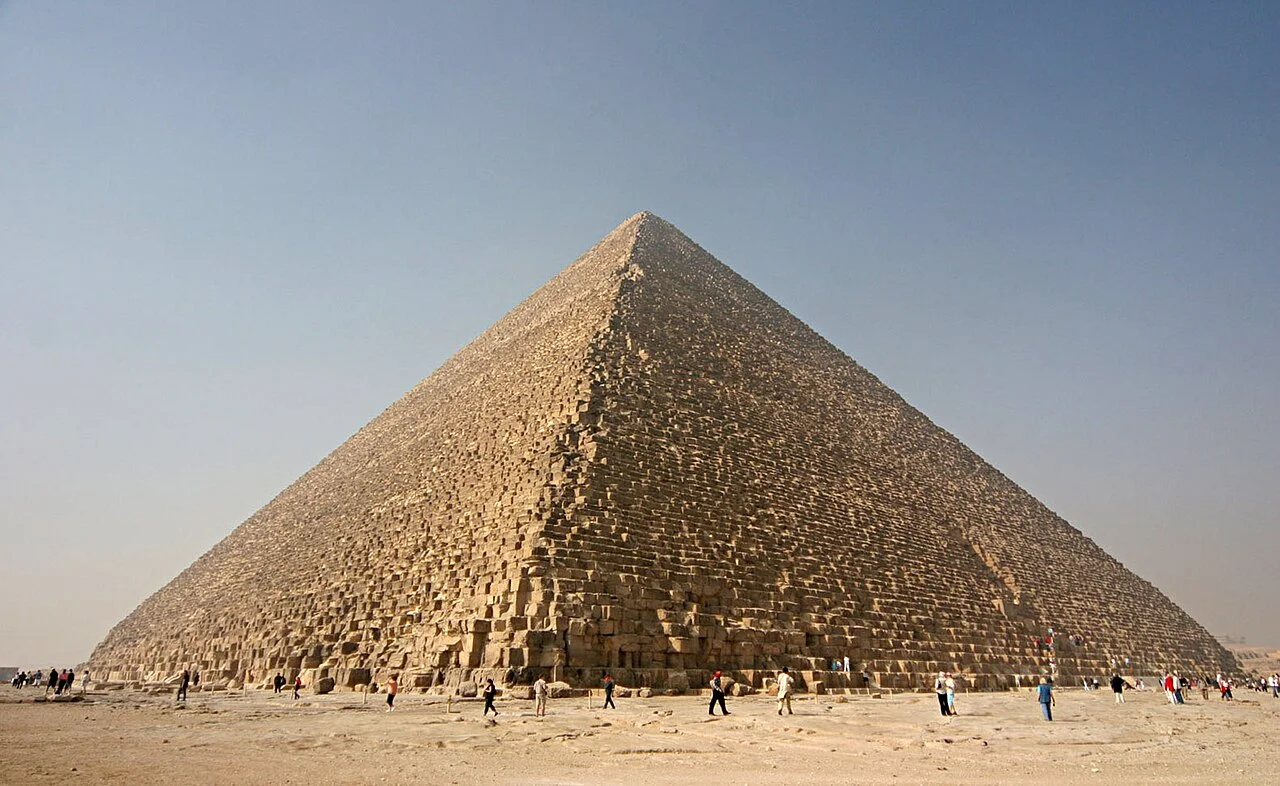
The Pyramid itself — rising 136 metres today (originally 143.5 m) and still capped with a portion of its original limestone casing near the apex — was the eternal house of the king's body and the monumental statement of divine kingship. The Mortuary Temple formed its earthly service station: the place where human priests maintained the divine king's eternal life through ceaseless ritual action.
Visitor Information
The Mortuary Temple of Khafre is accessible within the Giza Pyramids complex. While the temple itself is largely an open ruin, it is one of the most atmospheric spots on the plateau — especially at dawn or late afternoon when the slanting light reveals the texture of its ancient stone blocks and the scale of its construction becomes truly apparent.
| Location | Eastern base of the Pyramid of Khafre, Giza Plateau, Giza Governorate, Egypt |
|---|---|
| Opening Hours | Daily 8:00 AM – 5:00 PM (summer may extend to 6:00 PM) |
| Admission | Included in the Giza Pyramids complex ticket; separate tickets for pyramid interiors |
| Ticket Price (approx.) | EGP 360 for general access (foreigners); prices subject to change — verify at entry |
| Nearest City | Cairo / Giza (~13 km from Cairo city centre) |
| Transport | Taxi, Uber, or guided tour from Cairo; Metro to Giza station + taxi |
| Best Time to Visit | October to April; early morning (8:00–10:00 AM) to beat crowds and heat |
| Photography | Permitted; drone use requires advance permit from the Ministry of Antiquities |
| Nearby Sites | Valley Temple of Khafre, Great Sphinx, Pyramid of Khufu, Pyramid of Menkaure, Solar Boat Museum |
| Accessibility | The plateau terrain is uneven; limited facilities for mobility-impaired visitors |
Visitor Advice
Arrive as early as possible — the Giza Plateau receives thousands of visitors daily, and the area around the Mortuary Temple and Valley Temple is less crowded than the pyramid entrances. Wear sturdy shoes, carry water, and use sun protection. Hiring a licenced guide is strongly recommended for contextualising the ruins; independent exploration of the temple is possible but benefits greatly from expert interpretation.
Who Is This Site Best For?
The Mortuary Temple of Khafre rewards visitors with a particular interest in ancient Egyptian religion, architecture, and archaeology. While it lacks the dramatic visual impact of the intact Valley Temple or the Sphinx, its massive granite blocks and the sheer scale of its basalt paving convey an extraordinary sense of Old Kingdom ambition. History enthusiasts, architects, and serious Egyptophiles will find it essential; first-time visitors to Giza will benefit most by visiting it in context with the Valley Temple and Sphinx as part of a guided circuit.
Combining Your Visit
Plan to spend at least half a day on the full Khafre mortuary complex — Mortuary Temple, causeway (walk along the exterior), Valley Temple, and the Sphinx enclosure. Add a further half-day for the Pyramids of Khufu and Menkaure and the Solar Boat Museum. The Egyptian Museum in Cairo makes an ideal complement, particularly to see the famous diorite statue of Khafre from the Valley Temple excavations.
Frequently Asked Questions
What is the Mortuary Temple of Khafre and what was it used for?
How does the Mortuary Temple differ from the Valley Temple of Khafre?
How much of the Mortuary Temple survives today?
Is the Mortuary Temple of Khafre open to visitors?
What is the royal ka cult and why was the temple important to it?
Can I visit the Mortuary Temple without a guide?
Sources & Further Reading
The following authoritative sources were consulted in preparing this guide. For deeper study, these works are highly recommended.
- Giza Plateau Mapping Project (GPMP) — Harvard University & Boston Museum of Fine Arts: gizapyramids.org
- Mark Lehner, The Complete Pyramids (Thames & Hudson, 1997)
- Miroslav Verner, The Pyramids: Their Archaeology and History (Atlantic Books, 2002)
- Digital Egypt for Universities — UCL: Mortuary Temple of Khafre
- UNESCO World Heritage Centre: Memphis and its Necropolis — the Pyramid Fields from Giza to Dahshur