Karnak Temple Complex (Ipet-Sut) — Architecture, Pylons & History
The heart of ancient Thebes and the largest religious temple complex ever constructed in human history. Developed across over 1,500 years from the Middle Kingdom to the Ptolemaic period, Karnak spans over 200 acres dedicated to Amun-Ra, King of the Gods, and his divine family.
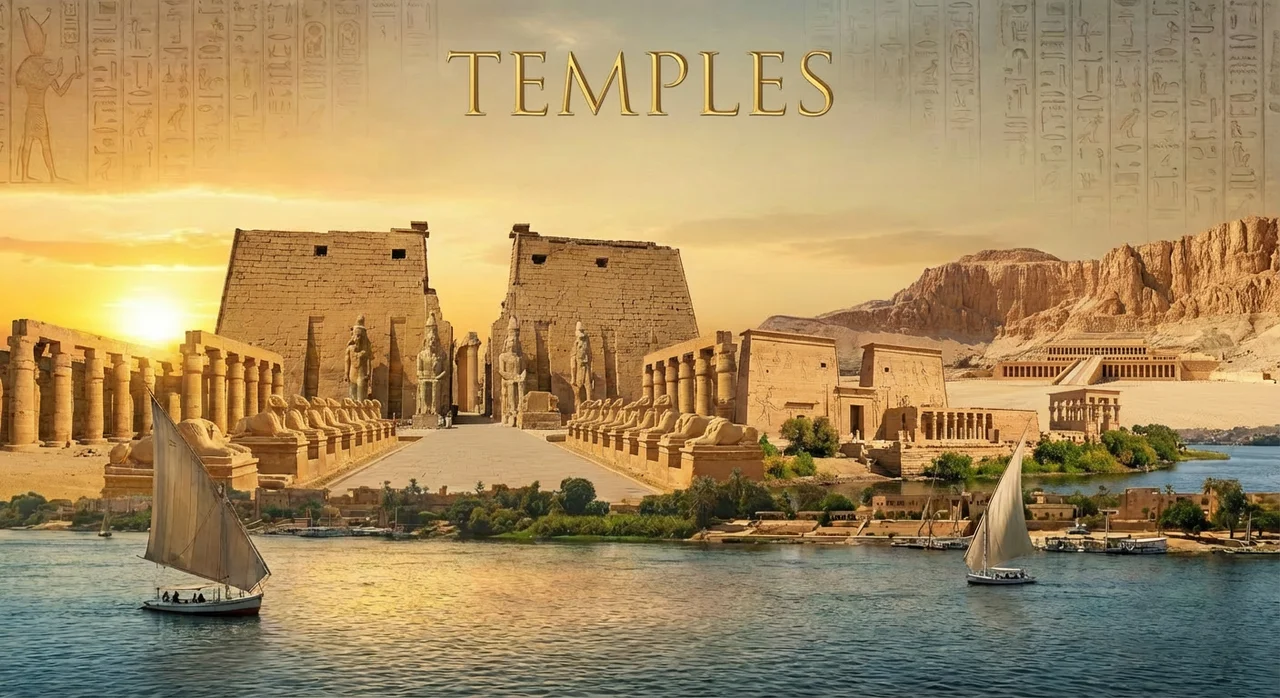
Architectural Layout and the Four Sacred Precincts
Known to the ancient Egyptians as Ipet-Sut ("The Most Select of Places"), Karnak is not a single isolated structure but a vast sacred landscape enclosed by massive mudbrick perimeter walls. The development of the site was an ongoing dynastic duty: over thirty pharaohs added pylons, courtyards, obelisks, and shrines to honor Amun-Ra and legitimate their earthly rule.
The complex is divided into four distinct walled enclosures:
- The Precinct of Amun-Ra: The colossal central core of the complex, covering over 60 acres. It contains the First through Sixth Pylons on the east-west axis, the Seventh through Tenth Pylons on the north-south processional axis, the Great Hypostyle Hall, the Middle Kingdom Court, the Festival Hall of Thutmose III (Akh-Menu), and the Sacred Lake.
- The Precinct of Mut: Dedicated to Mut, the divine consort of Amun-Ra and mother of the moon god Khonsu. Situated approximately 350 meters south of the Amun precinct and connected by an avenue of ram-headed sphinxes, it centers on the crescent-shaped sacred lake (Isheru) and houses hundreds of dynamic black diorite statues of the lioness goddess Sekhmet, commissioned by Amenhotep III.
- The Precinct of Montu: Situated north of the Amun enclosure, dedicated to the ancient Theban falcon-headed god of war who protected Upper Egypt before the rise of Amun during the Middle Kingdom.
- The Temple of Khonsu: Located within the southwest corner of the Amun enclosure, displaying remarkably preserved relief carvings from Ramesses III and the High Priests of Amun (21st Dynasty).
The Great Hypostyle Hall — Masterpiece of New Kingdom Engineering
Begun during the late 18th Dynasty under Amenhotep III and carried to completion by Seti I and Ramesses II (19th Dynasty), the Great Hypostyle Hall remains one of the greatest architectural triumphs of the ancient world. Covering an area of 5,000 square meters (54,000 sq ft), the hall contains 134 colossal sandstone columns arranged in 16 rows.
The 12 central columns, standing in two rows along the main processional nave, rise to an extraordinary height of 21 meters (69 ft) with open papyrus flower capitals that have a circumference of nearly 15 meters—broad enough for 50 people to stand atop a single capital. The remaining 122 columns rise to 15 meters (49 ft) with closed papyrus bud capitals. The height differential allowed architects to insert clerestory stone-grilled windows along the roofline, bathing the central aisle in sacred celestial light while casting the outer rows into mystical shadow, evoking the primordial marsh of creation (Zep Tepi).
Private Guided Expeditions to Karnak with Expert Egyptologists
Discover the hidden hieroglyphic inscriptions, the astronomical winter solstice alignment, and the newly restored Avenue of Sphinxes with Ultra Egypt Travel (Lic. #874 Class A). Our private chauffeured tours include VIP access, personalized academic commentary, and seamless ticketing.
Stone Quarries, Transportation & Structural Materials
The colossal scale of Karnak required massive logistical mobilization across Upper Egypt and Lower Nubia:
- Sandstone from Gebel el-Silsila: Unlike the limestone pyramids of Giza, over 80% of Karnak's structural masonry was quarried from the extensive sandstone quarries of Gebel el-Silsila, located 65 kilometers north of Aswan. Massive blocks were quarried along the river banks and floated downstream on heavy cargo barges (baris) during the high-water season of the Nile flood (Akhet).
- Aswan Pink Granite: Used for the most sacred and structurally demanding elements, including the monolithic obelisks of Queen Hatshepsut and King Thutmose I, the shrine thresholds, and the statues of Sekhmet and Amun. Hatshepsut's standing obelisk, carved from a single piece of red granite, weighs over 320 tons and stands 29.56 meters high.
- Mortarless Masonry & Earthen Ramps: The monumental pylon gateways and column drums were positioned without adhesive mortar, utilizing precision dressed joints and wooden swallowtail cramps. Construction was achieved through the progressive accumulation of earthen and mudbrick ramps, upon which stone drums were rolled into place before the entire facade was dressed and carved from top to bottom as the ramps were removed.
Architectural Specifications & Epigraphic Summary
| Architectural Element | Archaeological & Historical Record |
|---|---|
| Primary Construction Materials | Nubian sandstone (Gebel el-Silsila), red granite (Aswan), white calcite/alabaster (Hatnub), mudbrick enclosure walls. |
| Astronomical Orientation | East-West axis oriented precisely to the winter solstice sunrise, allowing the rays of Amun-Ra to penetrate the high sanctuary. |
| Avenue of Sphinxes (Dromos) | 2,700-meter paved ceremonial boulevard lined with over 1,050 ram-headed and human-headed sphinxes, fully restored in 2021. |
| Heritage Conservation Body | Franco-Egyptian Center for the Study of the Temples of Karnak (CFEETK) & Supreme Council of Antiquities (SCA). |
Academic & Official References
- Egyptian Ministry of Tourism and Antiquities: Official Documentation of the Karnak Temple Complex and Avenue of Sphinxes Restoration, Cairo.
- UNESCO World Heritage Centre: Nomination Archive for Ancient Thebes with its Necropolis (Ref. #87), Inscribed 1979.
- Richard H. Wilkinson: The Complete Temples of Ancient Egypt, Thames & Hudson, London.
- CFEETK (Centre Franco-Égyptien d'Étude des Temples de Karnak): Field Reports and Epigraphic Surfacing of the Karnak Temples.
- James Henry Breasted: Ancient Records of Egypt, Vol. II & III: The Eighteenth and Nineteenth Dynasties, University of Illinois Press.
- Ian Shaw: The Oxford History of Ancient Egypt, Oxford University Press.