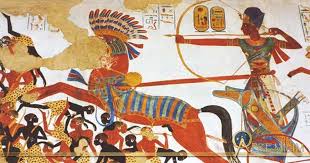
"I attacked them like the falcon of Horus. I found the 2,500 chariots surrounding me, but my heart did not waver... I was alone, but Amun was with me." – The Poem of Pentaur.
The Battle of kadesh is one of the most famous and well-documented military engagements of antiquity. Fought between the Egyptian Empire, led by Ramesses II (The Great), and the Hittite Empire under King Muwatalli II, it took place near the Orontes River in modern-day Syria. It represents the high-water mark of Bronze Age warfare.
The Hittite Trap
Ramesses II, young and eager for glory, marched north with four divisions (Amun, Ra, Ptah, and Seth). Near kadesh, his scouts captured two Bedouin spies who claimed the Hittite army was far away in Aleppo.
This was a ruse. The main Hittite force was actually hiding just behind the city of kadesh. Believing the false intelligence, Ramesses camped his Amun division without waiting for the rest of his army. The Hittites launched a surprise chariot charge across the river, shattering the Ra division and nearly capturing the Pharaoh himself.
5,000 Chariots of War
What followed was the largest chariot battle ever recorded, involving an estimated 5,000 to 6,000 chariots.
- The Hittites: Used heavy, three-man chariots designed for shock tactics and crushing infantry lines.
- The Egyptians: Used lighter, faster two-man chariots designed for maneuverability and archery.
Ramesses rallied his personal guard and fought with desperate bravery. The arrival of reinforcements from the coast (the Ne'arin) saved the Egyptian army from total annihilation, pushing the Hittites back into the river.
The Silver Treaty
Militarily, the battle was a stalemate. Ramesses failed to capture kadesh, and the Hittites failed to destroy the Egyptian army. Both sides claimed victory at home.
However, roughly 15 years later (c. 1259 BCE), the two empires realized they faced a common threat from the rising Assyrians. They signed the Eternal Treaty, recorded in both Egyptian hieroglyphs and Hittite cuneiform on silver tablets. It is the earliest surviving international peace treaty in history, promising mutual non-aggression and military alliance. A copy of this treaty hangs today at the United Nations headquarters in New York.
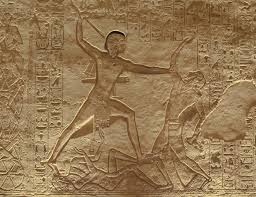
Propaganda in Stone
Ramesses II ensured his "victory" would never be forgotten. He carved the story of the battle onto the walls of almost every major temple in Egypt, including Karnak, Luxor, the Ramesseum, and Abu Simbel. The scenes depict him as a giant smiting his enemies single-handedly, a masterpiece of ancient propaganda.