
"If the earth were a single state, Istanbul would be its capital." – Napoleon Bonaparte.
Straddling Europe and Asia across the Bosphorus Strait, Istanbul (formerly Constantinople) stands as a testament to the might of the Ottoman Empire—a fusion of Islamic grace and Byzantine grandeur that controlled global trade routes for centuries.
Istanbul is the only city in the world located on two continents. Conquered by Sultan Mehmed II (The Conqueror) in 1453, the city transformed from the heart of Orthodox Christianity into the seat of the Islamic Caliphate, becoming a beacon of science, art, and architecture that influenced the world, including Egypt.
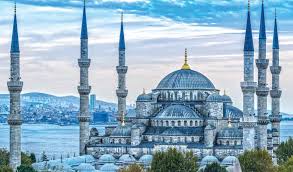
A Skyline of Domes and Minarets
The Ottoman skyline is defined by the work of the great architect Mimar Sinan and his successors, who blended Byzantine engineering with Islamic aesthetics.
Hagia Sophia (Ayasofya)
Originally built as a Christian cathedral by Emperor Justinian I in 537 AD, it served as the center of Eastern Orthodox Christianity for nearly 900 years. After the 1453 conquest, Sultan Mehmed II converted it into a mosque, adding minarets and Arabic calligraphy while preserving much of the interior mosaics. Its massive dome remained the largest in the world for a millennium.
The Blue Mosque (Sultan Ahmed Mosque)
Standing directly opposite Hagia Sophia, this masterpiece was commissioned by Sultan Ahmed I to rival its Byzantine neighbor.
- The Six Minarets: It famously features six minarets. Legend says the architect misheard the Sultan's request for "gold minarets" (altın) as "six minarets" (altı). To avoid arrogance (as only Mecca had six at the time), the Sultan paid for a seventh minaret in Mecca.
- Iznik Tiles: The interior is adorned with over 20,000 handmade ceramic tiles from Iznik, featuring more than 50 different tulip designs, which give the mosque its popular name.
Palaces of the Sultans
Topkapi Palace: The Harem & The Holy Relics
For 400 years, this sprawling complex was the administrative heart of the empire. Unlike European palaces, it is a collection of pavilions and courtyards.
- The Sacred Trust: After the conquest of Egypt in 1517, the Holy Relics of Islam (including the sword and mantle of Prophet Muhammad, peace be upon him) were brought here from Cairo. They are recited over by hafiz (Quran reciters) 24 hours a day.
- The Treasury: Home to the famous Topkapi Dagger and the Spoonmaker's Diamond (86 carats), one of the most famous diamonds in the world.
Dolmabahçe Palace
In the 19th century, the Sultans moved to this European-style palace on the Bosphorus. It symbolizes the empire's modernization (Tanzimat era). It boasts the largest crystal chandelier in the world, a gift from Queen Victoria.
Hidden Gems
Basilica Cistern (Yerebatan Sarnıcı)
An underground wonder built in the 6th century to filter water for the Great Palace. The forest of 336 marble columns rising from the water creates a hauntingly beautiful atmosphere. Visitors often seek out the two columns supported by inverted Medusa heads.
Galata Tower
Originally built by the Genoese in 1348, this tower offers one of the best panoramic views of the Golden Horn and the historic peninsula. It was from here that Hezarfen Ahmed Çelebi reportedly flew across the Bosphorus using artificial wings in the 17th century.
The Ottoman-Egyptian Connection
The history of Istanbul is inextricably linked with Egypt. In 1517, Sultan Selim I defeated the Mamluks at the Battle of Ridaniya (near Cairo), absorbing Egypt into the Ottoman Empire.
The Caliphate Moves
With the conquest of Egypt, the title of Caliph passed to the Ottoman Sultans. Istanbul became the center of the Islamic world, utilizing the wealth of the Nile to protect the holy cities of Mecca and Medina.
Muhammad Ali Pasha
In the 19th century, Muhammad Ali, an Ottoman commander of Albanian origin sent to Egypt, rose to become the Khedive. He modernized Egypt, modeling Cairo's architecture (Downtown Cairo) after the Europeanized districts of Istanbul.
Master of the Trade Routes
Istanbul controlled the Bosphorus, the vital choke point between the Black Sea and the Mediterranean. It was the terminus of the Silk Road.
- Grand Bazaar (Kapalıçarşı): One of the world's first shopping malls, established in 1461. It spans 61 streets with over 4,000 shops selling carpets, leather, jewelry, and antiques.
- Spice Bazaar (Mısır Çarşısı): Built in 1660, it derived its name ("Egyptian Bazaar") because it was constructed using tax revenues from Cairo. It was the center for the spice trade coming from India via Egypt.