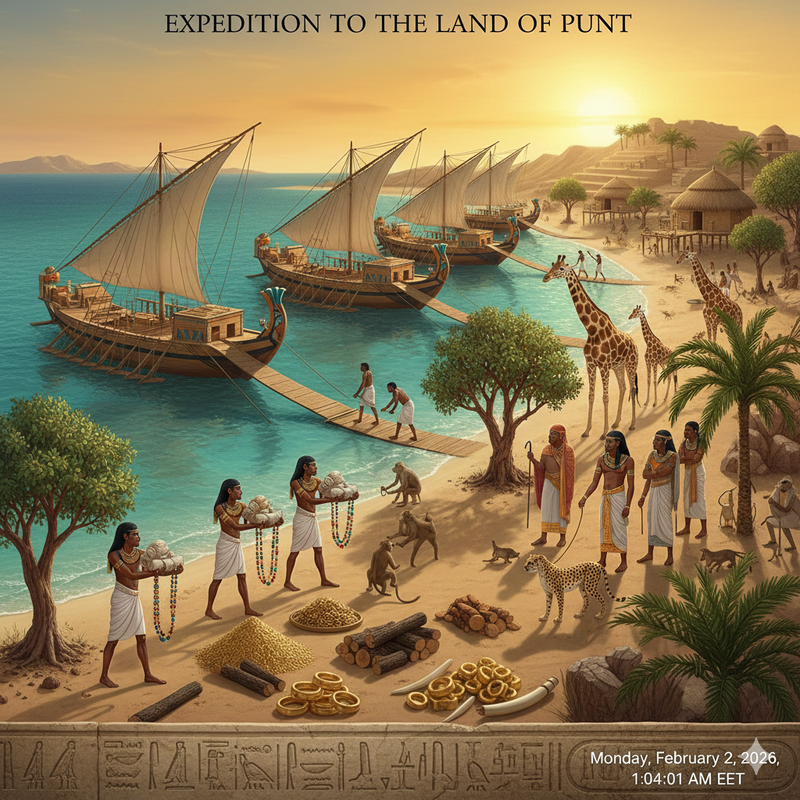
"The ships were laden very heavily with marvels of the country of Punt; all goodly fragrant woods of God's Land, heaps of myrrh-resin, with fresh myrrh trees, with ebony and pure ivory, with green gold of Emu." – Inscription at Deir el-Bahri.
The Land of Punt (Ta-Netjer, meaning "God's Land") was Ancient Egypt's most mystical and valuable trading partner. While expeditions to Punt date back to the Old Kingdom, the most famous and well-documented journey occurred during the 18th Dynasty under the reign of the female Pharaoh, Hatshepsut (c. 1479–1458 BCE).
Where was Punt?
The exact location of Punt remains a topic of debate among Egyptologists, but most evidence points to the Horn of Africa, likely modern-day Somalia, Eritrea, or eastern Sudan. It was accessible via the Red Sea coast.
To the Egyptians, Punt was a semi-legendary place of abundance, the source of the aromatic resins essential for temple rituals and mummification.
The Voyage (Year 9 of Hatshepsut)
Hatshepsut, eager to establish her legitimacy and satisfy the god Amun, commanded a grand fleet to re-establish trade links that had been disrupted during the Hyksos period.
- The Fleet: Five massive ships were constructed, each capable of carrying 210 men (rowers, sailors, and marines). They sailed from a Red Sea port (likely Mersa Gawasis) down the coast.
- The Mission: This was a peaceful trade mission, not a conquest. The Egyptians brought weapons, jewelry, and tools to exchange.
The Treasures of Punt
The reliefs at Hatshepsut's mortuary temple in Deir el-Bahri provide a detailed inventory of the goods brought back. It was a botanical and zoological triumph.
Myrrh Trees
In a historic first, the Egyptians transported 31 living myrrh trees with their root balls intact. They were planted in the courts of Deir el-Bahri to create a garden for Amun. This is the first recorded attempt at transplanting foreign flora.
Exotic Goods
The ships returned laden with heaps of frankincense resin, ebony logs, pure ivory, "green gold" (electrum), cinnamon wood, panther skins, and live animals including baboons, monkeys, and giraffes.
Queen Ati
One of the most famous images from the expedition reliefs depicts the rulers of Punt who greeted the Egyptians: King Parahu and his wife, Queen Ati.
Queen Ati is depicted with a unique physique—distinctly curvy with pronounced steatopygia (accumulation of fat on the buttocks and thighs). While early art historians called this a caricature, modern scholars view it as a realistic depiction of a medical condition (like lipodystrophy) or simply a different cultural standard of beauty and wealth in Punt.