"O you who opens the ways, O you who opens the paths... Open a path for me, that I may pass."
The afterlife was not a place one could enter unprepared. It was a perilous realm filled with demons, gates of fire, and complex geography. To ensure the soul reached the Field of Reeds safely, the Ancient Egyptians created elaborate Funerary Texts—spiritual maps and spellbooks to guide the deceased.
These texts evolved over thousands of years, democratizing the afterlife from the exclusive privilege of the King to a hope for every Egyptian.
1. The Pyramid Texts (Old Kingdom)
The oldest religious texts in the world (c. 2400 BC), first appearing in the Pyramid of Unas at Saqqara.
- Format: Carved directly onto the stone walls of the royal burial chamber.
- Purpose: Designed exclusively for the Pharaoh to help him ascend to the sky and join the sun god Ra or become an "Indestructible Star."
- Nature: They contain no illustrations, only vertical columns of hieroglyphs painted blue or green.
2. The Coffin Texts (Middle Kingdom)
Following the collapse of the Old Kingdom, the afterlife became accessible to nobles and officials.
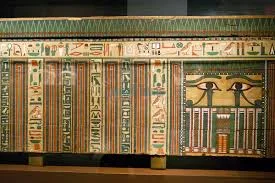
- Format: Painted on the interior of wooden coffins.
- Innovation: They introduced the Book of Two Ways, the first-ever map of the underworld, showing paths of land and water separated by a lake of fire.
- Shift: Emphasis moved from the celestial realm (stars) to the subterranean realm of Osiris.
3. The Book of the Dead (New Kingdom)
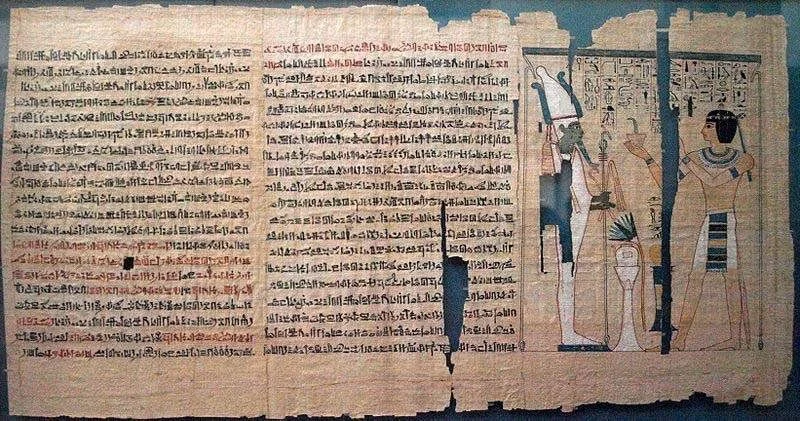
Known to the Egyptians as Pert em Hru ("Coming Forth by Day"), this is the most famous collection of spells.
Unlike previous texts, these were written on papyrus scrolls and could be purchased by anyone wealthy enough. They were often beautifully illustrated with vignettes.
Key Spell: The Weighing of the Heart
Spell 125 describes the ultimate test. The heart of the deceased is weighed against the Feather of Ma'at (Truth). If the heart is heavy with sin, it is devoured by Ammit. If balanced, the soul is granted eternal life.
4. The Books of the Netherworld
In the New Kingdom, while commoners used the Book of the Dead, Pharaohs decorated their tombs in the Valley of the Kings with new, complex texts describing the sun god's nightly journey.
-
The Amduat: "That Which Is In the Afterworld." It maps the 12 hours of the night, showing Ra sailing through the underworld river, bringing life to the dead and battling the serpent Apophis.
-
The Book of Gates: Focuses on the massive gates separating the hours of the night. Each gate is guarded by a fearsome deity; the deceased must know the guardian's name to pass.