At a glance
The “Tomb of Narmer” is the conventional label for a small royal tomb in Cemetery B at Umm el-Qa'ab, the desert-edge necropolis of Abydos. It consists of two joined chambers—numbered B17 and B18—lined with mud-brick. In the archaeological literature, the attribution to Narmer rests on early dynastic inscriptions and find contexts connecting the chambers with the king’s name and court.
Why it matters: This is not a monumental “Valley of the Kings” style tomb. It is older—closer to the origins of the Egyptian state—and helps scholars understand how royal burial, administration, and ideology were organized at the very start of the dynasties.
Table of contents
1) Where is the tomb?
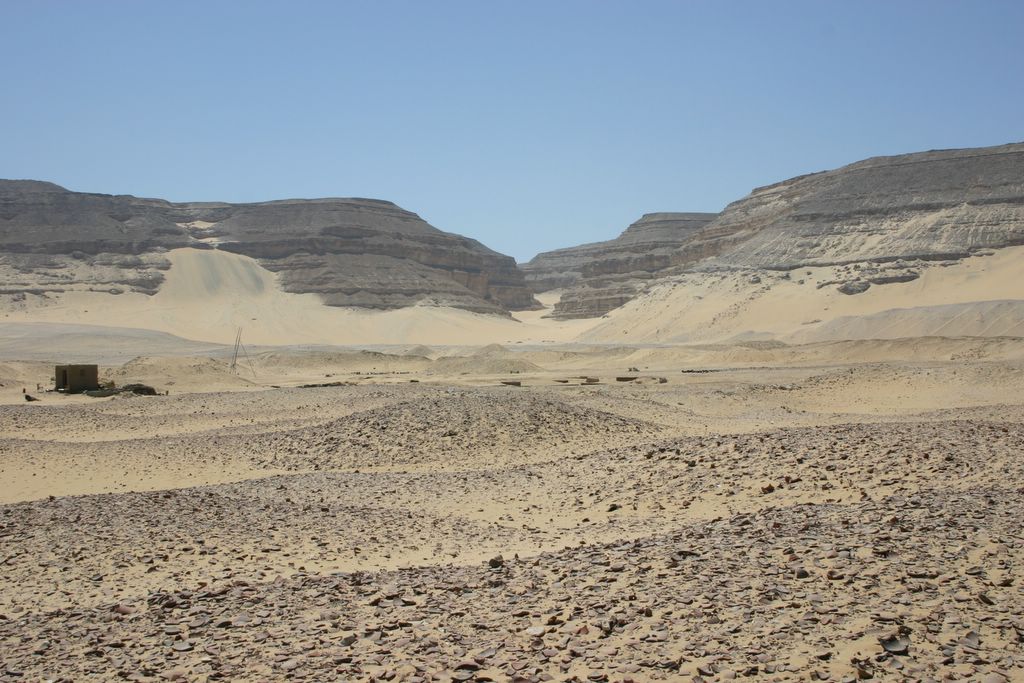
Umm el-Qa'ab lies west of the modern Nile Valley at Abydos (today in the Sohag region of Upper Egypt). The name means “Mother of Pots,” referring to the millions of broken offering jars that carpet the ground—physical traces of pilgrimage and ritual activity continuing long after the Early Dynastic royal burials.
Narmer’s tomb is in Cemetery B, a cluster of early royal tombs positioned near earlier “proto-royal” burials and close to the later First Dynasty tombs. In the numbering system used by excavators, Narmer is associated with B17/B18.

Coordinates (approx.)
For mapping and navigation, a representative point for Umm el-Qa'ab is often given around: 26.1749° N, 31.9080° E.
Tip: On many itineraries, Umm el-Qa'ab is visited together with the Temple of Seti I and the Osireion at Abydos—these are in a different zone closer to the cultivated land.
2) Who was Narmer?
Narmer is one of the most famous names from the transition into dynastic Egypt. He is widely connected—through art and inscriptions—with the emergence of a unified kingship and the development of royal symbolism (including the serekh, the early royal name frame).
Scholars debate details of the political process and the exact sequence of late “Dynasty 0” and early First Dynasty rulers, but Narmer consistently appears as a pivotal figure at this threshold. The tomb attributed to him at Abydos is part of the primary archaeological evidence for this formative period.
Reading the name
“Narmer” is commonly written with signs interpreted as a catfish and a chisel. On small labels, jar sealings, and other administrative objects, the king’s name can appear compactly inside a serekh.
3) Architecture & plan (B17/B18)
The tomb attributed to Narmer is two joined chambers. In published catalogues, the overall footprint is modest compared with later First Dynasty tombs, yet it already shows a clear separation of spaces (burial chamber vs. storage or subsidiary areas) that becomes increasingly elaborated over the dynasty.

Key measurements (published)
- Total area: c. 10.0 × 3.1 m
- Depth: c. 2.5–2.8 m
- B18 (burial chamber) size: c. 3.35 × 5.6 m (depth c. 2.8 m)
- Construction: chambers lined with mud-brick
These figures vary slightly across reports and reconstructions, but they give a reliable sense of scale for an early royal tomb.
How an Early Dynastic royal tomb worked
Early royal tombs at Abydos were typically built as subterranean or semi-subterranean chambers with mud-brick linings. After funerary rituals, access routes were sealed and the superstructure could be covered by sand or low mounds. Storage spaces (for food, drink, and equipment) were conceptually essential: the tomb was a machine for sustaining the king’s afterlife.
What you see today
At Umm el-Qa'ab, visitors usually encounter the tombs as exposed brick-lined voids—rectangular trenches and rooms, shaped by excavation and conservation. The experience is more archaeological than “decorative”: there are no painted walls here, but the spatial logic is powerful once you understand that you are standing at the beginning of Egypt’s royal mortuary tradition.
4) Excavation history
Umm el-Qa'ab was explored in the late 19th century and excavated systematically around the turn of the 20th century. Work by Flinders Petrie in 1900–1901 included the tombs of Narmer (B17/B18) as part of a broader effort to map the earliest royal cemetery. In the later 20th century, the German Archaeological Institute (DAI) conducted renewed fieldwork, improving plans, stratigraphy, and artifact publication.
Why re-excavate?
Early excavations often focused on spectacular objects. Modern work adds high-resolution recording: small finds, sealings, micro-stratigraphy, and re-analysis of architecture—essential for understanding how the state formed.
5) Finds & inscriptions
The attribution of B17/B18 to Narmer is rooted in inscribed material recovered in and around the tomb: seal impressions, jar labels, and pottery fragments that preserve early royal naming conventions. Even when looting removed much of the original burial equipment, the administrative debris—labels and sealings—often survives as a durable signature of ownership and provisioning.
What kinds of objects matter most?
- Seal impressions: clay sealings that once secured storerooms, jars, or boxes, often bearing a royal name or institution.
- Tags/labels: small inscribed pieces (ivory, bone, wood) recording commodities, places, or events in early writing.
- Pottery and stone vessels: sometimes with inked or incised names, but more often valuable for dating and trade patterns.
A note on certainty
Early Dynastic tomb attributions can be complex. Scholars weigh inscriptions, architecture, and cemetery layout. When you see “Narmer?” in some publications, it signals healthy academic caution—yet the B17/B18 attribution is widely used and discussed in professional catalogues of Abydos’ royal tombs.
6) The sacred landscape of Abydos
Abydos is not only an Early Dynastic royal cemetery. Over time, it became one of Egypt’s most charged sacred landscapes. In later periods, Umm el-Qa'ab was closely linked with the cult of Osiris and long-lived pilgrimage traditions. The sea of pottery sherds across the site is a material archive of those rituals.
For the modern visitor, this layering matters: you may be looking at a royal tomb from the start of dynastic history, standing in a landscape that later Egyptians treated as a mythic center of resurrection.
7) Visiting tips
Best time to go
- Oct–Apr: cooler days and clearer light for photography.
- Early morning: softer light; fewer visitors; less windblown sand.
- Bring: water, sun protection, sturdy shoes (sand + uneven ground).
On-site reality
- Expect an archaeological landscape—minimal shade and limited signage.
- Photography rules can vary; follow site staff guidance.
- Combine with Abydos’ temples for a “full story” day.
Suggested itinerary (half day)
- Temple of Seti I (iconic reliefs + the Abydos King List)
- Osireion (atmospheric megalithic substructure)
- Umm el-Qa'ab (royal cemetery: early dynastic tombs incl. Narmer’s B17/B18)
Last updated: February 13, 2026
8) Sources & further reading
The following are reputable starting points used to compile the measurements and historical/archaeological context on this page.
- Eva-Maria Engel, The royal tombs at Umm el-Qa'ab (Archéo-Nil 18, 2008) — includes a catalogue entry for Tomb B17/18 (Narmer) with measurements and excavation history.
- Griffith Institute (University of Oxford), Artefacts of Excavation — 1900–01 Abydos — overview of Petrie’s work listing Narmer’s tomb (B17/B18) among the royal tombs excavated.
- Pleiades (Ancient World Gazetteer), Umm el-Qa'ab — provides a representative geospatial point used here for mapping and schema.
- Julia Budka, Umm el-Qa'ab and the sacred landscape of Abydos (2019) — discusses votive pottery and the long-term ritual landscape.
- Penn Museum (Expedition magazine), The Earliest Pharaohs and the University Museum — accessible overview of Early Dynastic royal tomb archaeology at Abydos.
Image credits: Wikimedia Commons (public domain) for the Umm el-Qa'ab landscape photo and schematic/plan imagery used above.