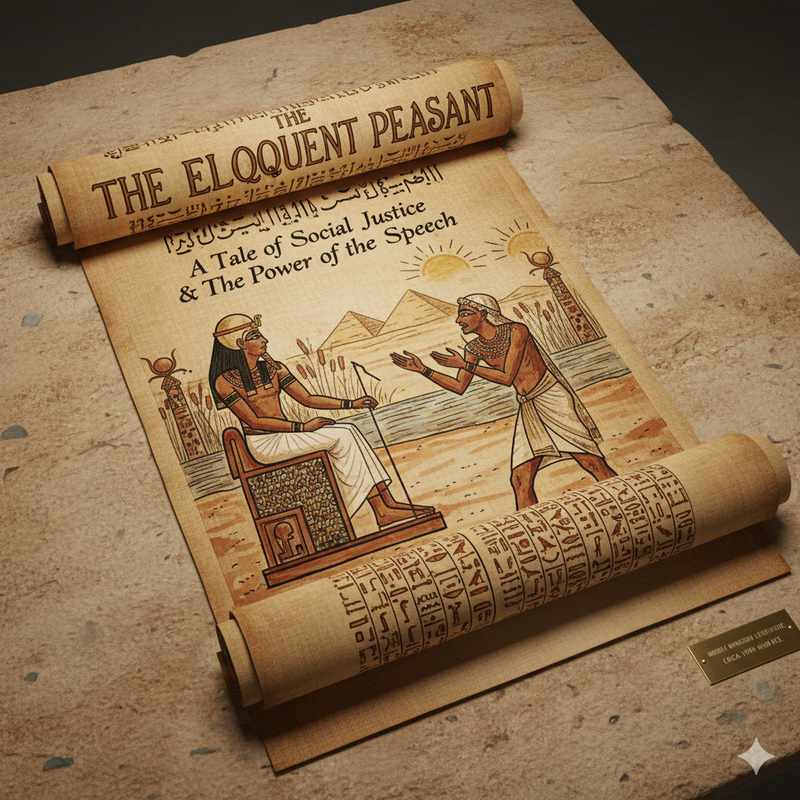
"Speak truth, do justice. For it is great, it is mighty, it endures. Its worth is tried, and it leads one to blessedness." – The Peasant Khun-Anup.
The Eloquent Peasant is one of the masterpieces of Middle Kingdom literature (c. 1850 BCE). Unlike tales of magic or war, this story focuses on the plight of the common man. It explores the concept of Ma'at (truth, justice, and order) and the duty of the powerful to protect the weak.
The Trap and the Theft
The story begins with a humble peasant named Khun-Anup living in the Wadi Natrun (Salt Field). He loads his donkeys with goods (salt, reeds, natron, skins) to trade in the city of Herakleopolis.
On his way, he encounters a corrupt official named Nemty-nakht, a subordinate of the High Steward Rensi. Nemty-nakht covets the peasant's goods and devises a trap. He spreads a cloth across the narrow public path, forcing Khun-Anup to guide his donkeys along the edge of a barley field. When one donkey takes a bite of barley, Nemty-nakht seizes all the donkeys and goods as "compensation."
The Appeal to the High Steward
Beaten and robbed, Khun-Anup does not give up. He travels to the city to petition the High Steward Rensi. Instead of begging, he delivers a speech of such extraordinary poetic beauty and wisdom that Rensi is stunned.
Rensi reports this to the Pharaoh, King Nebkaure (Khety). The King is intrigued by a peasant who speaks with the eloquence of a master scribe. He orders Rensi to:
- Not answer the peasant (to provoke him to speak more).
- Secretly provide food for the peasant and his family back home.
- Record every word the peasant says on papyrus.
The Nine Petitions
Thinking he is being ignored, Khun-Anup returns nine times to plead his case. His speeches evolve from specific complaints about the theft to philosophical treatises on the nature of justice and leadership.
Voice of the Common Man
He accuses the judges of being thieves and the leaders of being blind. He compares a just leader to a father for the orphan, a husband for the widow, and a shelter from the storm. He warns that Ma'at (justice) accompanies a man to the afterlife, while stolen wealth does not.
"The tongue of a man is the steering oar of a boat... Do not plunder the poor because he is poor... Justice is for eternity."
The Verdict
After the ninth petition, Khun-Anup is exhausted and threatens to seek justice in the afterlife (suicide). Rensi finally reveals the truth: the King has been listening all along.
The scribes read the recorded petitions to the King, who is delighted by their beauty. He orders immediate justice. Nemty-nakht is punished, and all his property—houses, lands, and cattle—is given to the peasant Khun-Anup. The victim becomes the master of the thief.