The Birthplace of Monasticism
The vast, silent deserts of Egypt are the cradle of Christian monasticism. In the 3rd and 4th centuries AD, as the Roman Empire grappled with its new Christian identity, thousands of devout men and women known as the Desert Fathers and Mothers left the worldly temptations of the cities. Seeking a life of pure faith through solitude, prayer, and asceticism, they retreated into the wilderness of the Thebaid (Upper Egypt) and the Eastern Desert. Their legacy is not just an idea, but a series of fortified monasteries that rise from the sands like citadels of faith. These ancient communities, many still active today, are among the oldest and most important Christian sites in the world.
The Monastery of Saint Anthony: The First of its Kind
Nestled deep in the Red Sea Mountains, the Monastery of Saint Anthony is the oldest continuously inhabited Christian monastery in the world. It was founded in the 4th century by the followers of Saint Anthony the Great, a wealthy young Egyptian who gave up all his possessions to live as a hermit and is now revered as the "Father of All Monks." After his death, his disciples established a monastery around his place of solitude, creating the first template for communal monastic life.
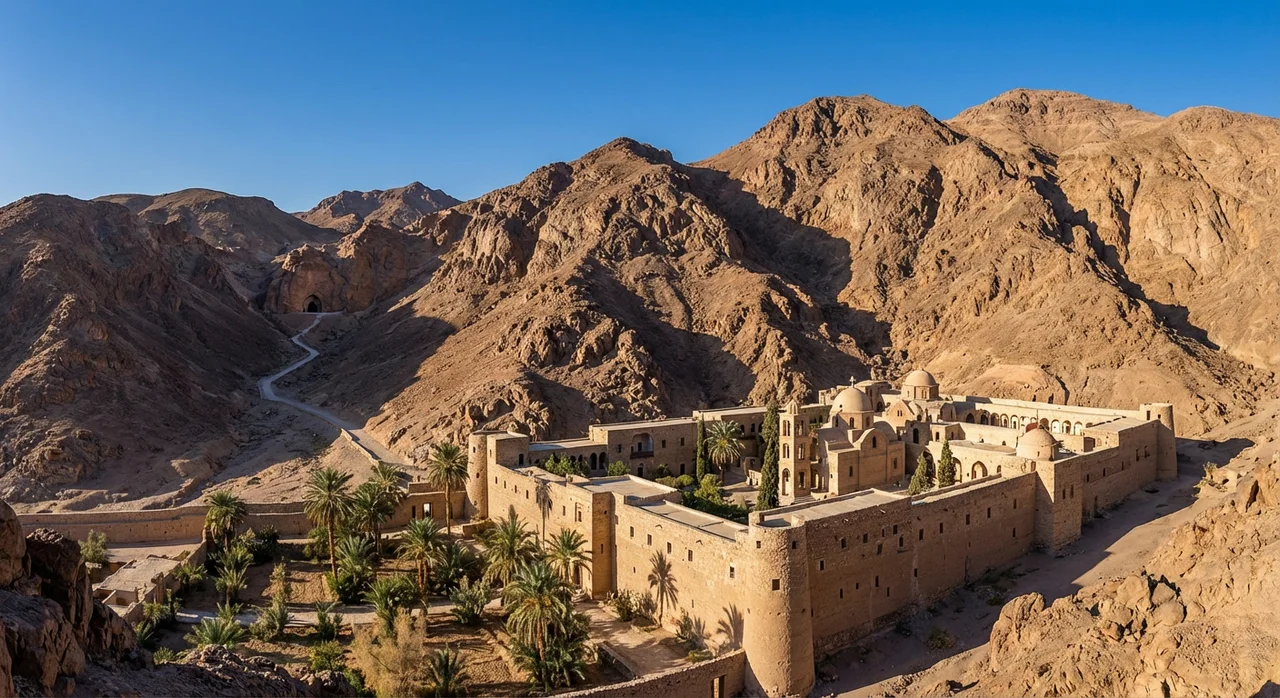
Having endured centuries of raids and rebuilding, the monastery today is a self-contained village, a fortress of faith protected by high walls:
- Fortified Walls: The imposing walls, which are over 12 meters high, were built to protect the monks and their treasures from Bedouin raids.
- Ancient Churches: The complex contains several churches, including the ancient Church of St. Anthony. Built over the saint's tomb, it contains some of the most remarkable and well-preserved Coptic wall paintings in existence, depicting saints, knights, and angels.
- A Self-Sufficient Community: The monastery has its own spring, a lush garden of palms and olive trees, a mill, and a bakery, allowing the monks to live in near-total isolation.
- The Saint's Cave: A steep, 1,200-step climb up the cliffs behind the monastery leads to the original cave where Saint Anthony lived for decades in prayer and contemplation. The view from the cave over the desert and mountains is breathtaking.
The Monastery of Saint Paul the Anchorite
Often visited alongside St. Anthony's is the Monastery of Saint Paul the Anchorite (Deir Anba Bola). Located in the Eastern Desert not far from St. Anthony's, it honors St. Paul, who is considered the very first Christian hermit. He lived in a cave for roughly 90 years, fed daily by a raven that brought him half a loaf of bread. The monastery is built around this sacred cave, which serves as an underground church today. Known for its "Tower of Refuge" (Keep), it reflects the need for defense in the harsh desert environment.
Wadi El Natrun: The Desert of Scetis
Located in the depression between Cairo and Alexandria, Wadi El Natrun (ancient Scetis) became the beating heart of Coptic monasticism. In the 4th century, thousands of monks flocked here, led by St. Macarius the Great. Today, four major monasteries remain active:
- Deir al-Baramus (Monastery of the Romans): The oldest in the region, named after saints Maximus and Domitius, sons of a Roman emperor who lived there.
- Deir Anba Bishoy: Famous for the incorrupt body of St. Bishoy and its five churches. It serves as a major papal residence.
- Deir al-Suryan (Monastery of the Syrians): Renowned for its library of ancient manuscripts and beautiful frescoes, reflecting the exchange between Coptic and Syrian monastic traditions.
- Deir Abu Maqar (Monastery of St. Macarius): The final resting place of St. John the Baptist's head and the prophet Elisha, recently restored to its former glory.
The White Monastery (Sohag)
In Upper Egypt, near Sohag, stands the imposing White Monastery (Deir el-Abyad), founded by Saint Pigol but famously led by his nephew, Saint Shenouda the Archimandrite. Uniquely built using white limestone salvaged from Pharaonic temples, its church resembles an ancient Egyptian temple in its grandeur and scale. Saint Shenouda transformed monasticism here into a powerful social force, opening the monastery gates to feed and protect thousands of villagers during invasions, proving that monks were not just recluses but protectors of their people.
Saint Catherine's Monastery: The Treasure of Sinai
At the foot of Mount Sinai, on the very ground where Moses is said to have received the Ten Commandments, lies the Sacred Monastery of the God-Trodden Mount Sinai. Better known as Saint Catherine's Monastery, this UNESCO World Heritage site is a treasure of incalculable value to civilization. It was constructed in the 6th century by order of the Byzantine Emperor Justinian I and is the oldest continuously working Christian monastery in the world that has never been destroyed in its entire 1,500-year history.
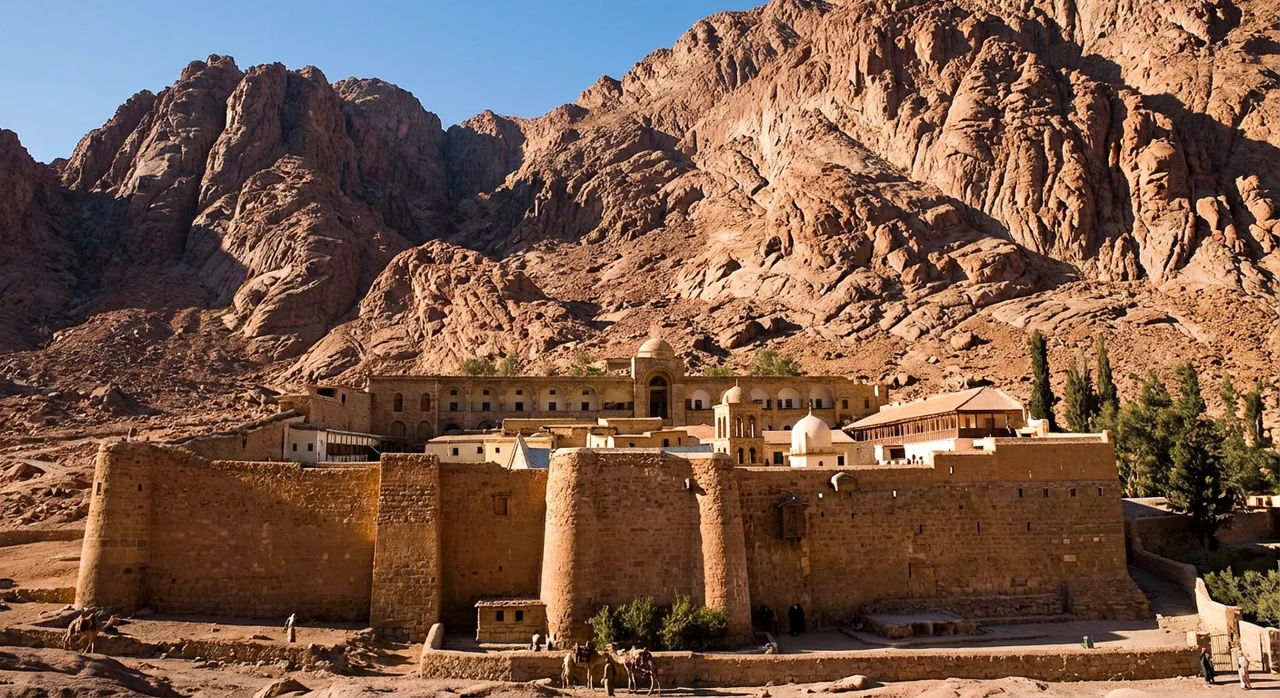
The monastery's unique survival is partly due to the **Ashtiname of Muhammad**, a charter of protection said to have been granted by the Prophet Muhammad himself, which commanded Muslims to protect the monastery.
The treasures contained within its fortress walls are priceless:
- The Burning Bush: The monastery is built around the site of the biblical Burning Bush. A rare, endemic species of raspberry, the Rubus sanctus, still grows on the grounds and is believed to be a descendant of the original bush.
- The World's Oldest Working Library: The monastery's library is second only to the Vatican's in its collection of early codices and manuscripts. It famously held the *Codex Sinaiticus*, one of the oldest and most complete copies of the Bible, and still contains over 3,300 manuscripts.
- Masterpiece of Byzantine Art: The main basilica houses the breathtaking 6th-century mosaic of the Transfiguration of Christ, considered a masterwork of Byzantine art.
- Unrivaled Icon Collection: It possesses the largest and most important collection of early Christian icons in the world, with rare examples from before the 8th-century iconoclasm that were destroyed elsewhere.
Monastic Architecture: The Keep (Qasr)
A distinctive feature of Egyptian monasteries is the Qasr or Keep. This multi-story tower, entered via a drawbridge on an upper floor, served as the last line of defense during raids. It typically contained a well, grain storage, a chapel, and cells, allowing monks to survive sieges for weeks. This architectural innovation, born of necessity in the lawless desert, became a standard feature of Coptic monasteries.