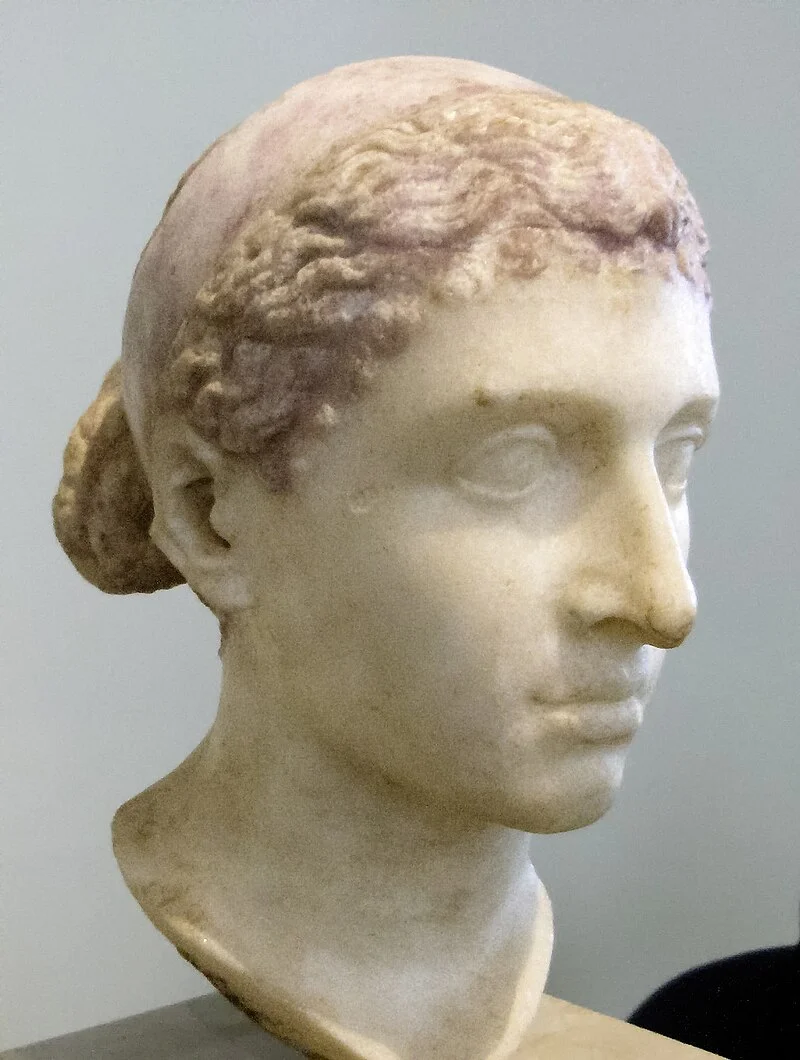
Basic Identity
Cleopatra VII Philopator was born around 69 BCE in Alexandria, Egypt, the cosmopolitan capital of the Ptolemaic Kingdom founded by Alexander the Great's general Ptolemy I. She was the daughter of Ptolemy XII Auletes ("the Flute Player") and became co-ruler with her father before ascending the throne as the primary monarch in 51 BCE. Unlike her Macedonian-Greek predecessors who ruled Egypt for generations without ever learning the Egyptian language, Cleopatra was remarkable in that she mastered the native Egyptian tongue along with at least eight other languages. Her full titulary embraced both Greek Ptolemaic and traditional Egyptian pharaonic elements, blending two civilisations into a single, formidable royal identity.
| Name Meaning | "Glory of Her Father" — from Greek kleos (glory) + pater (father). Her epithet Philopator reinforces this: "she who loves her father." |
|---|---|
| Titles | Pharaoh of Upper and Lower Egypt; Queen of Kings; Goddess Philopator; New Isis; Lady of the Two Lands |
| Dynasty | Ptolemaic Dynasty — the last ruling house of ancient Egypt, of Macedonian-Greek origin |
| Reign | c. 51–30 BCE (approximately 21 years), initially as co-ruler with her brothers Ptolemy XIII and Ptolemy XIV, then as sole ruler |
The Sovereign Who Held Rome at Bay
Cleopatra VII stands as one of the most historically significant rulers in the ancient world, and not merely because of her legendary romantic liaisons. She inherited a kingdom in economic crisis and political turmoil, burdened by crushing debts owed to Rome and threatened by internal dynastic rivalries. Yet through extraordinary intellectual gifts, diplomatic genius, and a command of statecraft few rulers of any era could match, she stabilised Egypt and maintained its sovereignty against the most powerful empire of the ancient world for over two decades. Cleopatra was the first Ptolemaic ruler to speak Egyptian, a profound political act that endeared her to her subjects and enabled her to serve as a priestess in native religious ceremonies — a role no previous Ptolemaic monarch had claimed. Her ability to communicate with diplomats, merchants, and priests in their own languages — reportedly including Ethiopian, Parthian, Hebrew, Aramaic, and Arabic — gave her an unparalleled edge in foreign negotiations. She cultivated the image of the goddess Isis, the divine mother of Egypt, presenting herself not merely as a Greek queen but as the incarnation of the nation's most beloved deity. The historical importance of Cleopatra VII extends beyond her reign: she represents the final, defiant flowering of a three-thousand-year pharaonic tradition, and her fall marked the moment the ancient Egyptian civilisation became absorbed into the Roman world.
Royal Lineage
Cleopatra VII was a member of the Ptolemaic dynasty, a ruling family of Macedonian Greek origin that governed Egypt from 305 BCE — when Ptolemy I Soter declared himself Pharaoh — until her own death in 30 BCE. She was born to Ptolemy XII Auletes, who maintained his throne largely through expensive alliances and tribute paid to Rome, and whose reign was marked by instability and temporary exile. The identity of her mother remains uncertain; ancient sources do not name her, and scholars have debated whether she was a legitimate royal wife or a concubine, possibly of Egyptian descent. Cleopatra VII had two younger brothers — Ptolemy XIII and Ptolemy XIV — and two sisters, Berenice IV and Arsinoe IV, each of whom would become both allies and deadly rivals at various points. Following pharaonic tradition and Ptolemaic custom, she was required to have a male co-ruler; she thus nominally reigned alongside her younger brother Ptolemy XIII, whom she was expected to marry, though in practice she held supreme power. She bore a son, Caesarion (Ptolemy XV), with Julius Caesar, and three children — Alexander Helios, Cleopatra Selene II, and Ptolemy Philadelphus — with Mark Antony, making her progeny the final heirs of the Ptolemaic bloodline.
Isis on Earth: The Divine Queen's Religious Vision
Cleopatra VII pursued one of the most theologically sophisticated religious policies of any ancient ruler, deliberately identifying herself with the Egyptian goddess Isis — the divine mother, protector of the dead, and goddess of magic and healing. This was not mere political theatre; Cleopatra underwent formal initiation as a priestess, participated in temple rituals, and was depicted in native Egyptian style in temple reliefs at sites such as Dendera, where she and her son Caesarion appear carved in traditional pharaonic iconography on the rear exterior wall. The Temple of Hathor at Dendera features one of the most famous surviving reliefs showing Cleopatra offering to the gods, demonstrating the depth of her embrace of native Egyptian religion. She also maintained the Ptolemaic royal cult of Alexander the Great, presenting herself as his spiritual heir. In a remarkable fusion of Greek and Egyptian theology, she was simultaneously worshipped in Alexandria as the "New Aphrodite," the Greek goddess of love and beauty, and as Isis in the Nile Valley — a dual divine identity that united her multicultural kingdom. This religious strategy was profoundly effective: it gave Egyptian priests a genuine stake in her success, secured the temples' vast economic resources as political allies, and provided a supernatural legitimacy that transcended the merely political.
Alexandria: The Queen's Jewel of the Mediterranean
Cleopatra VII presided over Alexandria, the greatest city in the ancient Mediterranean world, and invested in its institutions as expressions of her royal grandeur and intellectual ambition. The city was home to the legendary Library of Alexandria and the associated Mouseion (the ancient world's closest equivalent to a modern research university), both of which Cleopatra patronised and kept as thriving centres of Greek scholarship, science, and philosophy. She reportedly welcomed scholars, physicians, and philosophers to her court and was herself considered learned in mathematics, astronomy, and philosophy. Cleopatra also constructed new monuments and expanded existing temple complexes; she built a mausoleum for herself within the palace quarter of Alexandria that was described by ancient sources as extraordinarily lavish. She erected a Caesareum — a temple complex dedicated to the divine Julius Caesar — near the Alexandrian harbour, adorned with two towering obelisks that still survive today, relocated to London (Cleopatra's Needle on the Thames Embankment) and New York City (Central Park). Her stewardship of Alexandria kept it as the undisputed cultural capital of the eastern Mediterranean, a role it would retain even after the Roman annexation.
The Lost Tomb: A Royal Mystery Beneath Alexandria
Cleopatra VII planned and partially constructed her own magnificent mausoleum within the Royal Quarter of Alexandria, known to ancient writers as a towering structure of great beauty filled with her treasury of gold, silver, emeralds, pearls, ivory, and aromatic woods. Ancient sources, including Plutarch and Cassius Dio, describe her retreating to this mausoleum in her final days, barricading herself inside with her two faithful handmaidens — Charmion and Iras — and her immense personal wealth. After her death, the Roman conqueror Octavian (Augustus) reportedly gave her and Mark Antony an honourable burial together, as she had requested, though the exact location of the tomb was lost within decades. The mausoleum's site has never been conclusively identified; much of ancient Alexandria now lies beneath the Mediterranean Sea or under modern buildings due to centuries of earthquakes and coastal subsidence. Since the early 2000s, archaeologist Kathleen Martinez has been excavating the site of Taposiris Magna, a temple complex west of Alexandria, based on the theory that Cleopatra may have been buried there, within a sacred precinct dedicated to Osiris and Isis. The search for Cleopatra's tomb remains one of archaeology's most tantalising unsolved mysteries.
The Caesareum and the Monuments of a Godly Queen
Among the enduring architectural legacies of Cleopatra VII's reign is the Caesareum of Alexandria, a grand temple complex she began constructing in honour of Julius Caesar, later completed and repurposed by the Roman Emperor Augustus as a shrine to the imperial cult. The Caesareum stood near Alexandria's harbour and was described by the Jewish philosopher Philo of Alexandria as among the most magnificent buildings in the world — a vast precinct of colonnades, libraries, groves, and ceremonial gateways. Two giant obelisks of Thutmose III, originally from Heliopolis, were moved to stand before the Caesareum; these are the monuments now known as Cleopatra's Needles in London and New York, though they predate Cleopatra by over a thousand years. At Dendera, the rear external wall of the Temple of Hathor bears a monumental relief carved during Cleopatra's reign, depicting her and Caesarion making offerings to the gods — one of the most spectacular surviving images of the queen in official pharaonic regalia. Cleopatra also maintained and restored multiple temple sites across Egypt as part of her policy of cultivating priestly support, contributing to the architectural heritage of sites from the Delta to Upper Egypt.
Two Faces of a Queen: Art Between Two Worlds
Cleopatra VII commissioned art in two distinct but complementary traditions that reflected her dual cultural identity. In the Egyptian style, she appears on temple walls carved in the flat, profile-view conventions of ancient pharaonic art, wearing the double crown, the vulture headdress of Mut, or the Isis crown of cow horns and solar disc — indistinguishable in style from depictions of queens dating back fifteen centuries. These images emphasised her legitimacy as a divine pharaoh to her Egyptian subjects. In the Greek and Roman tradition, she is depicted in busts and coins with realistic portraiture: a strong, prominent nose, a firm jaw, a diadem, and a characteristic rolled hairstyle known as the "melon" coiffure. The most celebrated surviving portrait is the marble bust now in the Altes Museum, Berlin, which shows these Greek features clearly. Her coinage — minted in bronze and silver across Egypt — is among the most reliable evidence of her actual appearance, consistently showing strong, decisive features rather than the classically idealised beauty that later legend attributed to her. Plutarch notably wrote that her charm lay not in physical beauty alone but in her voice, her wit, and the irresistible quality of her presence and conversation, suggesting her true artistry was the art of personality itself.
Egypt and Rome: A Kingdom Navigating the World's Greatest Power
Cleopatra VII's entire foreign policy was shaped by a single overwhelming reality: Egypt was the wealthiest nation in the Mediterranean, but it faced an increasingly dominant Roman Republic that had already reduced neighbouring kingdoms to client states or outright provinces. Her father, Ptolemy XII, had paid enormous sums to secure Roman support for his throne, a policy Cleopatra inherited along with its debts. Her primary foreign policy objective was therefore to preserve Egyptian independence by making Egypt indispensable to Rome's most powerful individuals rather than submitting to Rome as an institution. Her alliances with Julius Caesar and later Mark Antony were the instruments of this strategy: by binding herself to the dominant figure in Roman politics, she gained military protection, political leverage, and the possibility of a Graeco-Egyptian empire that might rival Rome itself. Under the arrangement with Antony, known as the Donations of Alexandria in 34 BCE, she was proclaimed "Queen of Kings" and her children received vast eastern territories as gifts — a breathtaking vision of an eastern empire. She also maintained trade routes connecting Egypt to Arabia, India, and sub-Saharan Africa, with Alexandria serving as the great entrepôt of luxury goods flowing into the Mediterranean world. Her commercial policies kept Egypt economically powerful throughout her reign.
The Polyglot Throne: Language as the Weapon of a Queen
Among Cleopatra VII's most extraordinary and historically unique contributions was her mastery of multiple languages as a tool of statecraft — a capability no previous Ptolemaic ruler had possessed or apparently even attempted. The ancient biographer Plutarch records that she spoke nine languages: Greek, Egyptian, Latin, Ethiopian, Parthian, Aramaic, Hebrew, Arabic, and the Median tongue. This was not mere intellectual accomplishment but a calculated political strategy. By speaking directly to ambassadors, merchants, soldiers, and priests in their own languages, she eliminated the filter of interpreters, created personal bonds of respect and intimacy, and gained intelligence that would otherwise have been lost in translation. Her decision to learn Egyptian was particularly revolutionary — no Ptolemaic ruler in the preceding two and a half centuries had done so — and it transformed her relationship with the Egyptian priesthood and people, allowing her to perform native religious rituals, address Egyptian communities directly, and claim a spiritual authority over the Nile Valley that her ancestors had never possessed. Cleopatra also reportedly wrote scholarly treatises on subjects including medicine, cosmetics, and weights and measures, though none survive. She stands as a unique figure in the ancient world: a female monarch who competed with the greatest male powers of her era not through armies alone, but through the force of intellect and the power of human communication.
Military Activity
Cleopatra VII was not primarily a military commander in the traditional pharaonic sense, but she was deeply involved in the military conflicts of her era and demonstrated considerable strategic thinking. Early in her reign, she faced civil war against her younger brother Ptolemy XIII, who drove her into exile in Syria around 49 BCE. She was in the process of raising an army near the eastern Egyptian border when Julius Caesar arrived in Alexandria, and she seized the diplomatic opportunity his presence offered to resolve the civil war on her terms. Caesar's forces defeated Ptolemy XIII, who drowned in the Nile during the Battle of the Nile in 47 BCE, restoring Cleopatra to full power. She also faced a revolt led by her sister Arsinoe IV, whom Caesar captured and sent to Rome as a prisoner. During the years of her alliance with Mark Antony, Cleopatra contributed Egyptian naval forces and financial resources to his campaigns, including his ill-fated Parthian campaign of 36 BCE. Most consequentially, she played an active role in the Battle of Actium in 31 BCE — the decisive naval engagement against Octavian — commanding a substantial Egyptian fleet. When the battle turned against them, Cleopatra withdrew her ships to Egypt, a decision that has been endlessly debated: some ancient sources accused her of cowardice or treachery, while modern scholars generally see it as a calculated attempt to preserve Egyptian naval strength for a potential future resistance.
The Granary of the World: Cleopatra's Economic Mastery
Egypt under Cleopatra VII remained the wealthiest nation in the Mediterranean world, and her economic management was central to both her political power and her survival. The kingdom's wealth rested on several pillars: the extraordinary agricultural fertility of the Nile Valley, whose annual flood cycle produced grain harvests that fed much of the Roman world; the revenues from Alexandria's trade, the largest port in the eastern Mediterranean; the income from royal monopolies on linen, papyrus, and luxury goods; and the revenues from temple estates. Cleopatra carefully managed the royal tax system and is recorded in ancient documents adjusting grain prices and tax exemptions in response to agricultural conditions — evidence of attentive hands-on economic governance. She maintained Egypt's role as the dominant supplier of grain to Rome, which gave her enormous political leverage: the Roman populace depended on Egyptian wheat, making Egypt economically indispensable to any Roman politician seeking popular support. She also accumulated vast personal reserves of gold, silver, and precious stones in her treasury, which she kept in her mausoleum and used as bargaining chips in her final negotiations with Octavian. Ancient sources mention her wealth with awe — Octavian's primary concern after her death was securing the Egyptian treasury intact to fund his new empire.
Administration
Cleopatra VII governed Egypt through a sophisticated administrative apparatus inherited from her Ptolemaic predecessors and further refined by her own appointments and policies. The kingdom was divided into nomes (provinces), each governed by a strategos (military governor) who oversaw local administration, tax collection, and law enforcement under the central authority of the royal court in Alexandria. Cleopatra maintained the Ptolemaic practice of a bilingual bureaucracy, with documents issued in both Greek (the language of the ruling class and administration) and Demotic Egyptian (the language of the native population), though she herself was the first ruler to be fully comfortable in both. A papyrus document survives from 33 BCE bearing what may be Cleopatra's personal notation — the single Greek word "γινέσθωι" (ginésthoi, meaning "make it happen" or "let it be done") — written in a distinctive hand at the bottom of a tax exemption decree in favour of a Roman ally of Antony named Publius Canidius. If authentic, this is one of the most intimate surviving traces of the queen herself. She also managed the Egyptian priesthood through a system of royal patronage, granting temple lands and tax exemptions to secure clerical loyalty, a policy that proved enormously effective throughout her reign.
Isis and Aphrodite: The Sacred Iconography of a Living Goddess
The religious iconography of Cleopatra VII was among the most carefully constructed and politically sophisticated of any ancient ruler. In her Egyptian guise, she was consistently portrayed as the goddess Isis, wearing the characteristic crown of cow horns enclosing a solar disc, sometimes with the addition of the double feathers of Ma'at or the vulture headdress of Mut. The most spectacular surviving example is the great relief on the rear wall of the Temple of Hathor at Dendera, where Cleopatra and her son Caesarion stand on a colossal scale, making offerings to the Hathorian triad — depicted entirely in the traditional flat, frontal-profile style of Egyptian sacred art, with no concession to Hellenistic naturalism. In the Greek tradition, she appears on coins wearing the royal diadem and sometimes a radiate crown, occasionally depicted with the attributes of Isis or Aphrodite. She dressed as Isis in public ceremonies and reportedly appeared to meet Mark Antony at Tarsus dressed as Aphrodite-Isis on a golden barge with purple sails and silver oars, surrounded by attendants costumed as Erotes and Nereids — a living divine tableau deliberately staged for maximum political impact. This fusion of Egyptian and Greek divine imagery was the visual language of her political theology: she was simultaneously the goddess of every community in her multicultural kingdom.
Twenty-One Years at the Edge of History
Cleopatra VII reigned for approximately 21 years, from around 51 BCE until her death in 30 BCE — a remarkable tenure given the extraordinary turbulence of the era in which she governed. She came to power at approximately age eighteen, when the Roman Republic was tearing itself apart in the civil wars that would eventually produce the Roman Empire, and she navigated this catastrophic instability with a skill that preserved Egyptian sovereignty far longer than anyone could reasonably have expected. Her reign was interrupted briefly in 49–48 BCE when her brother Ptolemy XIII had her expelled from Alexandria, but she returned to power with Caesar's military support and never relinquished it again until her death. During those twenty-one years, she witnessed the assassination of Julius Caesar, the formation and collapse of the Second Triumvirate, the suicides of Brutus and Cassius, the long conflict between Antony and Octavian, and finally the catastrophic defeat at Actium — remaining throughout a significant political actor rather than a passive spectator. Her reign represents the final chapter of the Ptolemaic Kingdom, which itself lasted from 305 to 30 BCE — 275 years — making the Ptolemaic dynasty one of the longest-lived successor states of Alexander the Great's empire.
Death and Burial
Following the defeat at the Battle of Actium in 31 BCE, Cleopatra and Mark Antony retreated to Alexandria. When Antony received false news that Cleopatra was dead, he fell upon his own sword, dying of his wounds in August 30 BCE. Octavian's forces arrived in Alexandria shortly after, and when Cleopatra learned that Octavian intended to take her to Rome to be paraded in his triumph — the supreme humiliation — she resolved on death. On approximately 12 August 30 BCE, she died in her mausoleum at roughly the age of thirty-nine, along with her two faithful handmaidens Charmion and Iras. The ancient sources disagree on the method: the most enduring tradition, preserved by Plutarch, holds that she was killed by the bite of an asp (Egyptian cobra, sacred to the sun god Ra and to Egyptian royalty), which was smuggled to her concealed in a basket of figs. Other ancient accounts suggest poison applied to a hairpin or hidden in a comb. Modern toxicologists and historians have debated all scenarios; some scholars, including the German historian Christoph Schäfer, have proposed a combination of poisons rather than snakebite. Octavian, impressed by her dignity, reportedly granted her wish to be buried alongside Mark Antony, though the location of their joint tomb remains unknown and is actively sought by archaeologists to this day.
Historical Legacy
The legacy of Cleopatra VII is vast, complex, and has been continually reinterpreted across more than two thousand years of history, literature, and art. In the immediate aftermath of her death, the Roman victor Octavian (Augustus) shaped her image to justify his conquest of Egypt — portraying her as a dangerous oriental seductress who had corrupted the Roman general Mark Antony, a narrative that served his political purposes but fundamentally distorted historical reality. This Roman propaganda portrait — of Cleopatra as a femme fatale rather than a brilliant stateswoman — proved extraordinarily durable, influencing centuries of Western cultural production. Shakespeare's Antony and Cleopatra (c. 1607) immortalised the romantic vision, while the nineteenth and twentieth centuries saw her portrayed in operas, novels, and Hollywood films, most famously by Elizabeth Taylor in the 1963 epic Cleopatra. Modern Egyptological and classical scholarship has worked to recover the historical Cleopatra from beneath these layers of mythologisation, revealing instead a rigorous intellectual, a skilled administrator, and a supremely capable political operator who represented her kingdom's interests with exceptional sophistication against impossible odds. Her story also holds profound significance for the history of gender and power: she ruled in her own right, negotiated with the world's greatest powers as an equal, and chose death over submission — a legacy of agency and defiance that has resonated across cultures and centuries.
Evidence in Stone
The archaeological evidence for Cleopatra VII is scattered across several continents and encompasses a remarkable range of media. The most visually striking surviving monuments are the reliefs at the Temple of Hathor at Dendera in Upper Egypt, where she and Caesarion are depicted in full pharaonic style on the rear exterior wall — one of the most frequently visited archaeological sites in Egypt today. Her portrait coinage, minted across Egypt and in allied territories, provides the most numerous and consistent representations of her actual physical appearance, showing strong features very different from the idealised beauty of later legend. A marble portrait bust in the Altes Museum in Berlin, dated to the 1st century BCE, is widely accepted by scholars as a genuine contemporary portrait of the queen. In Egypt itself, excavations at Taposiris Magna west of Alexandria — led by archaeologist Kathleen Martinez — have uncovered coins bearing Cleopatra's image, a bronze head believed to depict Mark Antony, and dozens of mummies of high-status individuals that have excited speculation about the queen's possible burial there. A papyrus fragment in the German city of Heidelberg, bearing a tax exemption dated to 33 BCE and annotated with what may be Cleopatra's own handwriting ("ginésthoi"), is among the most precious documentary relics of her reign. The ongoing search for her lost tomb ensures that archaeological investigation of her legacy continues to generate new discoveries.
Importance in History
Cleopatra VII occupies a singular place in world history for several converging reasons that extend far beyond her fame in popular culture. She was the last ruler of an independent Egypt for nearly two thousand years — from her death in 30 BCE until the formation of the Republic of Egypt in 1953 CE, Egypt was governed by foreign powers: Romans, Byzantines, Arabs, Ottomans, and British. Her reign thus marks the end of a pharaonic civilisation that had endured, in various forms, for over three millennia. She also stood at one of history's great pivot points: the transition from the Hellenistic world of competing Greek-speaking kingdoms to the Roman world of a single Mediterranean empire. Her choices — her alliances, her strategies, her ultimate refusal to submit — shaped how that transition unfolded. At a time when virtually all political power was held by men, she governed one of the world's great kingdoms for over two decades in her own name, negotiated with the most powerful men alive as an equal, and left a cultural imprint that has never faded. She demonstrated that Egypt's greatest assets were not merely grain and gold, but knowledge, language, and the art of human connection — a lesson in the power of intellectual diplomacy that remains relevant in any era. As the embodiment of Egypt's final assertion of independence and the last heir of both the pharaohs and Alexander's legacy, Cleopatra VII remains not merely a historical figure but a permanent symbol of Egypt's ancient greatness.
📌 Comprehensive Summary
👑 Name: Cleopatra VII Philopator ("Glory of Her Father, She Who Loves Her Father")
🕰️ Era: Ptolemaic Dynasty – Hellenistic Period (51–30 BCE)
⚔️ Key Achievement: Preserved Egyptian sovereignty through brilliant diplomatic alliances with Rome
🪨 Monument: Temple relief at Dendera; Caesareum of Alexandria (obelisks now in London & New York)