"Egypt absorbed its conquerors. Whether Kushite, Greek, or Roman, every ruler sought to be buried as a Pharaoh, adopting the gods of the Nile while blending them with their own traditions to create a unique cultural fusion."
The funerary customs of Ancient Egypt were resilient, lasting over 3,000 years. However, they were not static. As Egypt came under the rule of foreign dynasties—first the Nubians, then the Greeks, and finally the Romans—the concepts of the afterlife evolved, resulting in a fascinating blend of art, religion, and identity.
The Nubian Revival (Kushite Period)
When the Kushite kings from Nubia (modern Sudan) conquered Egypt in the 8th century BC, they didn't destroy Egyptian culture; they revived it with intense piety.
- Return of the Pyramid: Long after Egyptians stopped building pyramids, the Nubian Pharaohs (like Taharqa) revived the practice. They built steep, needle-like pyramids over their tombs in Napata and Meroë.
- Devotion to Amun: The Kushites were devout worshippers of Amun. They restored ancient temples and texts, seeing themselves as the true guardians of Egyptian tradition.
The Greek Fusion (Ptolemaic Period)
After Alexander the Great, the Ptolemies (a Greek dynasty) ruled Egypt. They introduced Syncretism—the blending of gods.
Serapis: The Hybrid God
To unite Greeks and Egyptians, Ptolemy I created Serapis. He combined the Egyptian Osiris and Apis Bull with the appearance of the Greek god Zeus. Serapis became a god of the afterlife and healing, worshipped in both Greek and Egyptian styles.
The Tomb of Petosiris: This famous tomb shows the cultural mix perfectly. Scenes of daily life are carved in pure Egyptian style, but the figures wear Greek togas and have curly Greek hair.
The Roman Gaze: Fayum Portraits
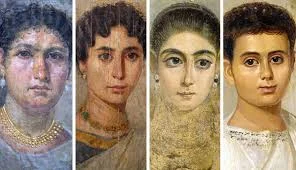
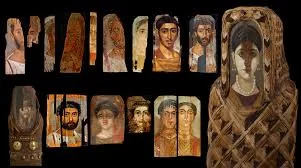
When Rome annexed Egypt (30 BC), mummification continued, but the aesthetic changed dramatically. The traditional idealized mummy mask gave way to the Fayum Mummy Portraits.
These are wooden boards painted with hot wax (encaustic) placed over the mummy's face. Unlike the generic golden faces of pharaohs, these portraits are:
- Hyper-Realistic: They show real people with distinct features, hairstyles, jewelry, and even sadness in their eyes.
- The Window to the Soul: They are some of the only surviving examples of realistic painting from the ancient world, staring back at us across 2,000 years with haunting humanity.