Chronological & Historical Context
King Qa'a was the seventh and final ruler of Egypt's First Dynasty. His reign marked the culmination of the early dynastic period, characterized by stability, prosperity, and impressive architectural achievements.
- Reign: Approximately 2910 – 2880 BC (circa 26–33 years).
- Dynasty: 1st Dynasty, seventh and last pharaoh.
- Significance: Long, stable reign; builder of the largest First Dynasty tomb; formalized the Nebty title; peacefully transitioned to the Second Dynasty.
- Predecessor: Semerkhet (the usurper).
- Successor: Hotepsekhemwy (first king of the 2nd Dynasty).
Name, Titles, and Identity
🔹 Horus Name: Hor-Qa'a
The king's Horus name is composed of the falcon (Hor) and the word Qa'a, meaning "raised arm" or "uplifted arm."
➡️ Interpretation: "The raised arm" — a gesture symbolizing power, protection, and kingship.
🔹 Alternative Names and Variants
- Qaa, Ka'a, Qáa: Variant spellings.
- Nebty Name (Two Ladies): Nebty-Sen — "Kissed by the Two Ladies" (Nekhbet and Wadjet). This is one of the earliest known uses of the Nebty title as a separate royal name.
- Abydos King List: Appears as Qa'a.
- Saqqara King List: Appears as Qebehu or Qebeh (slightly corrupted).
- Turin King List: Damaged, but a fragment seems to preserve part of his name.
- Manetho: Recorded as Bieneches, with a reign of 26 years.
Egypt Before Qa'a
By the time Qa'a ascended the throne, Egypt had been unified for over two centuries. The First Dynasty had seen periods of both stability and turmoil, with the controversial reign of Semerkhet preceding Qa'a's accession.
- Predecessors: Narmer, Hor-Aha, Djer, Djet, Den, Anedjib, and Semerkhet.
- State of the Realm: Egypt was a mature centralized state with a developed bureaucracy, established royal cults, and extensive trade networks.
- Challenges: The usurpation of Semerkhet had created political tension, but Qa'a appears to have restored stability and legitimacy.
Reign & Major Events
Qa'a's reign was one of the longest and most prosperous of the First Dynasty, marked by religious festivals, building projects, and administrative efficiency.
📅 Recorded Events
- Hed-sed Festival: Qa'a celebrated the Heb-sed (jubilee festival), traditionally marking 30 years of rule—strongly supporting a long reign.
- Religious Festivals: Numerous feasts were recorded on year labels, indicating active religious patronage.
- Royal Building Projects: He commissioned the construction of palaces and religious structures.
- Censuses: Year labels record cattle counts and other administrative events.
🌍 Trade & Economy
- Imported Materials: Lapis lazuli from Afghanistan, turquoise from Sinai, and other exotic materials.
- Stone Vessels: Hundreds of fine stone vessels, many imported, attest to extensive trade networks.
- Sinai Expedition: A rock inscription at Wadi Maghara confirms expeditions to the turquoise mines.
- Economic Prosperity: The wealth of his tomb reflects a flourishing economy.
The Formalization of the Nebty Title
Qa'a made a significant contribution to the evolution of the Egyptian royal titulary by formalizing the Nebty (Two Ladies) name as a separate royal title.
- Nebty-Sen: "Kissed by the Two Ladies" — referring to Nekhbet (vulture goddess of Upper Egypt) and Wadjet (cobra goddess of Lower Egypt).
- Significance: This title emphasized the king's role as the ruler of both Upper and Lower Egypt, unifying the Two Lands under divine protection.
- Legacy: The Nebty title would become a permanent and essential part of the royal titulary for all future Egyptian pharaohs.
Family and Royal Lineage
Qa'a's family connections are not as clearly documented as some of his predecessors, but the following is known:
- Father: Most likely Semerkhet, his immediate predecessor. The succession appears to have been peaceful.
- Mother: Possibly Queen Semat (who was likely Semerkhet's wife), though not definitively proven.
- Consort/Wives: At least one queen, possibly named Qa'a-nebti (name appears on a few artifacts).
- Successor: Hotepsekhemwy, who became the first king of the Second Dynasty. The transition was peaceful, though the familial link between the dynasties is unknown.
Other Attestations
Qa'a is widely attested across Egypt, demonstrating the reach and organization of his administration:
- Saqqara Mastabas: High officials who served under Qa'a were buried in large mastaba tombs at Saqqara, containing seal impressions bearing his name.
- Year Labels: Over 30 different year labels have been discovered, recording specific events of each year of his reign—an unusually high number confirming his long rule.
- Stone Vessels: A large cache of stone vessels inscribed with his name was found at Abydos, Saqqara, and as far south as Elephantine.
- Sinai Inscription: A rock inscription at Wadi Maghara bearing his name confirms expeditions to the turquoise mines.
- Copper Statues: A famous pair of copper statues (now lost) was said to have been found in his tomb, representing him in a ritual pose.
Governance & Administration
Qa'a's reign was characterized by efficient administration and a well-organized central government:
- Centralized Bureaucracy: The king maintained a network of officials, scribes, and nomarchs who managed the state's affairs.
- Taxation & Tribute: The agricultural estates and taxation system were well-managed, ensuring a steady flow of resources to the crown.
- Record Keeping: The numerous year labels and seal impressions indicate a sophisticated system of record keeping.
- Royal Estates: The crown controlled vast agricultural estates that supported the court and funded building projects.
Religion & Ideology
Qa'a's religious policies reinforced the divine status of the king and the unity of the Two Lands:
- Horus Cult: His Horus name "Qa'a" emphasizes his connection to the falcon god, reinforcing divine kingship.
- Nebty Title: The "Two Ladies" (Nekhbet and Wadjet) underscored the unity of Upper and Lower Egypt under his rule.
- Funerary Cult: His massive tomb at Abydos and the accompanying cult enclosure demonstrate the importance of the royal funerary cult.
- Religious Festivals: He celebrated numerous religious feasts, including the Hed-sed jubilee, reinforcing his role as the intermediary between the gods and the people.
Key Artifacts of Qa'a
Several significant artifacts from Qa'a's reign have survived, providing insight into his rule and the material culture of the First Dynasty:
- Year Labels: Over 30 commemorative plaques recording annual events such as religious festivals, censuses, and building projects.
- Stone Vessels: Hundreds of fine stone vessels, many imported, bearing his name.
- Cylinder Seals: Found at multiple sites, bearing his name and titles.
- Sinai Rock Inscription: At Wadi Maghara, confirming his expedition to the turquoise mines.
- Copper Statues: A famous pair (now lost) representing him in a ritual pose.
- Furniture & Game Boards: Fragments found in his tomb, indicating the wealth and sophistication of his court.
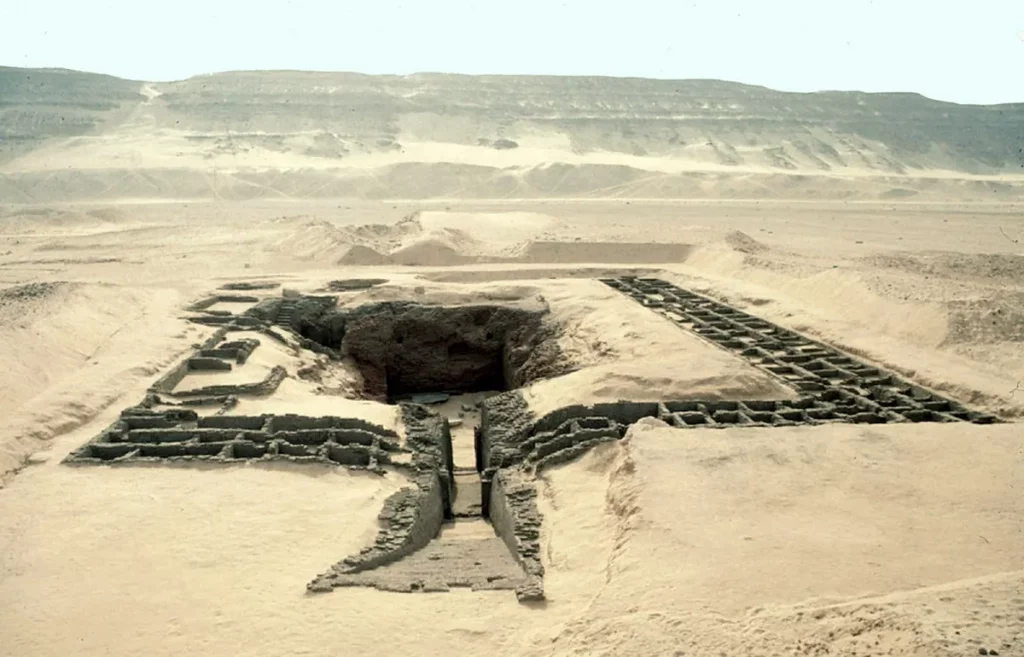
Tomb & Burial: Tomb Q at Abydos
Qa'a's tomb is considered the finest and most ambitious royal tomb of the First Dynasty, a testament to his wealth, power, and organizational ability.
📐 Architecture
- Location: Umm el-Qa'ab, Abydos.
- Tomb Designation: Tomb Q.
- Dimensions: Approximately 30 × 23 meters — one of the largest tombs of the dynasty.
- Structure: A large, rectangular, brick-lined pit divided into multiple chambers.
- Roofing: Sophisticated wooden roofing system with internal mudbrick partitions.
- Burial Chamber: Surrounded by a complex of storage rooms for funerary goods.
🏺 Findings & Significance
- Subsidiary Burials: Over 50 smaller graves of retainers, servants, and possibly animals — though the practice was in decline.
- Hundreds of Stone Vessels: Many imported, attesting to extensive trade networks.
- Ivory & Ebony Labels: With year inscriptions recording events of his reign.
- Cylinder Seals & Copper Tools: Bearing his name.
- Cult Enclosure: A separate funerary chapel built nearby for the mortuary cult.
- Legacy: Tomb Q served as a model for later funerary architecture.
Art in the Age of Qa'a
The art of Qa'a's reign represents the high point of First Dynasty craftsmanship, with a focus on royal iconography and titulary:
- Relief Carving: Fine raised relief work on stone vessels and labels.
- Inscriptions: Well-executed hieroglyphs, demonstrating the maturity of the writing system.
- Iconography: The king is often depicted with the Horus falcon and the Two Ladies (Nekhbet and Wadjet).
- Craftsmanship: The copper statues (now lost) and stone vessels reflect a high level of skill and artistic sophistication.
- Foreign Influences: Imported materials and vessel styles indicate cultural and trade connections with neighboring regions.
Legacy & Transition to the Second Dynasty
Qa'a holds the significant historical position of being the last king of the First Dynasty, and his legacy is overwhelmingly positive and enduring:
- Peak of the First Dynasty: His reign represented the culmination of the administrative, artistic, and architectural achievements of the First Dynasty.
- Architectural Achievement: His tomb (Tomb Q) is considered the finest and most ambitious royal tomb of the dynasty, serving as a model for later funerary architecture.
- Consolidation of Royal Titulary: He formalized the use of the Nebty (Two Ladies) name as a separate royal title, a practice that would become standard in all future dynasties.
- Peaceful Succession: He ensured a smooth transition to the Second Dynasty, avoiding the chaos that had marked Semerkhet's reign.
- Historical Recognition: Unlike Semerkhet, Qa'a was universally recognized as a legitimate king. His name appears prominently on both the Saqqara and Abydos King Lists.
📌 Comprehensive Summary
👑 Name: Qa'a (Hor-Qa'a — The raised arm)
🕰️ Era: Early Dynastic Period (c. 2910 – 2880 BC)
🏛️ Dynasty: 1st Dynasty, 7th & Last Pharaoh
🏛️ Key Title: Nebty-Sen ("Kissed by the Two Ladies")
🪨 Greatest Legacy: Tomb Q at Abydos — the largest and finest First Dynasty tomb
👪 Family: Father Semerkhet → Successor Hotepsekhemwy
⚰️ Burial: Tomb Q, Umm el-Qa'ab, Abydos