Definition & Origins
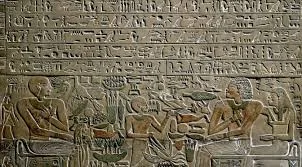
The Pyramid Texts are the earliest known corpus of ancient Egyptian religious texts. Carved directly onto the subterranean walls and sarcophagi of pyramids during the Old Kingdom, they predate the Bible, the Vedas, and the Quran by thousands of years.
| Time Period | Old Kingdom (c. 2400–2300 BCE) |
|---|---|
| First Appearance | Pyramid of King Unas (5th Dynasty) |
| Location | Saqqara Necropolis |
| Purpose | Guiding the King's soul to the eternal sky |
The Age of Pyramids
These texts appear exclusively in the pyramids of kings and queens from the late 5th Dynasty (Unas) to the 8th Dynasty (Ibi). Before this, the walls of the great pyramids (like those at Giza) were famously blank. The decision to carve spells into stone marked a shift in religious thought, ensuring the king's magical protection would last as long as the stone itself.
Magical Function
The texts were not meant to be read by the living; they were "activated" by the presence of the mummy. Their functions were threefold:
- Protection: Warding off snakes, scorpions, and demons in the dark tomb.
- Resurrection: Calling upon the soul (Ba) to reunite with the body (Khat).
- Ascension: Providing the "password" for the king to ascend to the sky and become an imperishable star.
Cosmic Theology
The texts reveal a complex worldview centered on the divinity of the King. Unlike commoners, the King was not destined to stay in the underworld but to join his father Ra in the sky. The texts emphasize Ma'at (Cosmic Order) and the power of the spoken word (Heka) to overcome death.
Destinations of the Soul
The texts describe conflicting destinations, showing that Egyptian theology was evolving:
- Stellar: The King becomes an "Imperishable Star" in the northern sky (circumpolar stars that never set).
- Solar: The King joins Ra in his solar barque to travel across the heavens eternally.
- Osirian: The King enters the Duat (Underworld) to rule as Osiris.
The Utterances
The texts are divided into "Utterances" (spells), each beginning with the phrase Djed Medu ("Words to be spoken"). There is no single narrative; rather, they are a compilation of rituals, hymns, and magical incantations arranged by location within the tomb (burial chamber, antechamber, corridor).
The Blue Script
The texts are written in Old Egyptian, an archaic form of the language. In the Pyramid of Unas, the hieroglyphs are painted a vibrant Blue (the color of water and the heavens). This symbolized that the texts were alive with the regenerative power of the primeval waters (Nun) and the sky, creating a magical environment for the king's rebirth.
Key Deities
The texts provide the earliest written evidence for many major gods:
- Atum: The creator who rose from the waters.
- Osiris: The prototype of the dead king.
- Nut: The sky goddess who swallows and rebirths the king/star.
- Seth: Who appears as a helper of Ra (ladder to the sky) before his later villainization.
Evolution of Funerary Texts
The Pyramid Texts were the ancestor of all later Egyptian religious literature. In the Middle Kingdom, they evolved into the Coffin Texts (available to nobles), and in the New Kingdom, they became the Book of the Dead. This process, known as the "Democratization of the Afterlife," eventually allowed every Egyptian access to the spells once reserved only for kings.
Legacy of Stone
The Pyramid Texts are significant not just for religion, but for human history. They represent humanity's first attempt to defeat death through the written word. They show a civilization grappling with mortality and constructing a complex, poetic, and magical reality to ensure that life continues beyond the grave.
Encyclopedia Summary
| Subject | Oldest Religious Texts |
|---|---|
| Location | Saqqara Pyramids (Unas, Teti, Pepi) |
| Key Spell | The Cannibal Hymn |
| Color | Blue (Symbolizing Water/Sky) |
| Goal | Ascension to the Stars/Gods |