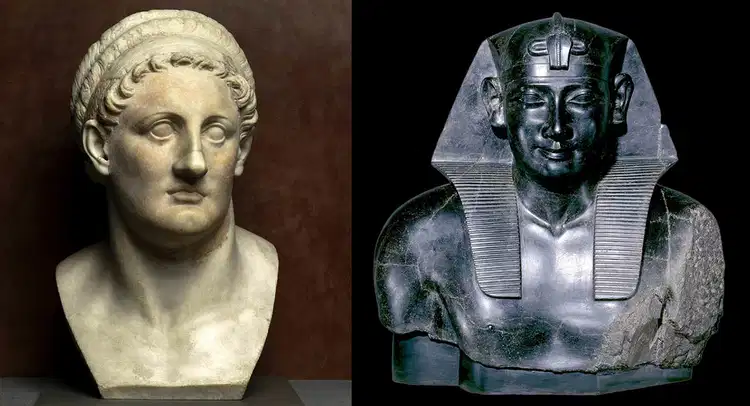
Ptolemy I Soter
The general who became pharaoh and founded a dynasty of knowledge.
(Ptwlmys — Ptolemy)
🕰️ Reign
305 – 282 BC
📚 Legacy
🏛️ Dynasty
Ptolemaic (Founder)
👑 Title
Soter ("Savior")
Chronological & Historical Context
Ptolemy I Soter was a Macedonian Greek general under Alexander the Great who, after Alexander's death, seized control of Egypt. He founded the Ptolemaic Dynasty, which would rule Egypt for nearly 300 years, and established the legendary Library of Alexandria, transforming the city into the intellectual capital of the ancient world.
- Reign as King: 305 – 282 BC.
- Reign as Ruler: 323 – 282 BC (as satrap and then king).
- Dynasty: Ptolemaic (Lagid) Dynasty – Founder.
- Significance: Founded a 300-year dynasty and created the ancient world's greatest center of learning.
- Predecessor: Alexander IV of Macedon.
- Successor: Ptolemy II Philadelphus.
Name, Titles, and Identity
🔹 Greek Name: Πτολεμαῖος Σωτήρ
Ptolemaîos Sōtḗr, meaning "Ptolemy the Savior." The epithet Soter ("Savior") was awarded for his aid to the people of Rhodes.
➡️ Interpretation: "Ptolemy the Savior" — a title that reflected his role as a protector and benefactor.
🔹 Egyptian Pharaonic Titulary
- Horus Name: Wer-pehty-nesu-qeny — "Great of strength and brave king."
- Nebty Name: Itji-em-sekhem-heqa-tjel — "Who has seized with his own power, the ruler of Sile."
- Prenomen: Setepenre-meryimen — "Chosen by Ra and beloved of Amun."
- Nomen: Ptwlmys — "Ptolemy."
- Dynasty Name: The dynasty is also known as the Lagid dynasty, after Ptolemy's father, Lagus.
Early Life & Rise to Power
Ptolemy's journey from Macedonian nobleman to pharaoh of Egypt is one of the most remarkable stories of the ancient world.
⚔️ Early Life & Alexander's General
- Birth: c. 367/366 BC in Eordaea, Macedon, Greece.
- Father: Lagus, a Macedonian nobleman.
- Mother: Arsinoe of Macedon.
- Connection to Alexander: Ptolemy was a close friend and one of Alexander the Great's most trusted generals.
- Role in Conquests: He fought alongside Alexander and played a key role in his campaigns.
🏛️ Satrap & King
- Satrap of Egypt (323 BC): After Alexander's death, Ptolemy was appointed satrap (governor) of Egypt, which he quickly claimed as his own kingdom.
- Securing Egypt: He defended Egypt against attacks from rival generals like Antigonus.
- Proclaiming Kingship (305 BC): On November 7, 305 BC, Ptolemy openly declared himself king of Egypt, founding the Ptolemaic dynasty.
- The Title "Soter": In 304 BC, the Rhodians awarded him the divine title Soter ("Savior") for his aid against a siege.
Reign and Policies (305–282 BC)
Ptolemy ruled Egypt for nearly 40 years, focusing on consolidation, cultural integration, and economic development.
⚖️ Governance & Consolidation
- Long Reign: He ruled Egypt for nearly 40 years (323–285 BC as ruler, and 305–282 BC as king).
- Strategic Focus: Instead of endless wars to control all of Alexander's empire, Ptolemy focused on securing and expanding his own kingdom.
- Territorial Expansion: Used military campaigns, strategic alliances, and marriages to expand his influence over Cyprus, Phoenicia, and parts of Greece.
🛐 Cultural & Religious Policies
- Respecting Egyptian Culture: Ptolemy blended Greek and Egyptian peoples and religions, respecting local traditions.
- Cult of Serapis: Established the cult of the god Serapis, a new deity combining Greek (Zeus, Hades) and Egyptian (Osiris, Apis) beliefs.
- Coinage: Introduced a system of coinage to regulate Egypt's financial affairs, which had previously operated largely on a barter system.
The Foundation of the Library of Alexandria
Ptolemy I Soter's most profound and lasting legacy is his patronage of the arts and sciences, which culminated in the founding of the Library of Alexandria.
📚 The Vision
- Universal Library: Envisioned as a universal library aimed at collecting all the books in the world.
- The Museum (Mouseion): The Library was part of a larger research institute known as the Museum, a temple dedicated to the Muses, which functioned as a center for scholarly research.
- The Advisor: The idea may have been proposed to Ptolemy by Demetrius of Phaleron, an exiled Athenian statesman and scholar.
🧠 A Center of Learning
- Greatest Minds: The Library attracted the greatest scholars of the ancient world.
- Scale: It is estimated to have employed over 100 scholars at its height and housed hundreds of thousands of scrolls.
- Impact: It became the capital of knowledge and learning in the ancient world, influencing fields from mathematics to astronomy to medicine.
The Cult of Serapis
To unify his Greek and Egyptian subjects, Ptolemy established the cult of the god Serapis, a new deity that combined elements of Greek and Egyptian religious traditions.
- Syncretic Deity: Serapis combined aspects of Greek gods (Zeus, Hades, Dionysus) with Egyptian gods (Osiris, Apis).
- Religious Unity: The cult was designed to appeal to both Greek and Egyptian populations, fostering a shared religious identity.
- Iconography: Serapis was depicted with Greek-style curly hair and beard, wearing a modius (a grain measure) on his head, and holding a scepter.
- Serapeum: A grand temple to Serapis was built in Alexandria, which became one of the city's most important religious centers.
- Enduring Worship: The cult of Serapis continued throughout the Ptolemaic period and into the Roman era.
Family and Royal Lineage
Ptolemy's family connections were crucial to establishing the legitimacy and continuity of his dynasty.
- Father: Lagus, a Macedonian nobleman (the dynasty is also known as the Lagid dynasty).
- Mother: Arsinoe of Macedon.
- Wives:
- Eurydice — daughter of Antipater, regent of Macedon.
- Berenice I — his most influential wife; she became queen and mother of his successor.
- Children:
- Ptolemy II Philadelphus — son with Berenice I; succeeded his father.
- Arsinoe II — daughter with Berenice I; later married her brother Ptolemy II.
- Ptolemy Ceraunus — son with Eurydice; later became king of Macedon.
- Other children including Lysandra, Ptolemais, and Philotera.
- Successor: Ptolemy II Philadelphus, who continued his father's policies and expanded the Library.
Other Attestations
Ptolemy I Soter is attested through a variety of historical, archaeological, and literary sources.
- Historical Accounts: Mentioned by ancient historians including Diodorus Siculus, Arrian, and Plutarch.
- Egyptian Monuments: His pharaonic titles appear on Egyptian monuments, showing his acceptance as a legitimate ruler.
- Coinage: His image appears on coins minted during his reign, depicting him as a Greek king with diadem.
- Surviving Works: Ptolemy himself wrote a history of Alexander's campaigns, though it survives only in fragments quoted by later authors.
- Alexandria's Archaeology: Archaeological remains of Ptolemaic Alexandria, including parts of the Serapeum, attest to his building projects.
Governance & Administration
Ptolemy established a sophisticated administrative system that blended Greek and Egyptian traditions and would serve as the foundation for his dynasty's rule.
- Greek Administration: He imported Greek administrators and military commanders to fill key positions.
- Egyptian Bureaucracy: He retained the existing Egyptian system of nomarchs and local officials, adapting it to his needs.
- Coinage System: Introduced a standardized coinage system to facilitate trade and tax collection.
- Royal Estates: Controlled vast agricultural estates that generated revenue for the crown.
- Taxation: Established a comprehensive system of taxation and tribute to support the state.
Religion & Ideology
Ptolemy's religious policies were central to his strategy of unifying his Greek and Egyptian subjects.
- Pharaonic Legitimacy: He adopted Egyptian royal titulary and participated in traditional Egyptian religious rituals.
- Serapis Cult: The creation of Serapis was a masterstroke of religious syncretism, blending Greek and Egyptian beliefs.
- Greek Gods: He also patronized Greek gods, including Zeus, Athena, and Apollo, to maintain ties with the Greek world.
- Divine Kingship: Like the pharaohs before him, Ptolemy associated himself with divine power, adopting the Egyptian concept of kingship.
Key Artifacts of Ptolemy I
Several significant artifacts from Ptolemy's reign have survived, providing insight into his rule and legacy.
- Ptolemaic Coinage: Gold and silver coins bearing his image and title Soter.
- Egyptian Monuments: Inscriptions and reliefs at various sites showing him in traditional pharaonic attire.
- Serapeum Reliefs: Fragments of reliefs from the Serapeum depicting Serapis and Ptolemaic rulers.
- Surviving Papyri: Administrative papyri from his reign that shed light on the economic and social life of Ptolemaic Egypt.
- Statue of Ptolemy: A marble statue of Ptolemy I Soter, now in the Vatican Museums.
Death and Burial
Ptolemy I Soter died in January 282 BC at the age of 86 or 87, after a long and successful reign.
- Death: January 282 BC, in Alexandria, Egypt.
- Age: 86 or 87 years old — an exceptionally long life for the time.
- Burial Site: Likely in the royal necropolis of the Ptolemaic dynasty in Alexandria.
- Deification: After his death, the Egyptians raised him to the level of a god.
- Succession: He was succeeded by his son, Ptolemy II Philadelphus, who continued his father's policies.
Legacy
Ptolemy I Soter's legacy is one of the most enduring in Egyptian history, spanning nearly 300 years of Ptolemaic rule and leaving an indelible mark on world culture.
- Founder of the Ptolemaic Dynasty: He established a dynasty that ruled Egypt until the death of Cleopatra VII in 30 BC.
- Library of Alexandria: He founded the greatest library of the ancient world, which became a symbol of knowledge and learning.
- Cultural Synthesis: His policy of blending Greek and Egyptian cultures created a unique Hellenistic civilization in Egypt.
- Economic Innovation: His introduction of coinage and financial reforms helped stabilize the Egyptian economy.
- Religious Syncretism: The cult of Serapis, which he established, endured for centuries and influenced later religious developments.
- Architectural Legacy: He transformed Alexandria into a magnificent city, the greatest of the Hellenistic world.
📌 Comprehensive Summary
👑 Name: Ptolemy I Soter (Πτολεμαῖος Σωτήρ — Ptolemy the Savior)
🕰️ Era: Hellenistic Period (305 – 282 BC)
🏛️ Dynasty: Ptolemaic (Lagid) Dynasty — Founder
📚 Greatest Legacy: Founded the Library of Alexandria and the Ptolemaic Dynasty
👪 Family: Father Lagus → Wives Eurydice & Berenice I → Son Ptolemy II Philadelphus
⚰️ Burial: Royal necropolis of the Ptolemaic dynasty, Alexandria