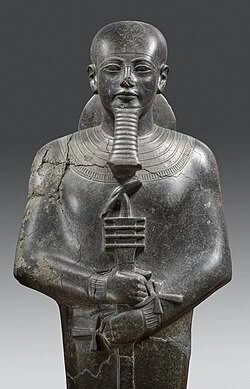
Ptah is one of the oldest and most philosophically significant gods of ancient Egypt. His name carries the essence of creation through craftsmanship.
Ancient Egyptian Name
𓊪𓏏𓎛 (Ptḥ)
Phonetic Pronunciation
P'-tah
Possible Meanings
"The Opener" or "The Sculptor"
Cosmic Identity
The Great Architect / Divine Intellect
His name likely refers to the act of "opening" the mouth of creation or "opening" the material to give it form, a direct link to the sculpture and architecture he patronized.
Ptah originated in Memphis (Men-nefer), the ancient capital of Egypt established at the junction of Upper and Lower Egypt.
Lord of Memphis: He was the primary deity of the capital city, which was considered the intellectual heart of the nation.
The Temple of Ptah: Known as Hwt-ka-Ptah (House of the Spirit of Ptah), the name of this temple gave rise to the Greek word Aigyptos, which became the modern name Egypt.
03 The Logos: Creation Through Mind
The Memphite Theology (recorded on the Shabaka Stone) presents one of the most sophisticated creation myths in human history, predating later philosophical concepts of the "Logos."
Mind → Word → Matter
The Heart (Mind): Creation began as a thought within Ptah's heart. He conceived the universe intellectually before it existed.
The Tongue (Speech): By speaking the names of things, Ptah brought them into physical reality.
Unified Purpose: "Everything that exists came into being through what the heart thought and the tongue commanded."
04 Unified Creation
Ptah did not compete with Atum or Ra; he provided the "intellectual blueprint" for their actions. He was often described as the "Heart and Tongue of the Ennead."
05 Master of the Abyss
In Memphite belief, Nun (the primordial waters) was the "raw material." Ptah organized the chaos into a structured world. Creation was an act of Engineering.
The Apis Bull was worshipped as the living manifestation of Ptah's soul (Ka) on earth. Upon death, the bulls were mummified and buried in the Serapeum at Saqqara.
06 The Memphite Triad
Ptah presided over a powerful divine family in Memphis:
Ptah: The Father and Architect.
Sekhmet: The fierce lioness goddess (his consort).
Nefertum: The god of the blue lotus (their son).
07 Iconography & Appearance
Mummiform Man: Shown wrapped in a tight shroud.
Skullcap: He wears a close-fitting blue skullcap.
Composite Scepter: Combining the Ankh, Djed, and Was.
Green/Blue Skin: Symbolizing fertility and renewal.
A deity representing the cycle of creation, death, and resurrection. This combined god was vital in funerary rituals to ensure the soul was "re-sculpted."
09 The Opener of Mouths
Ptah was the patron of the ritual performed on statues and mummies to "activate" them, allowing the soul to breathe and speak in the afterlife.
10 The Artisan's Refuge
In the village of Deir el-Medina, Ptah was beloved as a personal god—the "God who hears prayers" for every working craftsman.