Basic Identity
Psusennes I (Egyptian: Pasebakhaenniut) was the third king of the 21st Dynasty and ruled from Tanis for roughly 46 years, one of the longest reigns in the Third Intermediate Period. He is unique because his tomb was found intact, filled with treasures that rival—and in some ways surpass—those of Tutankhamun.
| Name Meaning | “The Star Appearing in the City” |
|---|---|
| Dynasty | 21st Dynasty (Third Intermediate Period) |
| Reign | c. 1047–1001 BCE (Approx. 46 Years) |
| Capital | Tanis (Lower Egypt) |
The Silver King
Psusennes I is historically vital for strengthening royal authority in Lower Egypt while maintaining a delicate balance with the powerful High Priests of Amun in Thebes. He proved that Egypt could still amass incredible wealth even without an empire, leaving behind a burial so rich he is often called "The Silver Pharaoh," as silver was rarer and more valuable than gold in ancient Egypt.
Priest & King United
He was the son of Pinedjem I, the High Priest of Amun, and Henuttawy, a daughter of Ramesses XI. This lineage perfectly fused the royal and priestly bloodlines, granting him undeniable legitimacy. Ascending the throne after Amenemnisu, his long reign brought stability and formalized the "dual power" system between Tanis and Thebes.
Two Powers, One Peace
While Psusennes I ruled Lower Egypt from Tanis, his brother and later his nephew served as High Priests of Amun in Upper Egypt. Instead of civil war, Psusennes I used family ties and marriage alliances to maintain peace. He shared titles and wealth with the priesthood, choosing diplomacy over domination to keep Egypt united in spirit if not in administration.
Wealth Without Empire
Psusennes I conducted no major military campaigns, yet his reign was incredibly wealthy. This prosperity came from the fertile agriculture of the Delta and the immense stored wealth of the temples. Egypt turned inward, isolated but secure. The richness of his tomb proves that even in a period of "decline," the pharaohs commanded vast resources.
The Miracle Discovery
In 1940, French archaeologist Pierre Montet discovered Psusennes I's tomb (NRT III) at Tanis. Unlike the tombs in the Valley of the Kings, this one was untouched by robbers. Inside the damp limestone chamber lay a sarcophagus of pink granite (reused from Merneptah), containing a black granite sarcophagus, which held a solid silver coffin—a masterpiece of ancient art.
Gold & Silver Splendor
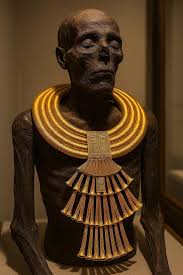
The treasures of Psusennes I rival those of Tutankhamun. He wore a magnificent gold funerary mask (though thicker and less idealized than Tut's) and was covered in jewelry including gold finger stalls, broad collars, and lapis lazuli pectorals. The use of a solid silver coffin was significant because silver had to be imported and was considered the "bones of the gods," implying immense sanctity and wealth.
The Reclaimed King
Due to the humid conditions of the Delta, Psusennes I's mummy was poorly preserved, reduced mostly to a skeleton. However, analysis shows he died at an advanced age, suffering from severe arthritis and bad teeth. His death marked the end of a long era of stability, though his dynasty continued peacefully under his successor, Amenemope.
The Two Treasures
| Feature | Tutankhamun | Psusennes I |
|---|---|---|
| Location | Valley of the Kings (South) | Tanis (North) |
| Primary Metal | Gold ("Flesh of Gods") | Silver ("Bones of Gods") |
| Discovery | 1922 (Howard Carter) | 1940 (Pierre Montet) |
| Fame | Global Icon | Scholarly Gem |
📌 Visitor-Friendly Summary
Psusennes I was the pharaoh who ruled quietly—but was buried like a god. His silver tomb rivals the greatest legends of Egypt.
👑 Key Title: The Silver Pharaoh
🏙️ Legacy: The Royal Necropolis of Tanis
✨ Treasure: The Solid Silver Coffin