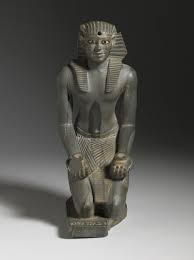
Basic Identity
Pepi I (also Pepy I) was the third king of the Sixth Dynasty. His long reign of nearly 50 years marked the last great flourishing of the Old Kingdom before its eventual decline. He is celebrated for his military campaigns, extensive building projects, and the unique copper statues that bear his likeness.
| Throne Name | Meryre (“Beloved of Ra”) |
|---|---|
| Titles | King of Upper & Lower Egypt, Son of Ra |
| Dynasty | Sixth Dynasty (Old Kingdom) |
| Reign | c. 2332–2283 BCE (Approx. 50 Years) |
The Restorer
Pepi I is historically significant for restoring central authority after the assassination of his father, Teti. He managed to curb the rising power of the nobility through strategic marriages and military strength, delaying the fragmentation of the state.
A Fragile Succession
He succeeded the short-lived Userkare (who may have been a usurper) and was followed by his son Merenre I. His father was Teti, and his mother was Queen Iput I. His accession required the suppression of internal dissent to secure the dynasty's future.
The Harem Conspiracy
Early in his reign, Pepi I faced a serious threat: a conspiracy in the royal harem involving a queen named Weret-yamtes. The plot was discovered and investigated by his loyal official Weni the Elder. Pepi's decisive action in punishing the conspirators demonstrated his determination to rule with an iron fist.
Strategic Alliances
To secure the loyalty of the powerful provincial nobility, Pepi I married two sisters from a prominent family in Abydos: Ankhesenpepi I and Ankhesenpepi II. Their father, Khui, became a key ally. These marriages integrated the southern elite into the royal family, a move that both strengthened and eventually weakened the monarchy.
Balancing Power
Pepi I expanded the administration, appointing capable officials like Weni. However, he also allowed regional governors (Nomarchs) to build lavish tombs in their own provinces rather than near the king's pyramid. This concession to local power helped maintain peace but eroded the god-king's absolute centrality.
Expeditions of Weni
Under the command of Weni the Elder, Egyptian armies launched multiple campaigns into the Sinai and southern Palestine ("Land of the Sand-Dwellers") to protect trade routes and punish bedouin raiders. Pepi also sent expeditions deep into Nubia to secure stone quarries and mercenaries.
Global Connections
His reign saw vibrant trade. Expeditions were sent to Byblos (Lebanon) for cedar and to Punt for exotic goods. Inscriptions bearing his name have been found as far away as Ebla in Syria, proving the extensive reach of Egypt's economic influence.
Devotion to the Gods
Pepi I was a prolific builder of temples. He founded chapels for Ra, Osiris, and local deities like Min (at Coptos) and Hathor (at Dendera). His piety was a tool of statecraft, reinforcing his image as the divinely appointed guarantor of Ma'at.
Men-nefer-Pepi
He built his pyramid at South Saqqara. It was named Men-nefer-Pepi ("Enduring is the Perfection of Pepi"). This name eventually came to refer to the entire capital city, which the Greeks later called Memphis.
Symbolic Construction
Like Teti's, his pyramid was of modest size (52m) with a rubble core. While the exterior has collapsed, the substructure is rich with texts. The focus was on the magical function of the tomb rather than its physical scale.
Elaborate Spells
The interior walls are covered with green-painted Pyramid Texts. Pepi's version is more extensive than his predecessors', containing new spells for transforming into a swallow or falcon, reflecting a developing theology of the soul's mobility (Ba).
The Royal Cluster
Pepi I broke with tradition by building separate small pyramids for his queens (Ankhesenpepi I, II, etc.) adjacent to his own complex. This "family cluster" emphasized the importance of the royal lineage and the elevated status of his wives.
The Price of Loyalty
To ensure loyalty, Pepi exempted many temple estates from taxes (by royal decree). While this secured religious support in the short term, it reduced the crown's revenue base, contributing to the long-term economic weakening of the central state.
Provincial Style
Art from his reign shows a shift. While royal workshops still produced high-quality work (like the copper statues), provincial tombs began to display a distinct, less refined "local style." This artistic divergence mirrored the political fragmentation beginning to take root.
The Bridge
Pepi I is remembered as the last truly strong king of the Old Kingdom. He successfully held the forces of decentralization at bay for 50 years. His name, "Men-nefer," lives on in the name of Egypt's ancient capital, Memphis.
The End of an Era
His reign represents the "Indian Summer" of the pyramid age—a time of glory and expansion that masked the structural cracks in the state. After him, the slide into the First Intermediate Period became inevitable.
📌 Comprehensive Summary
👑 Name: Pepi I (Beloved of Ra)
🕰️ Era: 6th Dynasty (Old Kingdom)
⚔️ Key Achievement: Copper Statues & Military Campaigns
🪨 Monument: Pyramid at Saqqara (Memphis)