Nun
The primordial ocean of chaos and the source of all creation.
(Nw / Nun)
01 Name and Pronunciation
Nun (also spelled Nu) is the oldest of the ancient Egyptian gods and the father of the gods. His name is deeply rooted in the concept of the "primeval waters."
| Ancient Egyptian Name | 𓈗𓈖𓅱 (Itn / Nw) |
|---|---|
| Common Transliteration | Nun or Nu |
| Phonetic Pronunciation | Noon |
| Literal Meaning | The Primordial Waters / The Primeval Ocean |
The name itself evokes the silent, heavy, and infinite nature of the water that existed before the first sunrise.
02 Role and Significance
Nun is not a "personal" deity. Unlike Osiris or Isis, he had no dedicated temples or organized cults. Instead, he represents a cosmic state of being.
The State of Potential
- The Primordial State: He is the raw, unformed universe before Ma'at (Order) was established.
- The Chaotic Waters: Represents the "inert" energy that contains all possibilities of life.
- Non-Destructive Chaos: In Egyptian thought, Nun is not "evil." He is the fertile darkness from which all light must emerge.
03 The Void: Nun Before Time
Before the "First Time" (Zep Tepi), the Egyptian cosmos was a void defined only by Nun. In this state, there was:
- No sky to hold the stars.
- No earth to support the feet.
- No sun to mark the passage of hours.
- No gods to govern the living.
04 Creation Myths
While Nun did not "act" as a creator, he provided the medium for creation. Major theological centers integrated him into their origin stories:
The Three Great Traditions
- Heliopolis: The god Atum willed himself into existence from within Nun and rose upon the Benben mound.
- Hermopolis: Nun was the leading male force of the Ogdoad, the eight gods who balanced the primeval forces.
- Memphis: The god Ptah used the "material" of Nun to shape the world through his heart (thought) and tongue (speech).
05 The Ogdoad (The Eight Gods)
In the theology of Hermopolis (Ashmunein), Nun was paired with his female counterpart, Naunet, to represent the primeval waters.
| Concept | Male Deity (Frog) | Female Deity (Snake) |
|---|---|---|
| Primeval Waters | Nun | Naunet |
| Infinity / Eternity | Heh | Hauhet |
| Darkness | Kek | Kauket |
| Hiddenness | Amun | Amaunet |
06 Attributes & Cosmic Symbolism
Nun is the personification of "Primordial Chaos." His nature is defined by four main characteristics:
- Formless: He has no shape until a creator god emerges.
- Boundless: He surrounds the "bubble" of the created universe.
- Timeless: He exists outside the cycles of day and night.
- Latent Power: He holds the seeds of all life, even those not yet created.
7. The Daily Rebirth
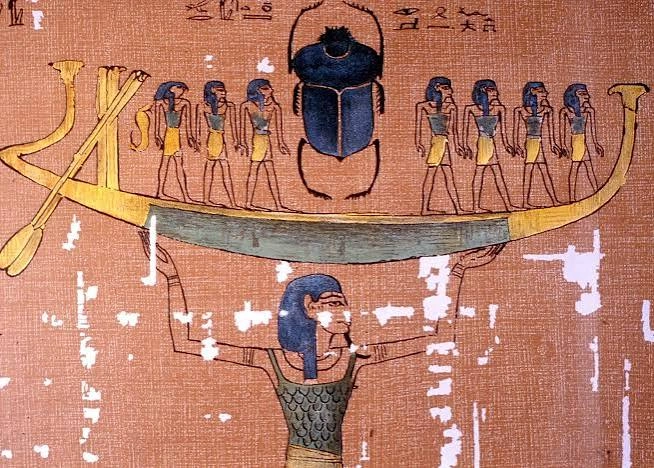
Every night, the sun god Ra travels through the underworld (Duat) and returns to the waters of Nun. This "bath" in the primordial ocean purifies and re-energizes the sun, allowing it to be reborn at dawn. Without Nun, the sun would eventually burn out.
07 Iconography & Art
Nun is rarely depicted as a statue, but in tomb paintings and papyri, he appears with distinct features:
- Blue or Green Skin: Representing the deep water and the fertility it brings.
- Lifting the Barque: He is often shown as a giant man rising from the waist out of the water, holding up the Solar Barque of Ra.
- The Frog-Headed Man: In the context of the Ogdoad, he is depicted with the head of a frog (symbol of water and fertility).
08 Physical Manifestations
Ancient Egyptians believed that Nun still existed beneath the earth. Every "Sacred Lake" in a temple (like the one at Karnak) was considered a physical link to the waters of Nun. Priests would purify themselves in these waters to connect with the source of creation.
09 The Fragility of Existence
Egyptian philosophy taught that the world is a fragile place surrounded by the infinite waters of Nun. If Ma'at (Order) were to fail, the boundaries of the universe would collapse, and Nun would rush back in, dissolving everything back into the original silent darkness.
10 Encyclopedia Summary
Nun is the oldest cosmic principle in Egyptian belief. He is the "Father of the Gods" because he provided the space and matter for their existence. As a symbol of eternity, chaos, and infinite potential, Nun remains the silent background of all Egyptian theology—the source from which all life comes and to which all life may eventually return.