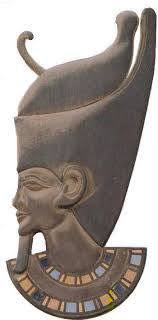
King Narmer
The unifier who joined the Red & White Crowns.
(Nar-Mer)
Chronological & Historical Context
King Narmer stands at the threshold of Egyptian history, bridging the gap between the Predynastic Period and the Early Dynastic Period. He is the figure who transformed Egypt from scattered tribes into a coherent nation-state.
- Reign: Approximately 32nd Century BC.
- Dynasty: Founder of the 1st Dynasty.
- Significance: Marks the beginning of recorded history and the pharaonic state.
Name, Titles, and Identity
🔹 Meaning of "Nar-Mer"
His name is a combination of two hieroglyphs: 𓆟 (Nar), a Catfish, representing aggression and power, and 𓌳 (Mer), a Chisel, representing endurance or pain.
➡️ Interpretation: "He who strikes like a catfish" or "The painful striker," reflecting his role as a warrior king who forcibly united the land.
🔹 The Narmer vs. Menes Debate
- Traditional View: Narmer is the same person as "Menes," whom Manetho lists as the first king.
- Modern View: "Narmer" is the historical conqueror (archaeologically attested), while "Menes" is likely a title meaning "The One who Endures" or refers to his successor, Hor-Aha.
Egypt Before Narmer
Before his reign, the Nile Valley was split into two distinct cultural and political entities:
- Upper Egypt (The South): Centered around Nekhen (Hierakonpolis). Symbolized by the White Crown and the Lotus.
- Lower Egypt (The North/Delta): Centered around Buto. Symbolized by the Red Crown and the Papyrus.
- The era was characterized by local chieftainships and constant warfare for control of resources.
Unification of the Two Lands
The unification (Sema Tawy) was the defining moment of ancient Egyptian history. It was not a diplomatic merger but a military conquest.
Narmer led his southern forces northwards, defeating the chieftains of the Delta. By conquering the north, he created the world's first nation-state with a centralized government, symbolized by his wearing of the Double Crown (Pschent).
The Narmer Palette
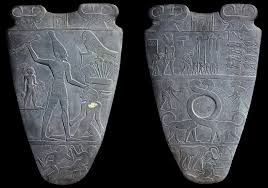
The Narmer Palette: Face A (Left) and Face B (Right)
Discovered in the Temple of Horus at Hierakonpolis, this siltstone palette is arguably the most important artifact from the dawn of history.
▶️ Face A: The Smiting
- Narmer dominates the scene, wearing the White Crown of the South.
- He grasps a northern enemy by the hair and raises a mace to strike—a pose that became the standard icon of pharaonic power.
- Horus (the falcon) holds a captive head emerging from the Delta marshes.
▶️ Face B: The Victory
- Narmer wears the Red Crown of the North, inspecting rows of bound and beheaded enemies.
- Two mythical serpopards (long-necked leopards) intertwine their necks, symbolizing the forced union of Upper and Lower Egypt.
- A bull destroys a walled city at the bottom.
✔ It serves as the "Birth Certificate" of Ancient Egypt.
Wars and Battles
Narmer's military campaigns were primarily internal, aimed at suppressing rebellion in the Delta (Lower Egypt) and consolidating control over the Nile Valley. However, artifacts also suggest campaigns into:
- Nubia: To secure trade routes and mineral resources.
- Canaan (Southern Levant): Pottery shards with his name found in Israel suggest an early Egyptian presence or military outpost there.
Governance & Administration
Narmer did not just conquer; he organized. He established the blueprint for the Egyptian state:
- Divine Kingship: He established the king as the sole intermediary between the gods and the people.
- Centralization: Created a bureaucracy to manage agriculture, taxation, and irrigation projects across the unified land.
- The Nome System: He likely began the division of Egypt into administrative districts (Nomes) governed by local nomarchs loyal to him.
The Capital: Memphis
To rule a unified Egypt, a new capital was needed at the junction of the two lands. Narmer (or his successor) founded Memphis (originally Ineb-Hedj, meaning "The White Wall").
Religion & Ideology
Narmer formalized the concept of Ma'at (Order) vs. Isfet (Chaos). The king's primary duty was to maintain Ma'at by defeating enemies and honoring the gods.
- Horus Connection: The king was identified as the living embodiment of Horus, the falcon god of the sky and kingship.
- Neith: Evidence suggests he also honored Neith, a goddess of war and weaving from the Delta, perhaps to appease his new northern subjects.
Key Artifacts
Beyond the Palette, Narmer left other significant traces:
- Narmer Macehead: A limestone ceremonial mace depicting a religious festival (possibly a Sed festival) and the dedication of booty to the temple.
- Ivory Labels: Found in Abydos, showing early hieroglyphic writing recording events like the "Smiting of the East."
- Baboon Statue: An inscribed statue found in the hidden galleries of Saqqara bearing his name.
Tomb & Burial
Narmer was buried in the royal cemetery of Umm el-Qa'ab at Abydos. His tomb is identified as Tomb B17/B18.
It consists of two mud-brick lined chambers. Though small compared to later pyramids, it contained seal impressions and artifacts that confirm his high status and the beginnings of royal funerary cults.
Art in the Age of Narmer
The art of Narmer's reign set the canon for Egyptian art for the next 3,000 years. Key conventions established include:
- Hieratic Scale: Depicting the king larger than everyone else to show his importance.
- Registers: Organizing scenes in horizontal bands (registers).
- Composite Perspective: Showing the head in profile, shoulders frontally, and legs in profile.
Global Legacy
Narmer is one of the most important figures in human history because he created the world's first territorial state. Before him, societies were city-states or tribes. After him, the concept of a unified "Nation" with defined borders, a central government, and a single ruler became a reality that would influence all future civilizations.
📌 Comprehensive Summary
👑 Name: Narmer (The Striking Catfish)
🕰️ Era: Early Dynastic Period (c. 3200 BC)
⚔️ Greatest Feat: Unification of Upper and Lower Egypt
🪨 Legacy: Founder of the 1st Dynasty & Builder of Memphis