Basic Identity
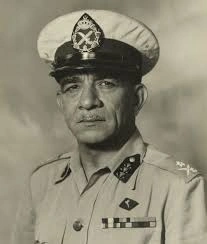
Muhammad Naguib (Arabic: محمد نجيب) was an Egyptian military general and statesman born on 20 February 1901 in Khartoum, Sudan, then part of the Anglo-Egyptian Condominium. He rose to become one of the most distinguished officers in the Egyptian Army, earning decorations in multiple conflicts before assuming his historic role as a revolutionary leader. As the senior figure of the Free Officers movement, Naguib led the Egyptian Revolution of 23 July 1952, which overthrew King Farouk I and dismantled the constitutional monarchy established in 1922. He served consecutively as Chairman of the Revolutionary Command Council, Prime Minister, and ultimately as the first President of the Republic of Egypt, a position he held from 18 June 1953 until his forced removal on 14 November 1954. His tenure, though brief, marked the irreversible transformation of Egypt from a monarchy into a republic and set the stage for the country's modern political identity.
| Name Meaning | Muhammad means "The Praised One" in Arabic, a name of profound religious significance in Islam; Naguib (Najīb) means "Noble," "Gifted," or "Distinguished" — a fitting epithet for a man of remarkable talent and principle. |
|---|---|
| Titles | General of the Egyptian Army; Chairman of the Revolutionary Command Council (July–November 1952); Prime Minister of Egypt (September 1952 – February 1954); President of the Republic of Egypt (June 1953 – November 1954) |
| Era | Modern Egypt – Republic Era. First President of the Egyptian Republic, succeeding the constitutional monarchy of King Farouk I of the Muhammad Ali Dynasty. |
| Presidency Dates | 18 June 1953 – 14 November 1954 (approximately 17 months). As Prime Minister from 7 September 1952, his total time as the dominant political figure of Egypt spanned over two years of revolutionary transition. |
Father of the Egyptian Republic
Muhammad Naguib occupies a singular and irreplaceable position in modern Egyptian history as the man who formally ended centuries of dynastic monarchy and inaugurated the republican era. When the Free Officers launched their revolution on 23 July 1952, it was Naguib's name and military reputation that gave the movement its legitimacy both domestically and internationally. He was the most senior and most decorated officer among the conspirators, and his willingness to stand at the forefront of the uprising persuaded the Egyptian public and foreign governments that this was not merely a coup but a genuine national transformation. As Prime Minister and later President, Naguib sought to steer Egypt toward a constitutional democracy with free elections, civilian oversight of the military, and a respect for political parties — a vision that distinguished him sharply from his eventual rival, Gamal Abdel Nasser. His championing of democratic norms, though ultimately frustrated, placed him on the right side of history in the eyes of later generations. The Republic of Egypt, proclaimed on 18 June 1953, was the institutional fruit of his revolution, and no complete account of Egypt's modern identity can be written without placing Muhammad Naguib at its very centre.
Family Background & Heritage
Muhammad Naguib was born into a middle-class Egyptian military family in Khartoum on 20 February 1901, at a time when Sudan was jointly administered by Britain and Egypt. His father, Yusuf Naguib, was an Egyptian Army officer stationed in Sudan, and it was this early immersion in a military household that shaped Naguib's lifelong dedication to the profession of arms. The family had roots in Upper Egypt, and Naguib always identified deeply with the Egyptian fellah — the common rural people — giving him a populist sensibility that endeared him to ordinary Egyptians throughout his career. He received his early education in Sudan and Egypt before enrolling in the Egyptian Military Academy, graduating in 1921 as one of its most promising cadets. He later pursued advanced military studies, earning degrees in law and political science from Cairo University, which distinguished him as an officer of unusual intellectual breadth. Naguib was married and had children, maintaining a private family life that contrasted with the turbulent public events of his revolutionary years. His modest origins, far removed from the royal courts and aristocratic families that dominated Egyptian political life before 1952, made him a genuinely representative figure of the Egyptian middle class that drove the nationalist movement.
National Identity & Islamic Values
Muhammad Naguib was a devout Muslim whose faith informed his sense of justice, humility, and public duty without translating into political Islamism. He consistently presented himself as a leader of all Egyptians regardless of religion, and his early governance included notable gestures of national unity that resonated across the country's religious communities. Unlike later Egyptian leaders who would instrumentalize religion for political purposes, Naguib saw Islam as a moral foundation for ethical governance rather than an ideological programme. He maintained respectful relations with the Muslim Brotherhood during the early revolutionary period, recognising its deep roots in Egyptian society while refusing to grant it exclusive political influence over the new state. Naguib permitted political pluralism and sought to preserve the role of Egypt's religious institutions, including Al-Azhar, as centres of learning and spiritual guidance independent of direct state control. He was known to be personally humble in his faith, praying regularly and conducting himself according to Islamic principles of honesty and accountability. His vision for Egypt was of a modern, Islamic-heritage nation governed by democratic constitutionalism — a synthesis that, while ultimately unrealised during his brief presidency, represented an admirable and sophisticated understanding of religion's proper role in public life.
Institutional Foundations of the Republic
Among Muhammad Naguib's most enduring contributions was the set of institutional foundations he helped lay for the modern Egyptian state in the turbulent months following the 1952 revolution. Under his leadership, the Revolutionary Command Council abolished the Egyptian constitution of 1923 on 10 December 1952 and ordered the dissolution of political parties, moves intended as temporary measures before the drafting of a new, more democratic constitutional framework. Naguib himself was a strong advocate for expediting this process and returning power to civilian elected government, a position that placed him in direct conflict with officers who preferred indefinite military rule. He supervised the promulgation of sweeping land reform legislation in September 1952, which limited individual land ownership to 200 feddans and redistributed surplus agricultural land to landless peasants — one of the most transformative social reforms in Egyptian history. This agrarian reform immediately alleviated the chronic poverty of millions of rural Egyptians and dismantled the economic power of the great landed aristocracy that had dominated the country under the monarchy. Naguib also oversaw the negotiations that led to the Anglo-Egyptian Agreement of 1954, which secured the withdrawal of British forces from the Suez Canal Zone — a long-standing demand of Egyptian nationalists. These institutional and legislative achievements, carried out under enormous political pressure, represent a legacy of practical state-building that has not always received the recognition it deserves.
Burial & Final Resting Place
Muhammad Naguib died on 28 August 1984 in Cairo, at the age of eighty-three, after a long period of physical decline. He was accorded a state funeral befitting a former head of state — a rehabilitation that would have been unthinkable during the Nasser era, when Naguib's name had been systematically erased from official Egyptian history. President Hosni Mubarak, who had already begun the process of restoring Naguib's historical reputation, ensured that the funeral was conducted with full military honours. Naguib was interred in Cairo, and his grave became a site of quiet national reflection for Egyptians who recognised his foundational role in the republic. The funeral drew figures from across the Egyptian political spectrum and was covered extensively by the Arab press as the passing of a man who had been unjustly silenced for three decades. In the years following his death, memorials, schools, streets, and public squares across Egypt were named in his honour, a belated acknowledgment of the enormous debt the Egyptian Republic owed to its first president. The contrast between his modest burial and the grandiose monuments erected to later leaders speaks to the fundamental integrity that defined Naguib's character throughout his life.
State Buildings & Presidential Institutions
Although Muhammad Naguib's presidency was too brief and too embattled to permit major construction projects, his tenure was associated with the consolidation and transformation of Egypt's key state institutions. The Abdeen Palace in central Cairo, formerly the official residence of the Egyptian royal family, was converted during his presidency into a republican administrative complex, symbolising the transfer of power from monarchy to republic. The Council of the Revolution established its secretariat in Cairo's governmental quarter, and Naguib worked from offices in the former royal administration, physically occupying the spaces that had once housed the instruments of royal authority. The land reform administration established under Law No. 178 of 1952 required the creation of an entirely new bureaucratic apparatus to survey, redistribute, and manage hundreds of thousands of feddans of agricultural land — an institutional achievement of considerable complexity. Naguib also supported the early development of Egyptian state broadcasting, recognising that Radio Cairo was the primary means by which the revolutionary government could communicate directly with the Egyptian people, bypassing the old newspaper proprietors who had served the interests of the ancien régime. The institutional legacy of his presidency, though frequently attributed to successors, was built on the bureaucratic and legal foundations that Naguib and his colleagues established in the critical transitional years of 1952 to 1954.
Public Image & National Symbolism
Muhammad Naguib possessed a natural charisma and an approachable warmth that made him one of the most genuinely beloved public figures in modern Egyptian history. His broad smile, avuncular manner, and evident sincerity created a powerful popular image that stood in contrast to the stern authoritarianism of many revolutionary leaders. Photographs of Naguib greeting crowds, shaking hands with peasants, and walking freely through Cairo's streets circulated widely and reinforced the image of a leader who had not lost touch with ordinary Egyptians even after reaching the highest office in the land. Egyptian artists, poets, and journalists of the early revolutionary period celebrated Naguib as the human face of the new Egypt — the embodiment of military virtue, moral seriousness, and national aspiration. His image appeared on commemorative items, and his speeches were broadcast repeatedly on state radio, establishing the visual and rhetorical vocabulary of the young republic. After his removal from power, however, the Nasser regime systematically suppressed his image, removing photographs from official records and forbidding mention of his name in public — a campaign of erasure that testified to how powerful his personal symbolism had been. The rediscovery and rehabilitation of Naguib's image after Nasser's death, and especially following the political opening of the Sadat era, restored him to his rightful place in the gallery of Egypt's modern national symbols.
Diplomacy & International Relations
Muhammad Naguib's foreign policy was guided by the twin imperatives of ending British occupation and establishing Egypt as a respected sovereign nation in both the Arab world and the international community. His most significant diplomatic achievement was the negotiation of the Anglo-Egyptian Agreement of 1954, which provided for the complete withdrawal of British forces from the Suez Canal Zone within twenty months — fulfilling a central demand of Egyptian nationalists that had gone unmet for decades. In pursuing this agreement, Naguib demonstrated a pragmatic willingness to negotiate with the colonial power rather than resorting to confrontation, a moderate stance that won him respect in Western capitals even as it drew criticism from more radical voices at home. He also worked to strengthen Egypt's relationships with fellow Arab states, positioning Egypt as a natural leader of the Arab League and a champion of Arab solidarity. Naguib was personally committed to good relations with Sudan, the land of his birth, and he navigated the sensitive question of Sudanese independence with considerable diplomatic skill, eventually accepting Sudan's right to self-determination — a concession that required him to override the position of Egyptian nationalists who insisted on the unity of the Nile Valley. His foreign policy legacy, though often overshadowed by the more dramatic Nasserist diplomacy that followed, was characterised by a measured professionalism and a genuine respect for international law that served Egypt's long-term interests well.
Democratic Vision & Constitutional Reform
One of Muhammad Naguib's most distinctive and historically significant contributions was his unwavering advocacy for a return to democratic civilian governance in Egypt following the 1952 revolution. While his fellow officers on the Revolutionary Command Council increasingly favoured the consolidation of military authority, Naguib consistently argued that the revolution's legitimacy depended on its commitment to representative government, freedom of the press, and the rule of law. He called for the swift restoration of political parties, the drafting of a new democratic constitution, and the holding of free elections — positions that made him genuinely popular with Egypt's educated civilian population but put him on a collision course with Nasser's faction. In early 1954, Naguib appeared to have won this internal struggle: for a brief period in March 1954, following widespread protests in his favour from students, lawyers, and political activists, the Revolutionary Command Council agreed to dissolve itself, restore political freedoms, and schedule elections. This remarkable episode demonstrated that Naguib had genuine mass support and that democratic aspirations were widespread in Egyptian society. The reversal of this decision within weeks, engineered by Nasser, and Naguib's subsequent removal and imprisonment, represented a decisive turning point at which Egypt chose authoritarian modernisation over democratic development — a choice whose consequences would shape the country for generations. Naguib's democratic vision, ahead of its time in the Arab world of the 1950s, stands as one of his most admirable and enduring legacies.
Military Activity
Muhammad Naguib was one of the most decorated combat officers in Egyptian military history, a distinction that gave him an unmatched credibility among both soldiers and the Egyptian public. He was wounded three times in combat — an almost unprecedented record for a senior Egyptian officer — serving in the Palestine War of 1948, where he distinguished himself in the defence of Faluja alongside other Free Officers, including Gamal Abdel Nasser. His bravery under fire and his willingness to share the hardships of front-line soldiers earned him fierce personal loyalty from the troops under his command. He had previously served in operations in Sudan and received advanced military training that took him to Britain for staff college education. Naguib held the rank of Major General at the time of the revolution, making him the most senior officer openly associated with the Free Officers movement — a crucial factor in the coup's success, since junior officers acting alone would have lacked the authority to command the loyalty of the broader Egyptian military establishment. His military record was not merely ornamental: it represented a lifetime of genuine professional achievement and personal courage that gave moral weight to his political leadership. After his removal from the presidency, Naguib wrote extensively about his military experiences, producing memoirs that offered an invaluable eyewitness account of the Egyptian Army's campaigns and the internal dynamics of the revolutionary movement.
Agrarian Reform & Economic Policy
The most consequential economic policy of the Naguib era was the landmark Agrarian Reform Law (Law No. 178 of 1952), promulgated in September 1952, which fundamentally restructured the relationship between land and power in Egypt. The law capped individual land ownership at 200 feddans (approximately 200 acres), with provisions for family extensions, and mandated the redistribution of excess land to landless peasant families in plots of 2–5 feddans each. This measure struck at the heart of the feudal aristocracy that had dominated Egyptian rural life for generations, with a small number of families owning vast estates while millions of peasants lived in poverty as tenant farmers or agricultural labourers. The reform was implemented by a newly created Agrarian Reform Authority, which supervised the survey, expropriation, and redistribution process with considerable efficiency. The law also regulated the rents that landlords could charge tenant farmers, providing immediate relief to the millions who worked land they did not own. Beyond agriculture, Naguib's government sought to attract foreign investment while protecting Egyptian industrial development, pursuing a broadly nationalist economic policy that aimed to reduce Egypt's dependence on cotton exports and build a more diversified economy. The economic foundations laid by Naguib's administration, particularly the agrarian reform, were among the most durable achievements of the revolutionary era and directly improved the material conditions of Egypt's rural majority.
Revolutionary Administration & Governance
Muhammad Naguib governed Egypt through one of the most complex administrative transitions in the country's modern history, simultaneously managing the dismantling of monarchical institutions, the suppression of counter-revolutionary activity, the negotiation of a British withdrawal, and the construction of new republican structures. The Revolutionary Command Council, which he chaired, functioned as both an executive cabinet and a supreme legislative authority during the transitional period, issuing decrees that had the force of law without the constraint of parliamentary oversight. Naguib was meticulous in his administrative approach, preferring consultation and deliberation to unilateral action — a style that reflected his legal training and his democratic instincts but that also made him vulnerable to the more decisive manoeuvring of colleagues like Nasser. He appointed a mixed cabinet that included both military officers and experienced civilian technocrats, including distinguished figures from Egypt's legal and academic communities, in an attempt to combine revolutionary authority with administrative competence. His handling of the Muslim Brotherhood, the Wafd Party, and the Egyptian communist left — all of which had to be managed carefully to prevent them from destabilising the transitional government — demonstrated considerable political skill. Naguib also oversaw the restructuring of the Egyptian judiciary to ensure its independence from royal patronage, a reform of lasting importance. His administrative record, evaluated fairly, was that of a capable and principled leader navigating extraordinary circumstances with considerable grace.
National Ceremonies & State Symbolism
The proclamation of the Republic of Egypt on 18 June 1953 was one of the most symbolically charged events in Egyptian history, and Muhammad Naguib stood at its centre as the new republic's first President. The ceremony formally abolished the monarchy, stripped the royal family of their Egyptian citizenship, and inaugurated a new era of republican governance — transforming Egypt's official identity for the first time since the Pharaonic era. Naguib oversaw the redesign of Egypt's national symbols to reflect the republican transition, and the new republican flag and state seals were formally adopted during his presidency. He participated in the major national commemorations of the revolutionary period, including the anniversaries of the 23 July Revolution, at which his speeches consistently emphasised the themes of national unity, social justice, and the sovereignty of the Egyptian people. The first Revolution Day celebrations in 1953, held under his presidency, set the template for a new national calendar of commemoration that replaced the monarchical ceremonies of the old regime. Naguib also attended religious ceremonies of national significance, including prayers at Al-Azhar on major Islamic occasions, reinforcing the continuity between Egypt's Islamic heritage and its new republican identity. His personal conduct at these events — accessible, unaffected, and genuinely moved by the public's enthusiasm — contributed powerfully to the symbolic legitimacy of the young republic in its most vulnerable early months.
A Presidency Measured in Months
Muhammad Naguib's formal presidency of Egypt lasted approximately seventeen months, from 18 June 1953 to 14 November 1954 — one of the shortest tenures of any Egyptian head of state, yet one of the most consequential. If his broader period of revolutionary leadership is considered, beginning with his appointment as Prime Minister on 7 September 1952, his time at the apex of Egyptian political authority extended to over two years of transformative governance. The brevity of his presidency was not the result of electoral defeat or natural succession but of a deliberate and ruthless internal power struggle waged by Gamal Abdel Nasser and his allies within the Revolutionary Command Council. During those seventeen months, Naguib presided over the proclamation of the republic, the enactment of land reform, the negotiation of the British withdrawal agreement, and the turbulent political crises of early 1954 — a remarkable volume of historical significance compressed into a very short period. The fact that his removal was necessary — that Nasser could not simply marginalise him but had to arrest him and place him under house arrest for nearly two decades — is itself testimony to the depth of Naguib's popular support and the genuine threat his democratic vision posed to the authoritarian alternative. His presidency may have been measured in months, but its legacy has been measured in decades.
Death and Burial
After his removal from the presidency in November 1954, Muhammad Naguib was placed under strict house arrest on a government estate in Marsa Matruh and later in Cairo, forbidden from political activity, public speaking, or contact with journalists and political figures. This enforced silence lasted for nearly eighteen years under Nasser, during which Naguib's name was expunged from official histories, his photograph removed from public records, and his role in the revolution systematically attributed to others. Following Nasser's death in 1970 and the ascension of Anwar Sadat to the presidency, Naguib's situation gradually improved. Sadat, who had his own complicated relationship with Nasser's legacy, allowed Naguib greater freedom and eventually permitted him to publish his memoirs — a volume that created a sensation when it appeared and forced a public reconsideration of the revolutionary period. Naguib spent his final years in relative comfort, receiving visitors, granting interviews, and witnessing — at least partially — the restoration of his historical reputation. He passed away peacefully in Cairo on 28 August 1984 at the age of eighty-three. He was given a state funeral with full military honours by order of President Hosni Mubarak, and was buried in Cairo. His death was mourned across Egypt and across the Arab world as the passing of a man who had served his country with honour and had paid a heavy personal price for his principles.
Historical Legacy
The historical legacy of Muhammad Naguib is, in many ways, still being written, as successive generations of Egyptians have reassessed the choices made at the founding of their republic. For the generation that lived through the revolution, Naguib was the warm, accessible human face of a new Egypt — the man who smiled where Nasser scowled, who listened where others commanded. After his forced removal and the long Nasserist silence, he became a symbol of the road not taken: of the democratic, constitutional, civilian-oriented future that Egypt might have chosen in 1954 but did not. Historians have increasingly recognised that Naguib's democratic vision was not naive but realistic, and that Egypt's subsequent decades of authoritarian governance — under Nasser, Sadat, and Mubarak — might have unfolded differently had the more moderate and pluralist path prevailed. The Egyptian Revolution of 2011, which toppled Mubarak, was accompanied by a renewed popular interest in Naguib as a precursor figure — a man who had understood, sixty years earlier, that legitimate governance required democratic accountability. Streets, schools, and hospitals across Egypt bear his name today, and his portrait hangs once again in official buildings. His memoirs, Egypt's Destiny, remain essential reading for anyone seeking to understand the founding of the modern Egyptian state. Muhammad Naguib endures as a figure of integrity, courage, and democratic principle whose importance to Egypt's history grows rather than diminishes with time.
Evidence in Stone
The historical record of Muhammad Naguib's life and presidency is preserved in an unusually rich and diverse body of primary sources, reflecting the modern era in which he lived. The Egyptian National Archives in Cairo hold extensive official documents from the revolutionary period, including decrees, meeting minutes of the Revolutionary Command Council, and diplomatic correspondence, many of which are now available to researchers and have informed a growing body of scholarly literature on the 1952 revolution. Naguib's personal memoirs, published in Arabic and translated into English as Egypt's Destiny (1955) and later supplemented by additional autobiographical writings, provide a uniquely intimate account of the revolution from the perspective of its most senior figure. The Egyptian press archives from 1952 to 1954, held at the Egyptian National Library, document the intense public enthusiasm that Naguib generated and preserve a record of the political debates of the transitional period. Foreign diplomatic archives — particularly those of the British Foreign Office and the United States State Department — contain extensive reports on Naguib's presidency, offering independent assessments of his character, his policies, and the internal dynamics of the revolutionary government. Photographic and film archives, including newsreel footage from the revolution and early presidential period, preserve the visual record of Naguib's public appearances. The Free Officers Museum in Cairo and various military museums hold artefacts associated with the revolutionary period, including documents, weapons, and personal effects that illuminate the material history of the 1952 revolution.
Importance in History
Muhammad Naguib's importance in history rests on several distinct but interrelated foundations. As the leader of the 1952 Revolution, he ended a century and a half of dynastic rule under the Muhammad Ali family and terminated Egypt's status as a British protectorate, achieving two of the central goals of Egyptian nationalism in a single week of revolutionary action. As the first President of the Republic of Egypt, he gave institutional form to the aspiration of millions of Egyptians who had dreamed of republican self-governance, creating a constitutional framework that, however imperfectly realised, established the principle of popular sovereignty as the basis of Egyptian political authority. As a proponent of democratic governance in the Arab world of the 1950s, he represented a path that was unusual and visionary in its regional context — a military officer who understood that the legitimacy of a revolution depended ultimately on the willingness to submit to the verdict of the people. His land reform policy was among the most significant social interventions in Egyptian history, permanently altering the rural class structure and improving the material conditions of Egypt's largest social class. His negotiation of the British withdrawal from the Suez Canal Zone restored a measure of genuine sovereignty to Egypt for the first time in decades. And his personal integrity — his refusal to seek wealth, his willingness to submit to imprisonment rather than recant his principles, his patient endurance of a decades-long official silence — gave him a moral stature that no subsequent Egyptian leader has quite matched. Egypt's founding as a modern republic begins with Muhammad Naguib, and that beginning deserves to be remembered with the full honour it is due.
📌 Comprehensive Summary
👑 Name: Muhammad Naguib (محمد نجيب) — "The Praised Noble One"; first President of the Republic of Egypt
🕰️ Era: Modern Egypt – Republic Era, 1953–1954; Revolutionary Transition Period 1952–1954
⚔️ Key Achievement: Led the 1952 Revolution and founded the Egyptian Republic
🪨 Monument: The Republic of Egypt itself; named streets, schools, and public institutions across Egypt