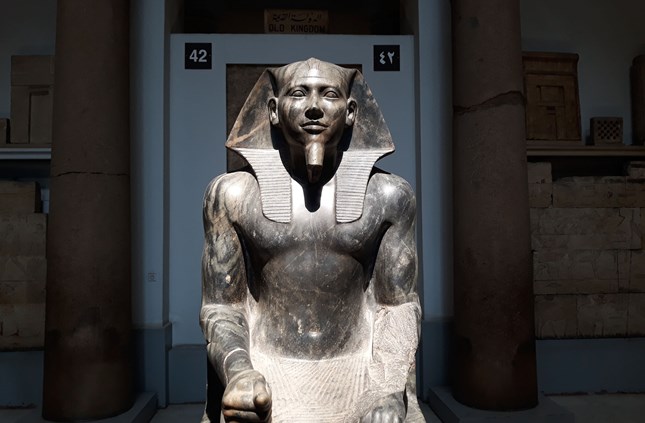
Khafre
The king who sculpted the Sphinx and perfected the Giza plateau.
(Khafre, "He Appears Like Ra")
The Giza Vision, Realized
After the brief interlude of Djedefre's reign at Abu Rawash, the royal lineage returned to Giza with Khafre, another son of the great Khufu. Khafre's mission was clear: to complete the grand vision for the Giza necropolis that his father had started. He didn't just build another pyramid; he created a unified, sacred landscape, linking his own monument to his father's with a level of artistic and architectural harmony that has never been surpassed.
The Second Pyramid: A Masterpiece of Illusion
At first glance, Khafre's pyramid appears taller than his father's Great Pyramid. This is a deliberate optical illusion. By building on a bedrock foundation that was 10 meters (33 ft) higher, Khafre ensured his monument would seem to dominate the skyline, a clever act of reverence and rivalry. While slightly smaller, its steeper angle makes it a breathtaking sight.
- The Glimpse of Perfection: Khafre's pyramid is unique because it retains a portion of its original polished Tura limestone casing at its apex. This "pyramidion" gives us our only real glimpse of how the Giza pyramids originally looked: not as the rough, tiered structures of today, but as gleaming, white, seamless monuments that would have dazzled in the Egyptian sun.
- Efficient Design: Learning from the complex interior of his father's pyramid, Khafre opted for a much simpler design with two entrances and a single burial chamber carved into the bedrock, demonstrating a focus on efficient construction and external perfection.
The Guardian of Eternity: The Great Sphinx
Khafre's most iconic and mysterious legacy is undoubtedly the Great Sphinx. Carved from a single, massive outcrop of limestone left over from the quarrying for Khufu's pyramid, it is the largest monolithic statue in the world. The evidence tying it to Khafre is overwhelming:
The Valley Temple and the Diorite Masterpiece
At the end of the causeway lies Khafre's Valley Temple, a marvel of Old Kingdom architecture. Built with massive core blocks of limestone and cased entirely in huge, polished slabs of red granite, its stark, minimalist design exudes a feeling of eternal power. This temple was the site of the final purification and mummification rites for the king.
It was within this temple that one of the greatest treasures of ancient art was discovered: the **life-sized diorite statue of Khafre**. This masterpiece, now in the Egyptian Museum in Cairo, depicts the king seated on his throne in perfect, serene majesty. Behind his head, the falcon god Horus spreads his wings in a protective embrace, a seamless fusion of the human and the divine. Carved from a block of incredibly hard diorite stone, it is a statement of absolute power and the pinnacle of Old Kingdom royal sculpture.
Legacy: The Master of the Giza Plateau
If Khufu was the master engineer, Khafre was the master artist and planner. He didn't just build beside his father; he harmonized with him, creating a landscape where the Second Pyramid, the Sphinx, the temples, and the causeways all work together in a single, unified theological and architectural statement. He inherited the title "Son of Ra" and gave it an awe-inspiring physical form.
He passed this completed vision to his son, **Menkaure**, who would add the third and final pyramid to the plateau. While Menkaure's pyramid was smaller, it marked the completion of a three-generation family project that has defined our image of ancient Egypt and has captivated the world for 4,500 years. Khafre's reign represents the perfect, confident balance of power, art, and faith, carved for eternity on the Giza plateau.