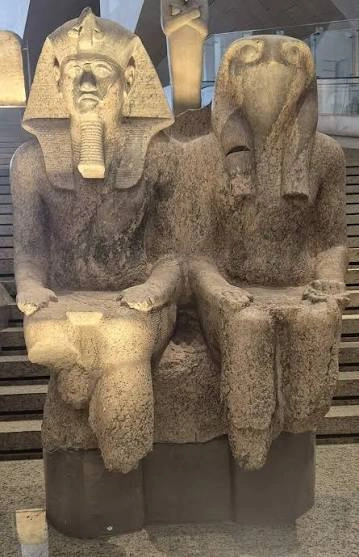
Horakhty
The solar form of Horus who bridges the rising and setting sun.
(Ḥr-ȝḫty / Horakhty)
☀️ Role
God of the Horizons
🦁 Manifestation
👑 Composite
Ra-Horakhty
🌅 Symbol
Falcon & Sun Disk
✦ Introduction to Horakhty
Horakhty is the ancient Egyptian god of the horizon, representing the sun at dawn and dusk. As a form of Horus, he embodies the daily journey of the sun across the sky. This article explores his mythology, his fusion with Ra, his link to the Great Sphinx, and his role in Egyptian kingship and cosmic order.
Quick Answer: Horakhty, meaning "Horus of the Two Horizons," is a solar deity representing the rising and setting sun. He is often merged with Ra as Ra-Horakhty and is associated with the Great Sphinx at Giza. His theology emphasizes the cyclical nature of time and the divine kingship of the Pharaoh.
01 Name and Meaning
Horakhty (Egyptian: Ḥr-ȝḫty) is a specialized solar form of the great god Horus. His name literally translates to "Horus of the Two Horizons," bridging the gap between day and night.
| Ancient Egyptian Name | 𓅃𓂋𓈎𓏏𓏭 (Ḥr-ȝḫty) |
|---|---|
| Phonetic Pronunciation | Ho-raakh-tee |
| Literal Meaning | "Horus of the Two Horizons" |
| Symbolism | Unity of Sunrise (East) and Sunset (West) |
The "Two Horizons" (Akhet) are the gateways of the sun. Horakhty is the active force that travels from the eastern gate of birth to the western gate of death, embodying the eternal cycle of renewal.
02 Nature & Solar Role
Horakhty is not a completely separate deity but a cosmic aspect of Horus. While Horus is typically the sky god and king, Horakhty is specifically the sun god moving across that sky. He represents the journey itself—the movement of time and light. In this role, Horakhty oversees the passage of the sun through the celestial realm, ensuring the continuity of day and night.
As a solar deity, Horakhty embodies the life-giving power of the sun. His daily cycle mirrors the cycle of birth, life, death, and rebirth, making him a central figure in Egyptian cosmology. He is often depicted as a falcon-headed man wearing the solar disk, emphasizing his connection to the sky and the sun.
Horakhty's importance is underscored by his inclusion in royal titulary and temple rituals. He was invoked in prayers for protection and prosperity, particularly in the context of the Pharaoh's divine right to rule.
03 The Solar Cycle
Horakhty acts as the bridge in the daily solar drama:
- Khepri (Dawn): The sun being born, symbolized by the scarab beetle rolling the sun across the sky.
- Horakhty / Ra (Day): The sun actively ruling and crossing the zenith, representing the height of power and order.
- Atum (Dusk): The sun completing its journey and entering the underworld, associated with the aging and renewal of the sun god.
This tripartite division reflects the Egyptian understanding of the universe as cyclical and balanced, with Horakhty occupying the pivotal role of the sun at its peak of activity.
04 Ra-Horakhty
Because their functions overlapped so heavily, Ra and Horakhty were fused into Ra-Horakhty. This composite deity became the standard "Sun God" for much of Egyptian history.
Why Fuse?
The fusion also facilitated the theological integration of Heliopolitan and local cults, making Ra-Horakhty a unifying figure in the Egyptian pantheon.
05 The Great Sphinx (Harmachis)
The Great Sphinx of Giza is famously associated with a specific form of Horakhty known as Harmachis (Hor-em-akhet), meaning "Horus in the Horizon." The Sphinx faces due east, eternally watching the sunrise, serving as the living image of the sun god waiting for the dawn.
The Sphinx as Horakhty
The Great Sphinx is thought to represent the Pharaoh as the living embodiment of Horakhty, ensuring that the sun god's cycle continues uninterrupted. Its monumental scale and alignment with the rising sun underscore the importance of Horakhty in royal ideology.
Archaeological evidence suggests that the Sphinx was originally carved from a single limestone outcrop and has been associated with Horakhty since the Old Kingdom. The Dream Stela of Thutmose IV explicitly links the Sphinx to Horakhty, reinforcing this connection.
06 Divine Kingship
Horakhty reinforced the Pharaoh's power. Since the King was the "Living Horus," linking Horus to the sun meant the King was also the "Son of Ra." This theology made the Pharaoh the bridge between the celestial order (Ma'at) and earthly government.
The Pharaoh's role as intermediary was celebrated in temple festivals and royal inscriptions, which often depict the king offering to Horakhty-Ra to maintain cosmic balance. This relationship was central to the stability of the state.
07 Iconography & Symbols
Horakhty shares much of his imagery with Ra, emphasizing their unity:
- Falcon-Headed Man: Representing speed, vision, and the sky.
- Sun Disk & Cobra: The solar disk rests on his head, protected by the Uraeus cobra.
- Double Crown: Sometimes wears the Pschent (Double Crown) to emphasize his rule over Upper and Lower Egypt.
In temple reliefs, Horakhty is often shown holding the ankh (life) and the was-sceptre (dominion), reinforcing his role as a provider of life and authority.
08 The Amarna Transition
Before Akhenaten fully established Atenism, he worshipped a transitional form of the god: "Ra-Horakhty who rejoices in the horizon in his name of Shu which is in the Aten." This shows that Horakhty was considered the closest traditional god to the pure solar disk before the radical break took place.
Akhenaten's early monuments depict Ra-Horakhty in a traditional manner, gradually shifting to the Aten as the sole deity. This evolution highlights Horakhty's role as a bridge between traditional polytheism and monotheistic solar worship.
09 Philosophy of Balance
Horakhty represents the perfect balance of duality. He is the god of "Two Horizons," signifying that every beginning (East) implies an end (West), and every end promises a new beginning. He embodies the cyclical nature of eternity.
This dual aspect is reflected in the Egyptian concept of Ma'at (order), which depends on the harmonious transition between opposites. Horakhty's role as the horizon deity ensures that the cycles of time and nature remain in balance.
10 Encyclopedia Summary
| Primary Role | God of Solar Movement & Horizons |
|---|---|
| Composite Form | Ra-Horakhty (Sun + King) |
| Physical Manifestation | The Great Sphinx (Harmachis) |
| Key Concept | The Unity of Dawn and Dusk |
| Symbol | Falcon with Sun Disk |
11 Temples and Cult Centers
Horakhty was worshipped throughout Egypt, with major cult centers at Heliopolis (associated with Ra), Giza (linked to the Sphinx), and Elephantine. Temples dedicated to Ra-Horakhty were often oriented toward the rising sun, with sanctuaries designed to capture the first light of dawn.
In these temples, daily rituals included offerings, hymns, and the reenactment of the sun's journey. The priesthood maintained calendars that aligned with the solar cycle, ensuring that ceremonies coincided with important astronomical events such as the solstices and equinoxes.
One of the most famous temples is the Temple of Ra-Horakhty at Heliopolis, which though now largely in ruins, was once a grand center of solar worship that influenced Egyptian theology for millennia.
Explore more about Egyptian temples and their connection to solar deities.
❓ Frequently Asked Questions
Explore Egypt with Us
Experience the wonders of ancient Egypt, from the Great Sphinx to the temples of the sun gods. Join our expert-guided tours and uncover the mysteries of the pharaohs.
