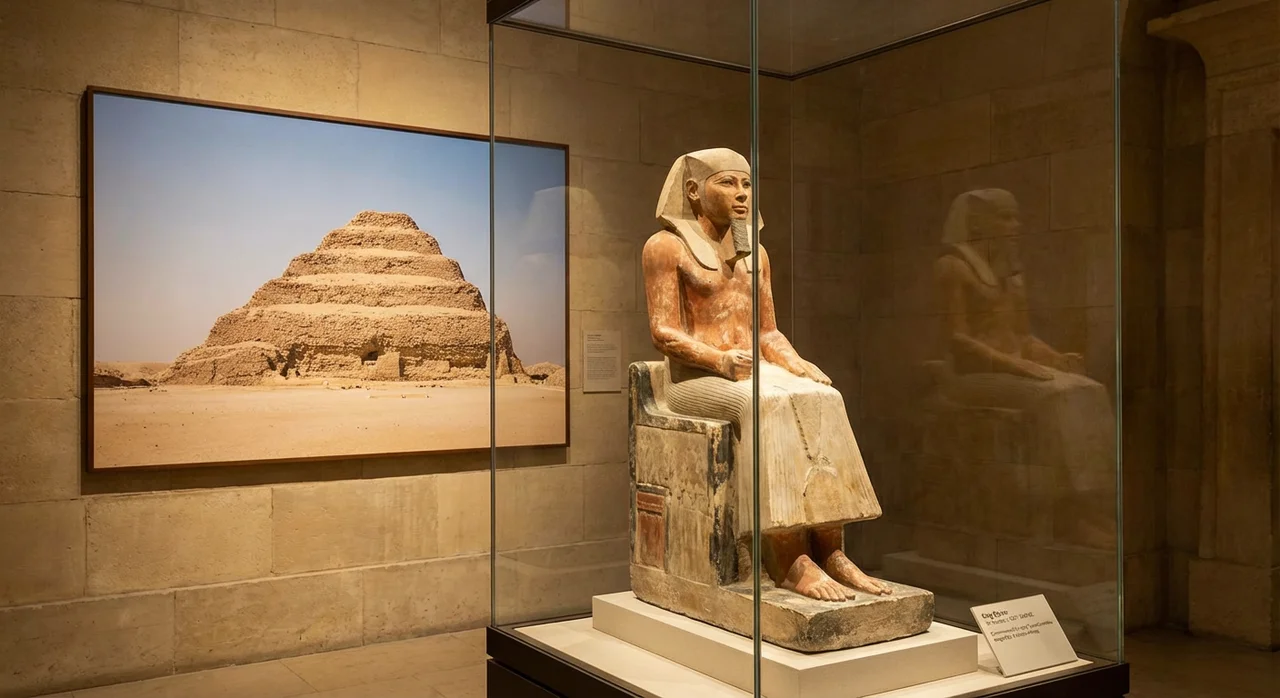
King Djoser
The revolutionary king who built the first pyramid.
(Netjerikhet, "Divine of Body")
🕰️ Reign
c. 2667–2648 BCE
🏆 Monument
Step Pyramid
🏛️ Architect
Imhotep
🌍 Era
Start of Old Kingdom
The Dawn of a New Age
King Djoser (known in his time as Netjerikhet) inherited a newly reunified and stable Egypt from his father, Khasekhemwy. This peace and prosperity enabled him to launch a project that would fundamentally alter the course of human history and define the identity of ancient Egypt forever. His reign marks the definitive end of the Early Dynastic Period and the glorious beginning of the **Old Kingdom**, an era of unparalleled architectural and cultural achievement.
The Step Pyramid: A Revolution in Stone
At Saqqara, overlooking the capital of Memphis, Djoser commissioned his vizier, Imhotep, to build his eternal resting place. What began as a simple, square mastaba tomb—similar to those of earlier kings—evolved into something the world had never seen.
- Evolution of Design: Imhotep expanded the initial mastaba twice before conceiving a radical new idea: stacking four smaller mastabas on top, and then expanding the entire structure into the final six-stepped pyramid, creating a symbolic "stairway to the heavens."
- A Feat of Engineering: The pyramid was the **world's first monumental building constructed entirely from cut stone**. It required quarrying, transporting, and lifting millions of tons of limestone, a logistical feat demonstrating the immense power and organizational capacity of the Egyptian state.
- A Palace for Eternity: The pyramid was the centerpiece of a 15-hectare complex, surrounded by a 10.5-meter-high wall. This enclosure contained temples, courtyards for eternal rituals (like the Heb-Sed), and elaborate subterranean galleries, all designed to serve the king's spirit in the afterlife.
Imhotep: The Genius Behind the Throne
The story of Djoser's achievement is inseparable from that of his chief minister, Imhotep. A man of seemingly limitless talent, his influence was so profound that Djoser honored him with an inscription on his own statue—an unprecedented tribute.
The Legend of the Famine Stele
A story carved two thousand years after his death, the "Famine Stele" on Sehel Island near Aswan, illustrates Djoser's enduring legacy as a pious and wise king. According to the legend, Egypt suffered a devastating seven-year famine where the Nile failed to flood.
In desperation, Djoser sought the counsel of Imhotep, who discovered that the source of the Nile was controlled by the ram-headed god **Khnum** at Elephantine. Djoser made a pilgrimage south, restored Khnum's temple, and made lavish offerings. Pleased, the god appeared to the king in a dream and promised to release the waters. The famine ended, and Djoser's reputation as a king who could intercede with the gods was cemented for all time.
Securing the Kingdom
While famed for his building project, Djoser also ensured Egypt's security and economic prosperity. His reign saw military expeditions into the Sinai Peninsula to subdue local tribes and secure the region's valuable mines of copper and turquoise—minerals essential for the tools and decorations of his new stone age. This military control guaranteed the flow of resources needed for his ambitious architectural vision.
Legacy: Architect of an Age
Djoser's contemporary Horus name, **Netjerikhet ("Divine of Body")**, was a powerful declaration of his status as a living god on Earth. The Step Pyramid was the ultimate expression of this divinity—a monument that elevated the king above all mortals and physically connected him to the celestial realm.