Definition & Origins
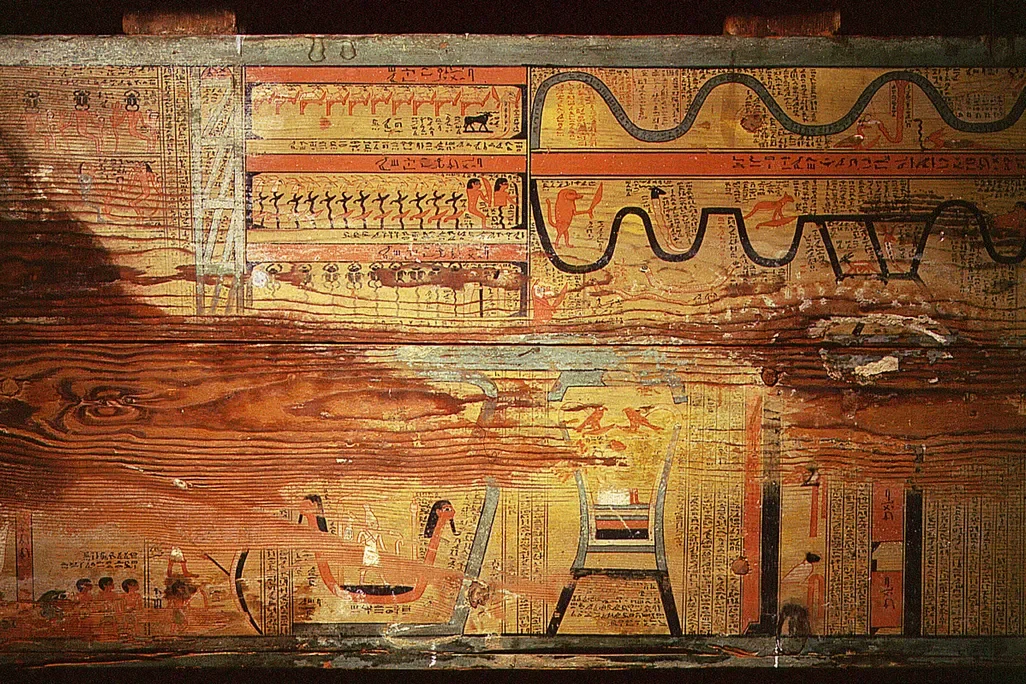
The Book of Two Ways is a specialized section of the Coffin Texts that serves as the world's oldest illustrated map of the afterlife. It depicts two zigzagging paths—one of land and one of water—navigating through the dangerous region of Rosetau to reach the mansion of Osiris.
| Date | c. 2000 BCE (Middle Kingdom) |
|---|---|
| Source | Coffin Texts (specifically from Dayr al-Barsha) |
| Medium | Painted on the floor of wooden coffins |
| Goal | To reach the Realm of Osiris safely |
The Birth of Cartography
Created during the Middle Kingdom, this text represents a major leap in religious thought: the visualization of the unknown. It was primarily used by the elite of the Hermopolite nome. By painting the map on the bottom of the coffin, the deceased literally lay "upon" the path, ensuring they would not get lost in the darkness of the underworld.
A Guide for the Soul
The Book was not just a map; it was a weapon. The Duat was filled with obstacles, demons, and traps. The text provided the Gnosis (magical knowledge) required to pass them. Knowing the secret name of a gate or a demon gave the soul power over it, turning a perilous journey into a navigable passage.
Fire and Water
The map depicts two primary paths separated by a central "Lake of Fire":
| Route | Element | Description |
|---|---|---|
| Blue Path (Water) | River / Sky | A celestial river journey, traveling by solar boat. |
| Black Path (Land) | Earth / Desert | A demonic landscape filled with gates and guardians. |
Both paths are dangerous, but they converge at the mansion of Osiris.
Geography of the Dead
The map details specific locations, turning the afterlife into a concrete geography:
- Rosetau: The "Mouth of the Passages," the entrance to the underworld.
- The Lake of Fire: A place of destruction for the wicked but nourishment for the blessed.
- The Walls of Flint: Barriers that can only be passed with magic.
- Field of Offerings: The ultimate destination of agricultural plenty.
Guardians with Knives
The paths are blocked by terrifying guardians with knives and grotesque forms. Their names invoke fear: "He who dances in blood," "The Bone-Breaker," and "Dog-Face." The deceased must greet each guardian by name to prove their initiation. Ignorance means annihilation; knowledge means safe passage.
Destination: Osiris
The ultimate goal of the map is the House of Osiris. Here, the deceased hopes to undergo judgment and be declared "True of Voice." Interestingly, the text also mentions Thoth and Ra, showing a synthesis where the deceased wants to be with Osiris (underworld) but also join Ra (sky) at sunrise.
Symbolic Art
The illustrations are schematic and abstract. They use color coding (blue for water, black for land, red for fire/danger) and symbols rather than realistic art. This abstraction emphasizes that this is a spiritual geography, not a physical one—a landscape of the mind and soul.
Order vs. Chaos
The Book of Two Ways symbolizes the imposition of Order (Ma'at) onto the chaos of death. By mapping the unknown, the Egyptians tamed it. The text asserts that even in the terrifying darkness of the Duat, there is a structure, a path, and a way forward for the righteous.
Precursor to the Amduat
This text laid the foundation for the sophisticated "Books of the Underworld" found in the New Kingdom royal tombs, such as the Amduat and the Book of Gates. It introduced the concept that the afterlife is a journey through hours and regions, a concept that would define Egyptian religion for the next thousand years.
Encyclopedia Summary
| Subject | First Illustrated Afterlife Guide |
|---|---|
| Key Feature | Two Paths (Water & Land) |
| Central Danger | The Lake/Ring of Fire |
| Requirement | Knowledge of Names (Guardians) |
| Goal | Mansion of Osiris |