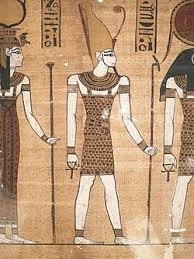
Atum
The self-created god of creation and the sun, progenitor of the Ennead.
(Itm / Tm)
01 Name and Meaning
Atum, phonetically written in Egyptian as Itm or Tm, is a name of immense theological density. Its root tem embodies a paradoxical duality that defines his existence.
Linguistic Essence
- The Complete One: Indicating he is the totality of all potential being.
- The All: He is the sum of both the physical world and the spiritual void.
- He Who Is Finished: Implying a state of absolute perfection and finality.
This name reflects Atum's nature as a complete, self-contained being who existed within himself as a potential force long before the first moment of time.
02 Origins and Primordial Nature
Atum existed before time, space, and matter. He is the bridge between non-existence and existence.
| Primeval State | Nothing existed except the infinite, silent Waters of Chaos (Nun). |
|---|---|
| Self-Creation | Atum willed his own form into being without parents or external aid. |
| The First Land | He arose upon the Benben Mound, the first solidified matter to emerge from the chaos of Nun. |
This act represents the singular moment when the universe transitioned from a state of static chaos to dynamic creation.
03 The Act of Creation
Atum created the universe through his own divine essence. Unlike myths that rely on craftsmanship, Atum's creation was a projection of his own biological and spiritual vitality.
Mechanisms of Life
- Spitting and Sneezing: Symbols of the outward breath and fluids of life that formed Shu (Air) and Tefnut (Moisture).
- Self-Generation: Symbolic acts of procreation without a partner, emphasizing his "complete" nature.
- Divine Speech: His "will" or "logos" catalyzed the separation of the elements.
04 The Ennead of Heliopolis
Atum is the progenitor of the Heliopolitan Ennead, the supreme group of nine gods who governed the structure of reality:
Through this divine lineage, the physical universe and the cycles of life, death, and order (Ma'at) were established.
05 Atum and the Sun Cycle
Atum is a solar deity, specifically associated with the sun's phase of Completion. He represents the sun as it sets, embodying old age, wisdom, and the transition into the underworld.
| Khepri (Scarab) | The Morning Sun - Rebirth and the potential of a new day. |
|---|---|
| Ra (Falcon) | The Midday Sun - Full power, vitality, and governance. |
| Atum (Old Man) | The Evening Sun - Completion, wisdom, and the return to the source. |
06 Relationship with Ra
Over centuries, Atum merged with Ra to form the supreme solar composite: Atum-Ra. In this union, Atum represents the original creative spark and the "fatherly" aspect of the sun, while Ra represents the active, ruling authority.
7. Cult Center: Heliopolis (Iunu)
Heliopolis was the intellectual and spiritual heart of Egyptian theology. The Benben Stone housed here was considered the exact spot where light first touched the world. The priests of Atum were the most influential scholars of their time.
07 Iconography and Depictions
Atum's imagery reflects his duality as a creator and an eternal force. He is most commonly shown as a human male wearing the Double Crown (Pschent) of Upper and Lower Egypt.
Alternative Manifestations
- The Serpent: Representing primeval power and the ability to outlive all things.
- The Mongoose: A symbol of his ability to strike and defeat chaotic enemies.
- The Ram: Symbolizing the creative power of the soul.
08 Atum and Kingship
Atum was the divine foundation of the Pharaoh's power. Pharaohs were referred to as the "Sons of Atum." The act of ruling Egypt was seen as a mirroring of Atum's rule over the initial creation, legitimizing absolute royal authority through divine heritage.
09 Funerary Religion
Atum plays a critical role in the deceased's journey. In the Pyramid Texts, he is invoked to assist the king in ascending to the sky. He is the one who guarantees the rebirth of the soul, much like he guarantees the rebirth of the sun each morning.
10 Atum and the End of the World
Unique to Egyptian thought is the concept of a terminal end. Atum is the god who will outlive all creation. He is prophesied to dissolve the world back into the waters of Nun, returning all things to their original silence, only to perhaps begin the cycle anew. He is both the Beginning and the End.
11 The Sacred Record
Atum is a central figure in Egypt's most sacred literature:
- Pyramid Texts: Documenting his role in early royal theology.
- Coffin Texts: Explaining his creative mechanisms in the Middle Kingdom.
- Book of the Dead: Detailing his role as a judge and protector in the afterlife.
12 Symbols and Sacred Animals
| Sacred Symbols | The Benben Stone, The Solar Disk, The Pschent Crown. |
|---|---|
| Sacred Animals | The Serpent (Primeval Power), The Ram (Creative Strength), The Mongoose. |
13 Theological Significance
Atum represents Cosmic Order (Ma'at) emerging from chaos. He is the archetype of the self-created leader and the embodiment of the unity of all existence. His theology bridges the gap between the physical world and the metaphysical void.
14 Atum vs Other Creator Gods
Egyptian religion allowed for multiple creator myths, each emphasizing a different aspect of divinity:
| Atum (Heliopolis) | Creation through self-generation and physical divine essence. |
|---|---|
| Ptah (Memphis) | Creation through intellectual thought and spoken word. |
| Amun (Thebes) | Creation through a hidden, invisible cosmic force. |
15 Encyclopedia Summary
Atum is the original source of all divine and physical existence. He is the Father of the Gods, the maintainer of Kingship, and the final guardian of the cosmic cycle. He stands at the center of Heliopolitan cosmology as the god of creation, destruction, and eternal rebirth.
16 The Hand of Atum
The "Hand of Atum" is a profound theological concept personifying the female principle within the creator god. Since Atum was alone, his hand became the agent of creation. This principle was later deified as the goddesses Iusaaset or Nebethetepet, and the title "God's Hand" was bestowed upon high priestesses to signify their role in stimulating divine creation.
17 Worship & Rituals
Atum was worshipped primarily in Heliopolis (Iunu). Daily rituals involved offerings of food and incense to his statue. He played a crucial role in the Sed Festival (Jubilee), where the king's power was renewed. The king would offer Ma'at to Atum, demonstrating that he had maintained order in the world the god created.