Aten
The one true god of Akhenaten's monotheistic revolution.
(Itn / Aten)
☀️ Role
Supreme Creator
👑 Prophet
🏛️ Sacred City
📜 Text
Great Hymn to the Aten
01 Name and Meaning
The name Aten (Egyptian: Itn) originally referred simply to the physical disk of the sun. Unlike other gods who had human or animal avatars, Aten was the celestial body itself — a radical departure from the anthropomorphic traditions of ancient Egyptian religion.
| Ancient Egyptian Name | 𓇳𓏏𓈖 (Itn) |
|---|---|
| Phonetic Pronunciation | Ah-ten |
| Literal Meaning | "The Solar Disk" |
| Theological Status | The Sole Creator & Sustainer |
Before the Amarna revolution, "Aten" was a common noun. Under Pharaoh Akhenaten, it became a proper noun — the name of the supreme and only god, elevated above all other deities in a sweeping religious reform.
02 Origins & Early Role
Before the New Kingdom, Aten was a minor aspect of the sun god Ra. Texts would describe Ra as being "within his Aten" (within his disk). He was not worshipped as a separate deity but was recognized as the visible vehicle of solar power — a divine manifestation rather than a god in his own right.
In the early 18th Dynasty, references to Aten became more prominent, particularly during the reign of Thutmose IV, who used the term to describe the sun's life-giving rays. However, it was not until Akhenaten that Aten was elevated to supreme status.
03 The Amarna Revolution
Around 1353 BCE, Pharaoh Amenhotep IV changed his name to Akhenaten ("Effective for the Aten") and initiated a radical religious overhaul that shook the foundations of Egyptian society:
- Monotheism (or Henotheism): He declared Aten the only god worthy of worship, effectively suppressing the traditional pantheon.
- The Great Ban: Temples of Amun and other traditional gods were closed, their priests dispersed, and their names systematically erased from monuments across Egypt.
- New Capital: He moved the administrative and religious capital to a virgin site in the desert called Akhetaten (Horizon of the Aten), modern-day Amarna, built specifically to honor the sun disk.
This period, known as the Amarna Period, represents one of the most dramatic ruptures in ancient Egyptian history — a deliberate break from millennia of tradition in favor of a new, abstract theology centered on light.
04 Light Without Form
Atenism was a radical departure from Egyptian tradition because it rejected mythology and anthropomorphism. Aten had:
- No Human Form: He was never depicted as a man, woman, or any humanoid figure.
- No Animal Form: No falcons, rams, bulls, or crocodiles — unlike traditional gods such as Horus or Sobek.
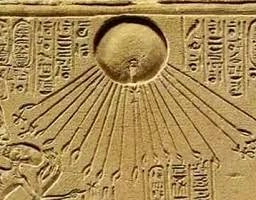
- Abstract Presence: He was represented solely as a sun disk with radiating arms ending in tiny hands, offering the Ankh (symbol of life) to the royal family.
This abstraction made Aten unique among Egyptian deities — a god of pure light and energy, without myth, without story, and without form.
05 Creator of All Life
The Great Hymn to the Aten beautifully expresses this theology, describing how Aten cares for every living thing — from the smallest chick in the egg to the foreign peoples of distant lands — with equal attention and love.
06 The Royal Intermediary
A key tenet of Atenism was that only Akhenaten knew the Aten. Ordinary people could not pray directly to the god; they had to pray to Akhenaten and Queen Nefertiti, who acted as the sole intermediaries between the divine light and humanity. This concentrated absolute spiritual and political power in the hands of the king, transforming the pharaoh from a divine king into the only conduit to the divine.
This theology effectively made Akhenaten the high priest, prophet, and living embodiment of the Aten on Earth — a radical centralization of religious authority unprecedented in Egyptian history.
07 The Great Hymn
Inscribed in the tomb of Ay at Amarna, the Great Hymn to the Aten is a masterpiece of ancient literature and one of the most beautiful religious poems ever composed. It praises the universality of the sun, describing how Aten cares for chicks in the egg, makes the Nile flood, and sustains foreign peoples alike. Scholars have noted striking similarities between this hymn and Psalm 104 in the Bible, suggesting a shared literary tradition of divine nature worship.
The hymn emphasizes Aten's role as the universal creator, the source of all life, and the sustainer of every nation — a vision of a single, benevolent deity that resonates with later monotheistic traditions.
08 Amarna Art Style
The religious shift brought a dramatic artistic revolution that broke with centuries of Egyptian tradition:
- Naturalism: Scenes of the royal family kissing, eating, and playing with children — intimate, human moments unheard of in earlier, more formal eras.
- The Hands of Light: The defining icon of the era is the sun disk extending rays that terminate in human hands, touching the king and queen with the ankh — a visual representation of divine grace.
- The Royal Cartouche: Uniquely, the name of the god Aten was written inside a royal cartouche, treating the god as a ruling king — a deliberate elevation of the divine to the highest earthly status.
This artistic style, known as the Amarna style, is characterized by exaggerated curves, elongated skulls, and a sense of movement and intimacy that was unprecedented in Egyptian art.
09 The Fall of Aten
After Akhenaten's death, the old order struck back with a vengeance. His son Tutankhamun restored the cult of Amun, changed his name from Tutankhaten to Tutankhamun, and systematically erased all traces of Atenism from the historical record. The city of Akhetaten was abandoned, and Atenist temples were dismantled to fill the pylons of Karnak. Akhenaten was branded "The Heretic," and Aten returned to being a minor solar aspect — a footnote in the long history of Egyptian religion.
However, the philosophical seeds planted by Atenism would echo through history, influencing later monotheistic traditions and continuing to fascinate scholars to this day.
10 The First Monotheism?
Atenism represents one of humanity's earliest experiments with monotheism — a shift from a pantheon of specialized gods to a single, universal, abstract force. It was a revolutionary concept that challenged the very foundations of ancient Egyptian society.
While it ultimately failed due to its exclusion of the common people, its lack of mythology, and its over-reliance on a single charismatic ruler, it remains a pivotal moment in the history of religion — a precursor to later monotheistic traditions and a testament to the power of ideas to reshape civilizations.
11 Encyclopedia Summary
| Primary Role | Supreme Solar Creator |
|---|---|
| Prophet | Pharaoh Akhenaten |
| Sacred City | Akhetaten (Amarna) |
| Key Symbol | Sun Disk with Ray-Hands |
| Sacred Text | The Great Hymn to the Aten |
| Period | 18th Dynasty, c. 1353–1336 BCE |
12 Visiting Amarna Today
The ancient city of Akhetaten, known today as Tell el-Amarna, is located in the Minya Governorate of Egypt, about 312 kilometers south of Cairo. Visitors can explore the remains of the Great Temple of the Aten, the royal palace, and the tombs of the nobles carved into the surrounding cliffs.
Amarna offers a unique archaeological experience — a window into one of the most fascinating and controversial periods of ancient Egyptian history. The site is less crowded than the major tourist hubs, allowing for a more contemplative and immersive experience.
13 People Also Ask
What is the difference between Aten and Ra?
Ra is the traditional Egyptian sun god, depicted with a human body and a falcon head, who travels across the sky in a solar barque. Aten, by contrast, is the physical sun disk itself — a purely abstract deity with no human or animal form. Under Akhenaten, Aten was elevated to the status of the sole god, while Ra was one of many traditional deities.
Why did Akhenaten choose Aten as the sole god?
Akhenaten likely chose Aten because of its abstract, universal nature — a sun disk that shines on all people equally, without favoritism. This theology aligned with his political and religious vision of a unified Egypt under a single, all-powerful deity, with himself as the sole intermediary.
Is Aten mentioned in the Bible?
Aten is not directly mentioned in the Bible, but scholars have noted strong linguistic and thematic parallels between the Great Hymn to the Aten and Psalm 104 in the Old Testament. Both texts praise a single creator deity who sustains all life, suggesting a shared literary or theological tradition.
What happened to Aten after Akhenaten's death?
After Akhenaten's death, the old priesthood of Amun regained power. His son Tutankhamun restored the traditional religion, and Atenism was systematically erased from the historical record. The city of Akhetaten was abandoned, and Aten returned to being a minor aspect of Ra.
How long did the Amarna Period last?
The Amarna Period lasted approximately 17–20 years, from roughly 1353 BCE to 1336 BCE, covering the reign of Akhenaten and the brief rule of his immediate successors. Despite its short duration, it left an indelible mark on Egyptian history and continues to fascinate scholars today.
14 Frequently Asked Questions
What is Aten in ancient Egyptian religion?
Aten is the ancient Egyptian solar disk god who became the center of a revolutionary monotheistic cult under Pharaoh Akhenaten during the Amarna Period (c. 1353–1336 BCE). Unlike traditional Egyptian gods, Aten had no human or animal form and was represented purely as a sun disk with radiating arms ending in hands.
Who was Akhenaten and what was his relationship to Aten?
Akhenaten was an Egyptian pharaoh of the 18th Dynasty who changed his name from Amenhotep IV to Akhenaten ('Effective for the Aten') and elevated Aten to the status of the sole god of Egypt. He declared Aten the only god worthy of worship, closed the temples of other deities, and moved the capital to a new city called Akhetaten (modern-day Amarna).
What is the Great Hymn to the Aten?
The Great Hymn to the Aten is a 14th-century BCE Egyptian poem inscribed in the tomb of Ay at Amarna. It praises Aten as the universal creator who sustains all life, from the smallest chick in the egg to the foreign peoples of the world. Scholars have noted striking similarities between this hymn and Psalm 104 in the Bible.
How was Aten depicted in ancient Egyptian art?
Aten was depicted as a sun disk with rays extending downward, each ending in a small human hand. These hands often hold the ankh, the symbol of life, reaching toward the royal family. This iconography was unique to the Amarna Period and reflected the abstract, non-anthropomorphic nature of the god.
Can I visit the ancient city of Akhetaten (Amarna) today?
Yes, the ancient city of Akhetaten, known today as Amarna or Tell el-Amarna, is located in the Minya Governorate of Egypt. Visitors can explore the remains of the Great Temple of the Aten, the royal palace, and the tombs of the nobles. Egypt Lover offers private guided tours to Amarna, allowing travelers to experience this unique archaeological site.