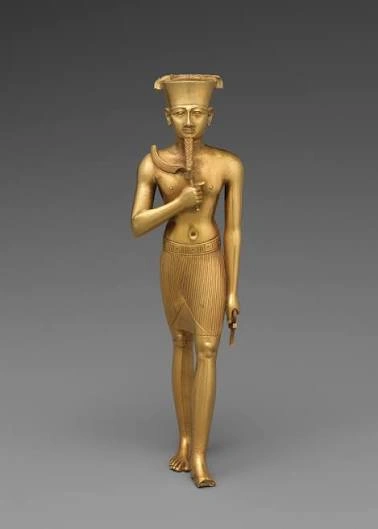
Amun
The hidden one, god of the air and creation, who became the supreme deity of Egypt.
(Imn / Amun)
🌬️ Concept
Hiddenness & Air
👤 Counterpart
Amaunet
🏛️ Sacred City
⚡ Symbol
Double Plumes & Ram
01 Name and Pronunciation
Amun (also known as Amon or Amen) is the most significant deity of the Egyptian New Kingdom. His name is synonymous with the unseen forces of the cosmos.
| Ancient Egyptian Name | 𓇋𓏠𓈖 (Imn) |
|---|---|
| Phonetic Pronunciation | Ah-mun |
| Literal Meaning | "The Hidden One" |
| Theological Concept | Invisibility, Breath, and Omnipresence |
The name reflects his nature as a god who is everywhere but can be seen nowhere—the "breath of life" that sustains all creatures.
02 Origins & Theban Roots
Amun began as a local deity in Thebes (Waset) during the Old Kingdom. Originally, he was a god of the air and wind, part of the elemental forces of nature.
- Middle Kingdom Rise: He gained prominence when Theban princes unified Egypt, becoming the patron of the ruling family.
- Air & Breath: His original element allowed him to be perceived as the invisible force that allows for life and movement.
03 The Ogdoad (The Hidden Element)
In the Hermopolitan system, Amun and his female counterpart Amaunet represented the concept of "Hiddenness."
| Concept | Male Deity | Female Deity |
|---|---|---|
| Primeval Waters | Nun | Naunet |
| Infinity | Heh | Hauhet |
| Darkness | Kek | Kauket |
| Hiddenness | Amun | Amaunet |
04 Amun-Ra: King of the Gods
During the New Kingdom, the "Hidden" power of Amun was merged with the "Visible" authority of the sun god Ra. This created Amun-Ra, the supreme state deity.
The Universal Sovereign
- Fusion of Opposites: Amun (Invisible) + Ra (Visible) = The Totality of Existence.
- Political Power: As Amun-Ra, he was the divine protector of the Empire and the guarantor of Ma'at.
- Lord of Kings: Pharaohs claimed their right to rule through his divine lineage.
05 The Self-Created Creator
6. Cult Center: Karnak
The Karnak Temple Complex in Luxor was the principal seat of Amun. It remains the largest religious site ever built. Generations of Pharaohs added pylons, obelisks, and shrines to honor Amun-Ra, making it the richest institution in the ancient world.
06 The Theban Triad
In Thebes, Amun was part of a divine family that governed the spiritual life of the capital:
- Amun: The Father and King.
- Mut: The Mother Goddess (The Great Queen).
- Khonsu: The Son and Moon God (The Navigator).
07 Iconography & Sacred Symbols
Amun's visual identity emphasized his royal status and creative power:
- The Plumed Crown: A man wearing a crown with two tall ostrich feathers (symbolizing the duality of air/sky).
- The Ram: His primary sacred animal, symbolizing creative strength and virility.
- The Goose: A symbol of the first sound made at creation (the "Great Honker").
08 Amun vs. The Aten (The Amarna Period)
The power of the Priesthood of Amun became so great it threatened the Pharaoh. Akhenaten attempted to abolish Amun's cult in favor of the Aten (the solar disk). After his death, the cult of Amun was restored with even greater ferocity by Tutankhamun (originally Tutankhaten).
09 The Grand Festivals
Amun was the center of Egypt's most spectacular celebrations:
- The Opet Festival: Amun's statue traveled from Karnak to Luxor Temple to renew the King's Ka.
- Beautiful Feast of the Valley: Amun visited the necropolis on the West Bank to bless the ancestors and the dead.
10 Encyclopedia Summary
| Core Role | King of the Gods, Creator, Protector of Kings |
|---|---|
| Primary Symbol | Tall Double Plumes, Ram, Ankh |
| Main Temple | Karnak (Thebes) |
| Theological Legacy | The concept of a transcendent, unseen supreme deity |